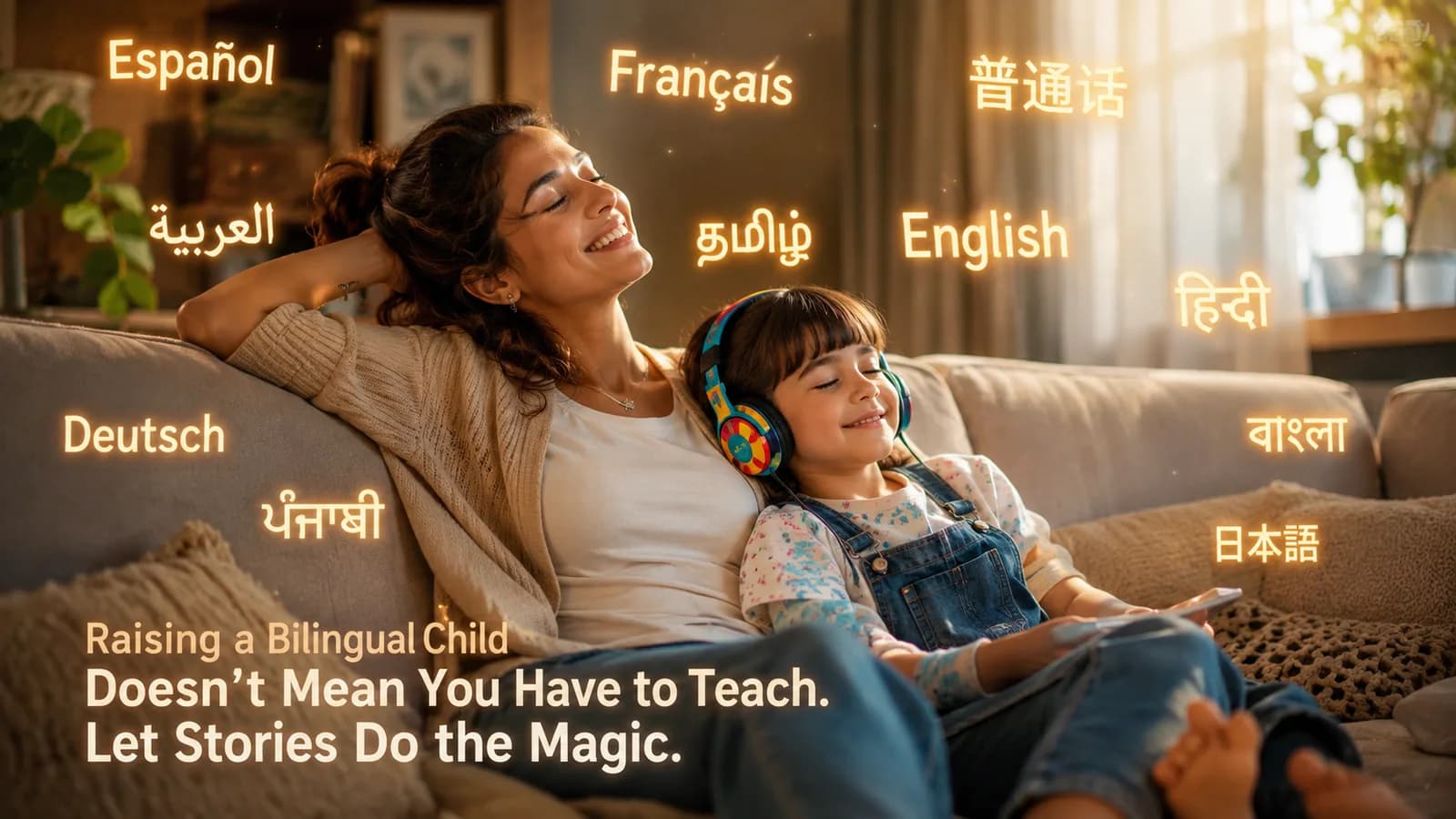
How to Raise a Multilingual Child Without Speaking the Language Yourself
Every few weeks, the thought comes back. "I'd love my child to speak French someday." Then almost immediately comes another: "But I don't even speak French myself." For many parents, that's where the dream quietly ends—before it ever begins.
You want your child to grow up bilingual — or even trilingual. You feel it deeply: the cognitive advantages, the cultural richness, the doors it opens for their future. And yet, the moment you sit down to actually make it happen, one thought stops you cold.
"I don't speak French. I don't speak Spanish. How on earth am I supposed to teach my child something I don't know myself?"
This is the monolingual parent's dilemma, and it is one of the most common, most paralysing anxieties in modern parenting. You are not alone in feeling it. And more importantly — you are operating under a misunderstanding about how children naturally learn language.
You do not need to be a fluent speaker to raise a multilingual child. You do not need to conjugate verbs, worry about your accent, or hire an expensive tutor. What you need is the right acoustic environment and consistency. This guide will show you exactly how to create both — and how Cocoloops was built specifically to solve this problem for families like yours.
Why the Traditional Approach Fails Busy Parents
When monolingual parents decide to bring a second language into their home, they almost always reach for the same three tools. And almost universally, those tools let them down within the first month.
Gamified apps like Duolingo are designed for adult habit formation. They rely on text matching — pairing the English word "apple" with the Spanish "manzana" — which requires a child to already read fluently. More fundamentally, they train children to play a game, not absorb a language. The streak becomes the goal. The language becomes incidental.
YouTube and cartoons feel like a shortcut, but hyper-stimulating visual content works against language acquisition. When fast-paced editing floods a child's nervous system with fast-paced visual stimulation. The spoken language in the background simply doesn't land.
Tutors absolutely have a role to play. The challenge is that language isn't built during one lesson each week—it grows through what happens between those lessons.
The deeper problem with all three approaches is this: they place the parent in the role of enforcer. You are monitoring screen time, chasing streaks, driving across town. It is unsustainable, and most families quietly give up within sixty days.
There is a better model — one that removes you from the role of teacher entirely.
How Cocoloops Actually Works: A Step-by-Step Walkthrough
Cocoloops is a multilingual audiobook platform for children aged 3 to 15. It is built around one deceptively simple insight: children acquire language fastest when they hear a story they already love, told in a new language. Here is exactly how that works in practice.
Step 1: Create your account and set your child's age bracket. This is not a formality. The platform uses your child's age to serve age-appropriate vocabulary, emotional themes, and narrative pacing. A three-year-old hears gentle, repetitive acoustic journeys. A ten-year-old unlocks complex adventure stories and layered mysteries.
Step 2: Browse the library and let your child choose. Start in English — or whichever language your child is most comfortable in. Browse by genre, theme, or interest, and let your child pick a story based entirely on what excites them. Ownership of the choice matters. A child who picked the story is a child who wants to hear it again.
Step 3: Listen and fall in love with the story. Your child hears the full narrative in their native language. They learn the characters, follow the plot, and emotionally invest in what happens. This is the anchor — the cognitive scaffold everything else will hang from.
Step 4: Switch the language. By now your child isn't thinking about language anymore—they're thinking about pirates, dragons, or astronauts. That's exactly when you make the switch.
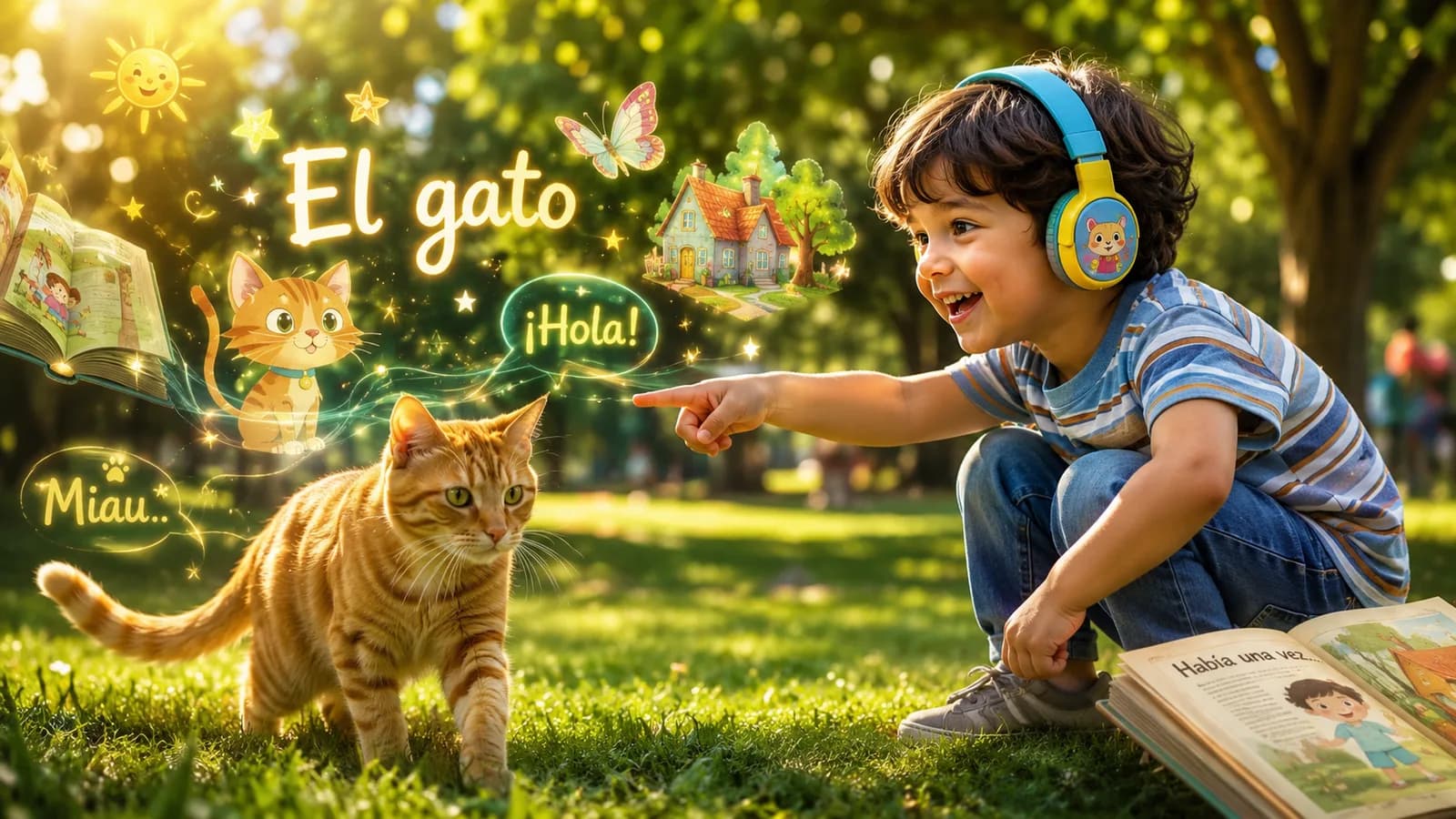
Step 5: Press play and let comprehension do the work. The same atmospheric sound design, the same character rhythms, the same story beats — now spoken entirely in a new language. Because your child already knows the narrative, their brain does not panic. Instead, it maps the familiar story onto the unfamiliar words, decoding meaning through context rather than translation. This is language acquisition happening in real time, without flashcards, without drilling, without you needing to say a single word in French.
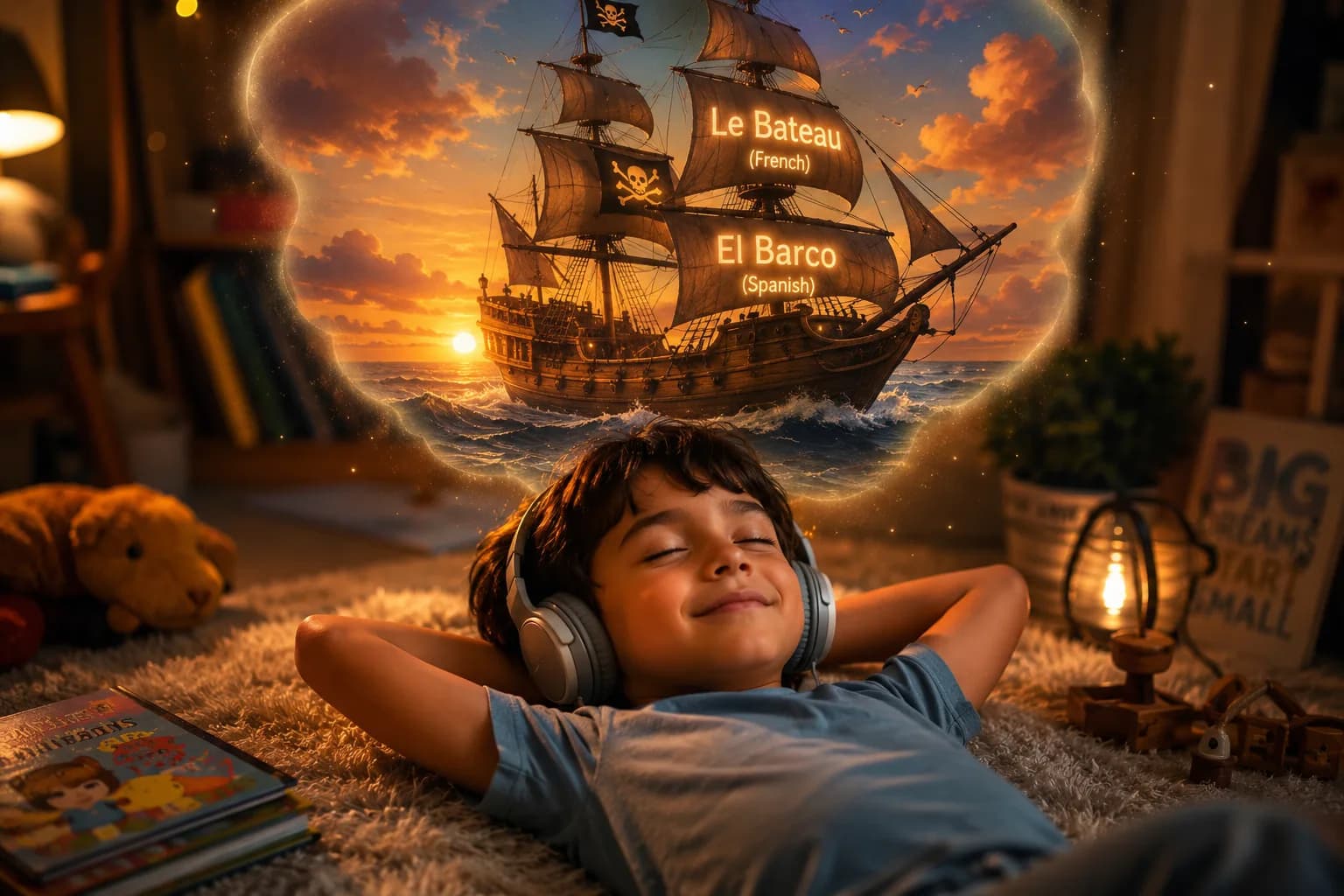
Step 6: Return and repeat. As your child grows, they return to the same stories. Over time, they begin actively comparing the English and French versions — noticing differences in expression, rhythm, and tone. This builds what linguists call metalinguistic awareness: the ability to think about language, not just in it.
The Science Behind Why This Works
If you've ever wondered why children seem to absorb songs without trying, linguist Stephen Krashen spent decades explaining exactly why. He called this idea "Comprehensible Input," a concept that transformed modern language learning., one of the most influential linguists of the twentieth century. His core finding was that humans do not acquire language by studying grammar rules. We acquire it by understanding messages — by hearing language used in context that we can already partially decode.
When your child listens to a Cocoloops story in Spanish after hearing it in English, they are receiving maximum comprehensible input. In simple terms, children learn languages best when they understand most but not all of what they hear.
Why does starting young matter so much? A landmark 2018 MIT study, which drew on data from nearly 670,000 speakers. It found that children who begin meaningful exposure to a second language before the age of ten show brain responses almost indistinguishable from native speakers. The window is open — but it does not stay open forever.
Cocoloops is built to make the most of that window. Every story is narrated by a native speaker of that language, which means your child absorbs authentic prosody — the natural rhythm, intonation, and emotional cadence of the language — not a translated approximation. This is precisely what the developing brain uses to map new sounds to meaning.
A Week in the Life: How Real Families Use Cocoloops
Worried about how this fits into a chaotic family schedule? Here is what a typical week looks like for a non-bilingual family using Cocoloops — without adding a single new chore to their to-do list.
Monday — The School Run. Instead of morning radio, a parent plays a Cocoloops story about a deep-sea adventure in English on the fifteen-minute drive to school. The children are hooked on the plot and completely quiet. That is a bonus.
Wednesday — Bilingual Bedtime. The children ask to hear the deep-sea story again at bedtime. A parent says, "Let's try the Spanish version tonight." With the lights low and no screen to compete for their attention, the children's auditory processing centres take over. They absorb Spanish vocabulary as they drift off.
Friday — The Lunchtime Background. A parent puts the Spanish version of the same story on the kitchen speaker while making lunch. No quizzing. No prompting. Just native-speaker audio filling the room — ambient daily exposure that accumulates quietly in the background.
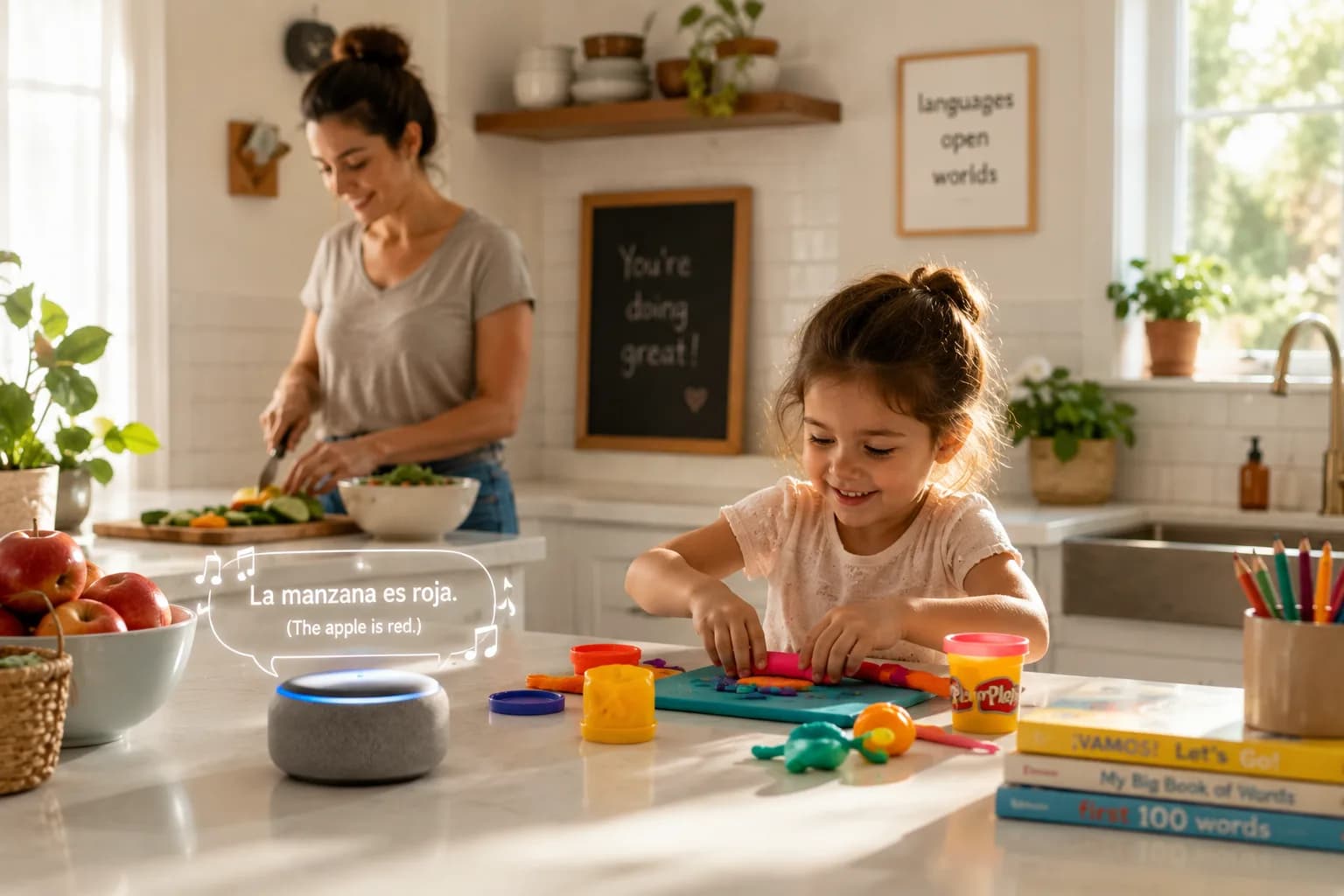
Sunday — Spot the Difference. During a relaxed afternoon, the family listens again. A parent casually asks, "Did anyone catch the Spanish word for submarine?" The children shout it out. They are proud. They know something their parent does not. That pride is rocket fuel for continued interest.
Total active effort from the parent: near zero. Total language exposure across the week: significant.
What You Need — and What You Don't
Most parents are surprised by how little they actually need to get started.
What you do need:
- A playback device — a smartphone, tablet, or smart speaker
- Roughly fifteen minutes a day, anchored to an existing habit like car journeys, meals, or bedtime
- Curiosity — a willingness to let your child lead the story choices
What you do not need:
- Any knowledge of the target language whatsoever
- A paid tutor or language school
- A screen-time budget — Cocoloops is purely audio
- Your child to be able to read — the platform works from age three, before literacy develops
Parent Questions Answered
"Will my child pick up a wrong accent if I try to say the words with them?" No. Children's brains are remarkably adept at identifying the dominant native sound source. As long as the primary audio input comes from Cocoloops' native-speaker narrators, your child will model their accent — not your well-intentioned attempts. In fact, trying and stumbling over a word shows your child that making mistakes is a normal, brave part of learning.
"What if my child refuses to listen to the foreign language version?" Much more often than parents expect. Try: "Let's listen to just five minutes in French, and if you really hate it, we'll switch back." The immersive sound design — music, effects, character voices — usually pulls them back in before those five minutes are up.
"How long before I see results?" Language acquisition has a silent period. For the first thirty to sixty days, your child is listening and absorbing without producing. This is normal and necessary. Around the two-to-three month mark, expect to hear foreign words drop naturally into English sentences, songs hummed in the new language, or unprompted recognition of words in the real world.
Your First 7 Days With Cocoloops
No need to plan far ahead. Here is a zero-pressure starter plan.
Day 1: Sit with your child and browse the Cocoloops library together. Let them choose a story based on the cover and their interests. Listen to it in English, from beginning to end.
Day 3: Play the same story in French or German or Spanish while your child draws. Because they already know the plot, their brain focuses on mapping meaning rather than trying to understand the story itself.
Day 5: Play the foreign language version again. Halfway through, The goal isn't to test them. It's simply to reconnect the story they already understand with the new sounds they're hearing.
Day 7: Let them choose a brand-new story in English. The cycle begins again — and this time, they already know how it works.
Start Tonight — No Language Skills Required
You do not need a linguistics degree. You do not need a flawless accent. You do not need to speak a single word of the language you want your child to grow up loving.
You need fifteen minutes, a device, and a story your child cannot wait to hear again.
Years from now, your child probably won't remember the first evening you pressed play. But they may remember the language—and the world it opened for them.
One familiar story can become your child's doorway into an entirely new language. Sometimes the biggest change in a family's future begins with nothing more than pressing play.
Start tonight with a free Cocoloops story →
Related reading:
Tags
Related Posts
All posts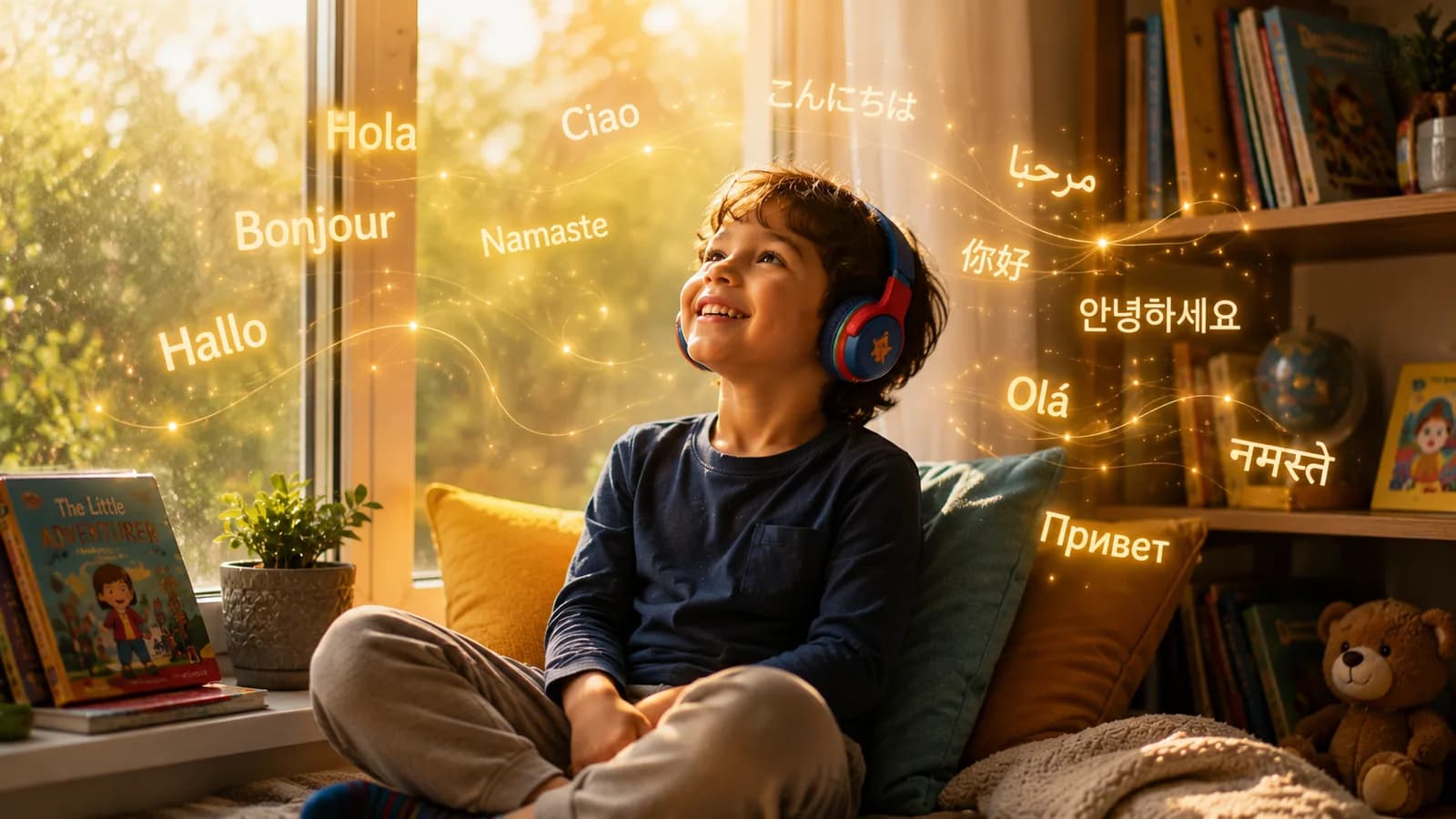

Newsletter
Get new stories & tips in your inbox
Parenting tips, audiobook picks, language learning — weekly.
