
Which Languages Does Cocoloops Offer — And How to Choose the Right One for Your Child
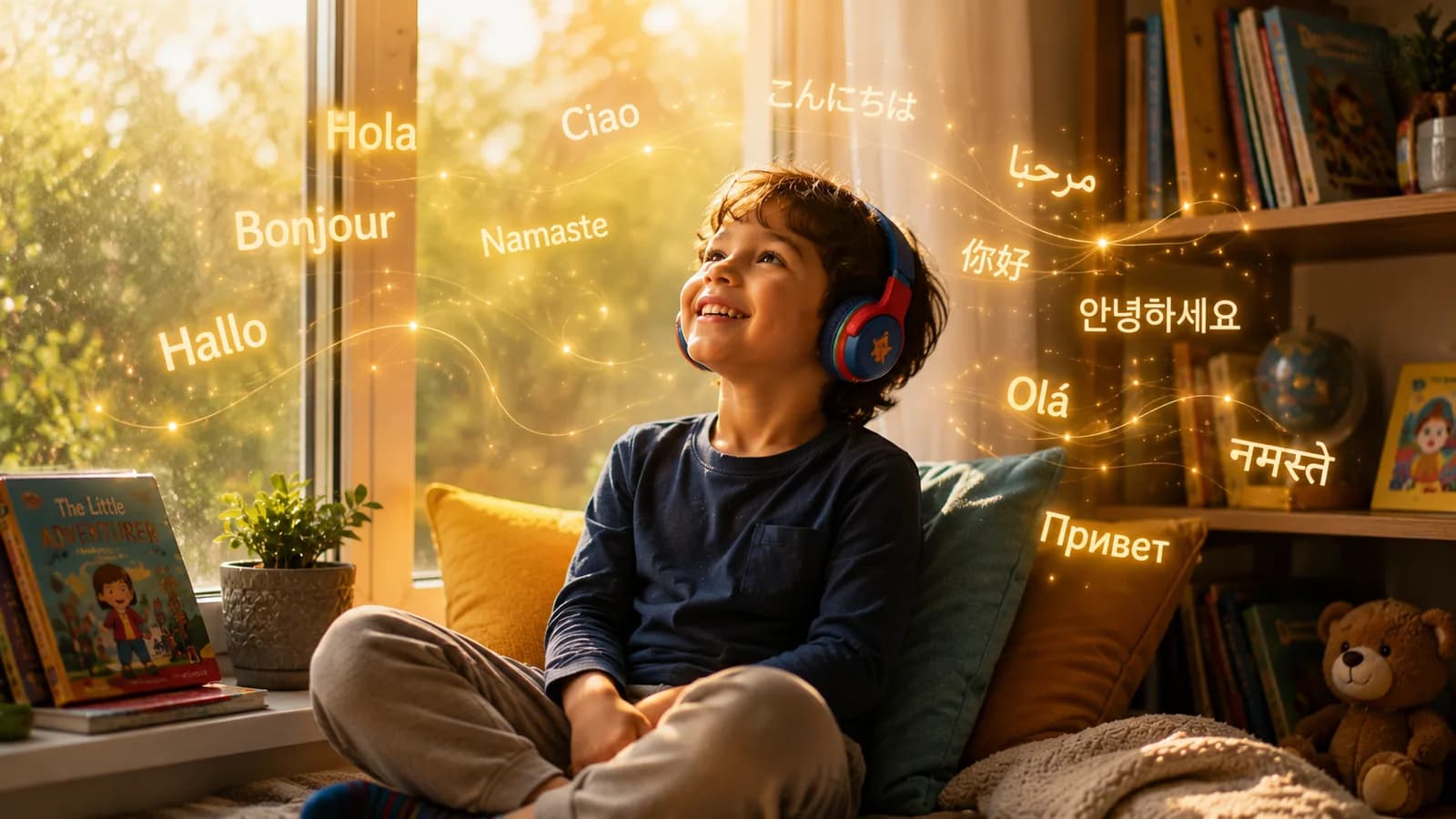
Ask a six-year-old if they want to study Spanish syntax and they will find somewhere else to be within seconds. Ask them if they want to travel to a different continent, unravel the mystery of how dreams work, or follow a brave character across the globe — and they are completely yours.
That is the philosophy behind Cocoloops. Our multilingual audiobook platform does not teach languages in a sterile vacuum. It builds immersive audio worlds that children genuinely want to inhabit — and the foreign language is simply the vehicle they ride to get there.
As the Cocoloops library grows, one of the most common questions parents ask is: which language should we actually start with? When the options in front of you include French, Spanish, German, Italian, and Hindi — each with its own compelling case — decision fatigue sets in fast.
This guide breaks down every language currently available on Cocoloops, the unique advantages of each for young learners, and a clear framework to help you choose the right sonic passport for your family. Whether you are searching for French audiobooks for children, Spanish stories for toddlers, or Hindi content for your heritage language home — this is where to start.
Why the Language You Choose Matters (and When It Doesn't)
Before diving into the options, it helps to reframe the question entirely.
If your child is under the age of eight, the specific language you choose matters far less than the habit of daily listening itself. The human brain's auditory cortex is extraordinarily elastic in early childhood. Exposing a young child to any foreign language through rich, authentic audio stretches their phonetic range, trains their ear to distinguish unfamiliar sounds, and helps children become more comfortable distinguishing unfamiliar sounds, which may support later language learning. For young children, consistent exposure often matters more than choosing the "perfect" language.
That said, choosing a language with a clear purpose behind it will dramatically increase your family's long-term motivation and consistency — and consistency is the single most important variable in language acquisition. A language chosen for a real reason gets listened to on a Wednesday evening when everyone is tired. A language chosen randomly does not.
The guiding principle is this: choose purpose-led, not popularity-led. Here is what each option on Cocoloops offers.
Option 1: French — The Global Classic
For families who want a language with genuine geopolitical reach and a rich literary and cultural tradition, French is one of the most powerful starting points available.
French is an official language in 29 countries across five continents, making it the fifth most widely spoken language globally. It is the primary second language taught in UK, Canadian, and many American school systems — which means a child arrives at school with greater familiarity and listening confidence. ahead. For families in international education systems, French is frequently not optional; it is expected.
Beyond the logistics, French offers a genuinely distinctive acoustic experience for English-speaking children. It introduces nasal vowel sounds, fluid liaisons between words, and a rhythmic cadence that is unlike anything in English. These are not obstacles — they are exactly the kind of phonetic challenges that stretch and develop a young brain's auditory range.
The Cocoloops French library is narrated entirely by native French speakers, which means your child absorbs authentic Parisian rhythm and intonation without ever looking at a spelling chart. Stories span adventure, science, and cultural exploration — and every one is available in English first, so comprehension is never a barrier to immersion.
Option 2: Spanish — The Fastest-Growing Language
For families in North America especially, Spanish is often the natural first choice — and the case for it is genuinely compelling.
With over 500 million native speakers, Spanish is the dominant language of Latin America and Spain, and the fastest-growing language in the United States. For English-speaking children, it is arguably the most accessible entry point into bilingualism. Spanish is a highly phonetic language: once a child learns the core vowel sounds, they can predict with remarkable accuracy how almost any written word will sound. Unlike French, there are very few acoustic surprises.
The English-Spanish relationship also offers an enormous cognitive shortcut: thousands of shared Latin root words, known as cognates. Words like familia, animal, secreto, and música are immediately recognisable to an English-speaking child without any prior instruction. This gives young listeners an instant confidence boost — a sense of I already know some of this — which Educational research suggests that early confidence encourages continued engagement.
Cocoloops Spanish stories for toddlers and older children are designed to capitalise on this accessibility. The library spans imaginative adventures, educational explorations, and culturally rooted narratives, all narrated by native Latin American and European Spanish speakers to give children exposure to the full breadth of the language.
Option 3: German — The European Powerhouse
German has an undeserved reputation for harshness and complexity. In practice, it offers English-speaking children some surprising structural advantages.
German is spoken by over 100 million native speakers and serves as the gateway to Europe's largest economy. For families with professional, academic, or cultural ties to Germany, Austria, or Switzerland, raising a child with early German exposure is an investment with long-term compound returns. For families without those ties, German still offers something compelling: cognitive rigour. German grammar is highly structured, logical, and rule-based — qualities that, Some educators appreciate German's structured grammar because it encourages children to notice consistent language patterns.
Here is the advantage many parents do not know: English is fundamentally a Germanic language. The everyday core vocabulary that children use most — words for water, apple, house, and mother — has direct Germanic equivalents that sound immediately familiar. German audiobooks for kids on Cocoloops allow children to absorb this structural language through immersive, beautifully produced audio, completely bypassing the grammar tables that make German feel daunting in a classroom context.
Older children who enjoy science, engineering, or logic-based subjects may particularly enjoy German-language stories. The language and the content reinforce each other.
Option 4: Italian — The Cultural and Musical Language
If you want to give your child a language that sounds genuinely beautiful from the very first listen, Italian is the answer.
Italian connects children to centuries of extraordinary art, architecture, cuisine, opera, and history. Acoustically, it is a masterpiece of open vowels, rolling consonants, and bouncing rhythmic cadences. To a young child's ear, Italian sounds inherently playful — almost sung rather than spoken. This musicality makes it one of the most naturally engaging languages for young listeners, many young children find its clear vowel sounds easier to imitate.
The phonetic clarity of Italian is another major advantage. Every vowel is pronounced cleanly and consistently. There are no nasal sounds, no silent letters, and very few exceptions to the core rules. Young children mimic Italian pronunciation with remarkable speed and accuracy, which builds early confidence in a way that more phonetically complex languages sometimes do not.
Cocoloops Italian stories for children lean into this beauty. The platform's uncompressed, high-fidelity audio ensures that every subtle sound — every rolled R, every double consonant — is delivered with crystal clarity, giving young ears the authentic phonetic model they need.
Option 5: Hindi — The Heritage Language
Hindi holds a unique place in the Cocoloops library — and in the story of why this platform exists.
Cocoloops was founded, in part, because Hindi audiobooks for children were almost impossible to find outside India. For the millions of Indian families raising children in Europe, North America, Australia, and the Gulf, Hindi is the language most at risk of disappearing in a single generation. Children grow up surrounded by English or German or French. Hindi becomes the language of grandparents — warm and familiar, but increasingly distant.
With over 600 million speakers, Hindi connects children to one of the world's oldest living storytelling traditions. It carries stories, songs, and ways of seeing the world that no other language can replicate. For heritage language families, Cocoloops Hindi content is not supplementary — it is essential. It is the bridge between a child growing up in Switzerland and the grandmother in Delhi who wants to tell them a story.

Every Hindi story on Cocoloops is narrated by a native speaker with authentic regional intonation, ensuring the language your child hears is living Hindi — not a flattened, textbook approximation.
Other Languages on Cocoloops
The Cocoloops library is actively growing. New language tracks, genres, and educational episodes are added regularly as the platform expands. Parents are encouraged to check the library directly for the most current catalog — languages and story collections that are not yet listed may already be in production.
The platform's commitment across every language remains the same: native-speaker narration, premium sound design, and the same story available across multiple languages so comprehension always provides the bridge into immersion.
How to Choose: A Decision Framework
Still finding it difficult to choose? Work through these four questions in order and the answer will find you.
1. Is there a heritage language in your family? If a grandparent, parent, or wider family member speaks a language that is not the dominant language of your home country, start there. The motivation of cultural continuity is more powerful and more durable than any external reason. Heritage language loss happens fast and quietly. Cocoloops is one of the most practical tools available to slow it.
2. Is there a language your child will encounter at school? If your child's school teaches French from Year 3, or Spanish is on the curriculum, use Cocoloops as daily audio reinforcement. A child who arrives at their first French class already familiar with native French prosody — even without formal vocabulary study — has a profound advantage over peers encountering the language for the first time.
3. Does your family have a cultural or geographical connection to a specific language? Frequent travel to a Spanish-speaking country, a deep family passion for Italian food and culture, a professional context involving German — any real-world connection dramatically increases long-term engagement. Choose the language that already has meaning in your family's life.
4. Starting from scratch with no specific connection? Choose Spanish or French. Both offer the highest volume of global resources, the most accessible phonetics for English-speaking children, and the strongest motivation infrastructure as your child encounters the language in school and wider life.
Can My Child Learn Two Languages on Cocoloops Simultaneously?
Yes — with one important caveat that depends on age.
For children aged three to five, we strongly recommend focusing on one primary foreign language at a time. At this stage, the brain is still consolidating the foundational sound system of the native language. For younger children, many families find it easier to build a consistent listening habit by focusing on one additional language at first. Once that routine is established, introducing another language often feels more manageable.
For children aged six and above, simultaneous learning across two languages is entirely achievable — provided you use deliberate time-blocking. Dedicate specific days or contexts to each language rather than switching randomly. For example: French stories on the school run Monday, Wednesday, and Friday; Spanish at bedtime on Tuesday and Thursday. Separating the languages by context gives children consistent routines that make it easier to associate each language with a familiar context.
Getting Started: Your First Story in Any Language
Starting is simpler than choosing.
Browse the Cocoloops library by genre first, not by language. Ask your child what they want to explore today — an adventure, a science mystery, a story about how the world works. Let them choose the narrative. Then listen to it once in English so they know the story well. The next day, switch the audio to your chosen language and press play.
That is the whole system. No preparation. No language skills required. Just a story your child already loves, now speaking to them in a new tongue.
Conclusion: Whichever Language Calls to You, Start Tonight
The best language for your child is the one they will hear consistently, in a context they love, over months and years. Every language on Cocoloops is delivered by native speakers, wrapped in premium sound design, and available in the same story across multiple languages — so switching, comparing, and returning is always one tap away.
Choose your language, find your story, and the best language is the one your child hears with joy, week after week.
Explore the full Cocoloops language library and start your child's first audio adventure tonight →
Frequently Asked Questions
What languages are currently available on Cocoloops?
Cocoloops currently offers stories in five languages: French, Spanish, German, Italian, and Hindi. The library is actively expanding, and new language tracks are added regularly. Parents can check the platform directly for the most current catalog.
Can I switch languages mid-story on Cocoloops?
Yes. One of Cocoloops' most distinctive features is the ability to switch the audio language of any story with a single tap. Your child can listen to the same story in English on Monday and in French on Wednesday — using their knowledge of the plot as a bridge to decode the new language.
Which language is easiest for English-speaking children to learn?
Spanish is widely considered the most accessible starting point for English-speaking children. It is phonetically consistent, shares thousands of cognate root words with English, and has an enormous range of supporting resources available globally.
At what age should my child start listening to a second language?
Research consistently shows that the earlier, the better. Early childhood is widely recognised as a particularly sensitive period for developing native-like pronunciation. Cocoloops content begins at age three, and even ambient daily listening at this stage builds meaningful phonetic range and familiarity.
Is Cocoloops suitable for heritage language families who want to preserve a minority language?
Yes — this is one of Cocoloops' core use cases. The platform was founded in part to address the scarcity of high-quality Hindi audio content for children outside India. For heritage language families across all five languages, Cocoloops provides native-quality, culturally authentic storytelling that complements what parents cannot always provide alone at home.
Related reading:
Tags
Related Posts
All posts
About Cocoloops
What Is Cocoloops? Multilingual Audiobooks for Kids Aged 3–15
Parenting Tips
Independence Day 2026: Hindi Stories, Activities & 80th Independence Day Ideas for Kids
Language Learning
What Is the Best Age for Children to Learn a Second Language?
Newsletter
Get new stories & tips in your inbox
Parenting tips, audiobook picks, language learning — weekly.
