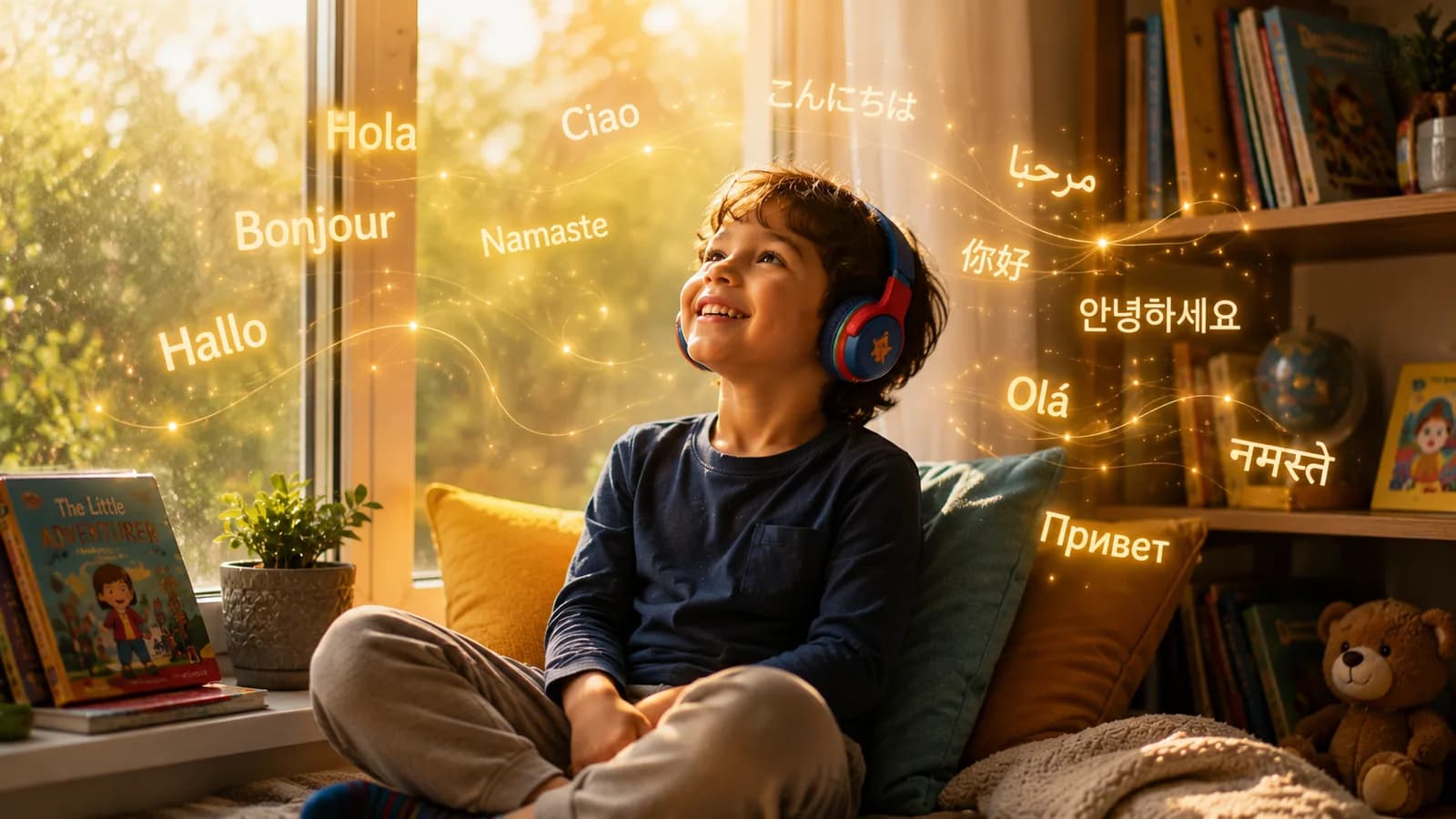
The Easiest Languages for English-Speaking Children to Learn First
Quick Answer
For English-speaking children, Spanish is the easiest language to learn first. It has phonetic regularity, a small and forgiving vowel system, extensive vocabulary overlap with English, and by far the largest supply of high-quality children's audio content. Italian follows closely, then French, then German. Crucially, this ranking is based on how children absorb language — not on the adult study metrics most difficulty rankings use.
Every year, the U.S. Foreign Service Institute publishes a ranking of the world's languages by difficulty for adult English speakers. Spanish takes around 600 classroom hours. Mandarin 2,200. The list is detailed, data-driven, and almost entirely irrelevant to your five-year-old.
Adult language learners measure difficulty through an analytical lens: verb conjugation tables, grammatical case systems, syntax rules, and the number of exceptions to every pattern. Children do not learn this way. They do not study a language — they absorb one. And the factors that determine how quickly a child absorbs a language are fundamentally different from the factors that determine how difficult it is for an adult to study it.
So, which are the easiest languages for kids to learn — specifically for English-speaking children — when we use criteria that reflect how children acquire language? That is what this guide answers, with an honest ranking of four languages and the specific child-centred reasons behind each placement.
Why 'Easiest' Means Something Different for Children
When adults call a language "easy," they mean: the grammar is manageable, the pronunciation is predictable, and the vocabulary overlaps enough with English to provide a running start. These are real advantages — but they are advantages framed around conscious study, which is not how children learn.
Children acquire language through auditory immersion, narrative engagement, emotional relevance, and repetition. They do not sit down and conjugate verbs. They listen to a story until they love it, and the language arrives as a byproduct of caring about what happens next. This means the "difficulty" of a language for a child is weighted entirely differently than for an adult.
For a child, the most important ease factors are:
Phonological familiarity — does the language use sounds the child's ear has already mapped from English? Languages that introduce radically unfamiliar phonemes require more phonological adjustment before acquisition accelerates.
Vocabulary overlap — are there enough shared root words (cognates) to give the child immediate recognition and confidence? Early wins matter enormously for sustained engagement.
Phonetic regularity — is the relationship between written form and spoken each sound consistent? For audio-first learners this matters less than for readers, but regular phonetics also means more predictable speech patterns that Children often find consistent sound patterns easier to become familiar with through repeated listening.
Richness of child-appropriate audio content — is there enough high-quality, engaging native-speaker content available in this language to sustain daily immersion? A language with minimal children's audio resources is practically harder to learn regardless of its linguistic structure.
Parent accessibility — can a non-fluent parent realistically support the learning environment? Languages with a larger global footprint and more accessible entry points make the parent's curation role easier.
Based on these five child-specific criteria — not adult study metrics — here is how the four primary Cocoloops languages rank.
#1 Spanish: The Clear Front-Runner
For English-speaking children, Spanish is the most accessible first language by a meaningful margin — and the reasons are rooted in linguistics, not just popularity.
Phonetic regularity. Spanish is one of the most phonetically consistent languages in the world. Spanish has one of the world's most consistent sound-to-spelling systems, making pronunciation much more predictable than English. Once a child's ear maps the five crisp, clean Spanish vowel sounds — a, e, i, o, u, each pronounced the same way every time — they have unlocked the pronunciation system for the entire language. There are no silent letters, no chaotic vowel shifts, and very few surprises. English, by comparison, is phonetically chaotic: "though," "through," "thought," and "tough" all end in the same four letters and produce four completely different sounds. Spanish is the antidote to that chaos.
Cognate density. English and Spanish share thousands of Latin root words. Animal, hospital, color, familia, natural, musical, principal — words that often sound familiar to English-speaking children and can make vocabulary feel more approachable. These shared words provide a running start that builds early confidence and vocabulary simultaneously. A child who discovers that they already "know" dozens of Spanish words before consciously learning the language is a child whose motivation to continue remains high.
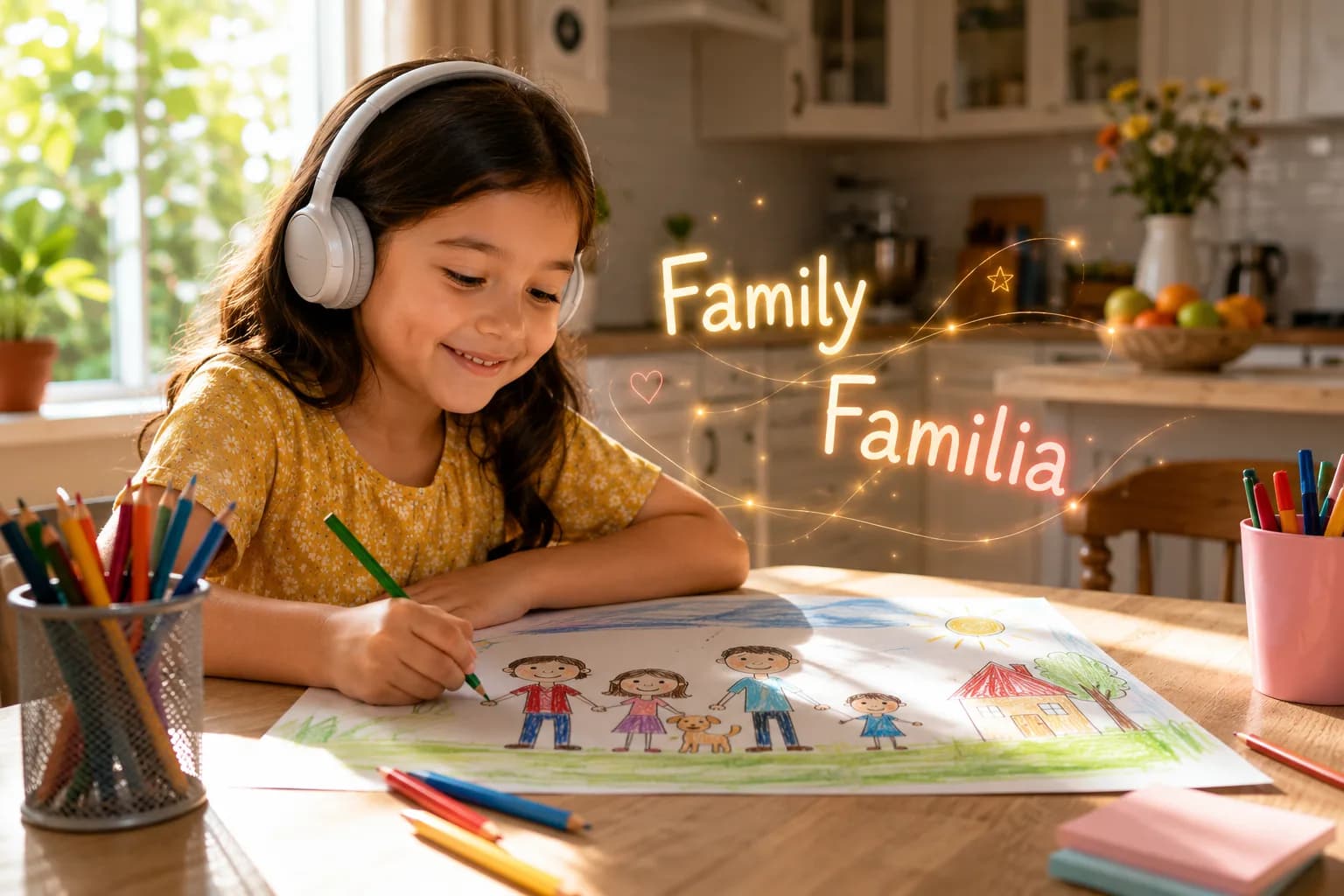
Global reach and content depth. With over 500 million native speakers across Latin America, Spain, and a rapidly growing Spanish-speaking community in the United States, Spanish is the language with the deepest pool of high-quality children's content available globally. The Cocoloops Spanish library reflects this — a broad range of narrative genres, native-speaker narrators, and age-calibrated stories that give families a genuinely rich audio environment to work with.
#2 French: Romance Language with Global Reach
French has a reputation for difficulty among adult learners — the spelling rules appear chaotic, the pronunciation requires unfamiliar mouth shapes, and the silent letters seem deliberately perverse. But here is the critical point: children learn French through their ears, not through its written form. And when you remove the written word from the equation, French becomes remarkably accessible.
Historical vocabulary overlaps. Following the Norman Conquest in 1066, the English language absorbed a vast quantity of French vocabulary — by some estimates, A large proportion of English vocabulary entered the language through French following the Norman Conquest. This means an English-speaking child already has an enormous passive vocabulary that maps directly onto French. Words like porc (pork), bleu (blue), carotte (carrot), restaurant, ballet, and portrait require no translation — the connection is immediate and instinctive.
School system alignment. French is the most widely taught second language in UK, US, Canadian, and Australian school systems. A child who builds early French phonological familiarity through audio immersion often begins formal French learning with greater listening familiarity and confidence through classroom instruction alone — they already recognize the sound of the language and have a partially formed mental map of its vocabulary.
The phonological challenge — and why it does not matter to young children. French does introduce genuinely unfamiliar phonemes: nasal vowels, the guttural R, and liaisons between words. These are features that cause adult learners considerable difficulty. For children under seven, these sounds are absorbed naturally through consistent exposure to native-speaker audio — the same way a French child absorbs them, without instruction, simply by hearing them repeatedly in meaningful contexts. This is one of the clearest examples of why the adult difficulty ranking is irrelevant to a five-year-old.
#3 Italian: The Musical Language
Italian is consistently underrepresented in children's language learning conversations, which is a genuine missed opportunity. It is one of the most phonologically accessible and emotionally engaging languages a young child can encounter.
Phonetic clarity. Like Spanish, Italian is highly phonetically regular — words are pronounced almost exactly as they are written, and the vowel sounds are crisp, open, and consistent. There are no nasal vowels, very few silent letters, and a sound system that English-speaking ears find pleasingly predictable.
Prosodic beauty. What distinguishes Italian most clearly from the other languages on this list is its prosody — the musical rise and fall of the spoken language. Italian is built on open vowels and rhythmic, bouncing cadences that give it an inherently song-like quality. To a young child's ear, Italian sounds like music before it sounds like language. This acoustic quality is not incidental — Many children find Italian's rhythmic sound engaging, which may help maintain attention during listening. Also, children find Italian pronunciation relatively easy to imitate because of its clear vowel system.

Cultural richness as motivational fuel. Italian connects children to a living cultural world of extraordinary depth — food, art, architecture, music, and storytelling traditions that have no equal in their historical richness. For families with Italian heritage especially, the cultural dimension of the language provides exactly the emotional relevance that accelerates acquisition.
#4 German: The Structural Advantage
German has the most intimidating reputation of any language on this list — and the reputation is not entirely undeserved for adult learners. The grammatical case system, in which words change their endings depending on their grammatical function in a sentence, genuinely does require significant cognitive effort from adult students approaching it analytically.
But children, particularly younger children, do not approach German analytically. They approach it through their ears. And when they do, they encounter a language that has a significant and underappreciated advantage for English-speaking learners.
(Need Corrections since Children don't automatically recognize... They may notice similarities over time, but they aren't instantly recognized.)
Germanic roots. English is, at its core, a Germanic language. The most fundamental, everyday vocabulary that children use most frequently — words for basic objects, relationships, and actions — shares direct Germanic ancestry with German. Wasser (water), Apfel (apple), Haus (house), Mutter (mother), Katze (cat), Buch (book) — these words are not learned from scratch. They are recognized. The shared root system gives young children an immediate foothold in the language's most essential vocabulary.
Structural logic for older learners. While German grammar is complex, it is also highly logical and rule-based — more so than English, which is full of irregularities and exceptions. For children aged eight to twelve who enjoy patterns, puzzles, and systematic thinking, German grammar is especially rewarding to children who enjoy patterns may find German .. Children who encounter German through audio immersion absorb the case endings by feel — learning which ending "sounds right" in context — which bypasses the analytical confusion that challenges adult study.
Comparison Table: Spanish, French, Italian, and German for Kids
| Language | Ease Rating | Key Phonics Challenge | Best Starting Age | Cocoloops Catalog | First 5 Words |
|---|---|---|---|---|---|
| Spanish | 10/10 | Rolling the R sound | 18+ months | Extensive | Hola, agua, gato, rojo, familia |
| Italian | 9/10 | Double consonants | 18+ months | Growing | Ciao, acqua, gatto, rosso, famiglia |
| French | 8/10 | Nasal vowels, silent letters | 18+ months | Extensive | Bonjour, eau, chat, rouge, famille |
| German | 7/10 | Guttural sounds, case endings | 3+ years | Growing | Hallo, Wasser, Katze, rot, Familie |
How to Choose Based on Your Child's Life (Not Just Ease)
Here is the insight that reframes every ranking on this list: ease is a useful starting point, but it is not the most important variable. The most important variable is relevance — and children measure relevance in a way that has nothing to do with linguistics.
A child's brain will decode a language rapidly when there is an emotionally compelling reason to do so. A child whose grandmother speaks Italian will find Italian easier than Spanish, regardless of what the phonetics say. A child who is completely invested in finding out what happens to the main character of a Cocoloops French story will find French suddenly very accessible. A child who knows the family is travelling to Germany and wants to order their own ice cream will crack German vocabulary with remarkable speed.
Consider these questions before making your choice:
Heritage. Is there a language spoken by grandparents, extended family, or ancestors that would build an emotional bridge for your child? If so, start there. The motivational advantage of heritage language learning consistently outperforms any phonetic ease advantage.

School. Will your child be studying a specific language in school? If so, Cocoloops audio immersion in that language is one of the most effective pre-learning investments available — a child who arrives at their first French or Spanish class already familiar with the language's sound system is positioned to excel.
Travel and culture. Does your family have a regular connection to a country or culture through travel, food, or community? A language that your child encounters in the real world is a language that retains its relevance beyond the listening session.
Blank slate. If none of the above apply and you are simply choosing the best entry point, Spanish is the recommendation — maximum phonetic accessibility, maximum cognate support, maximum content availability, and maximum global reach.
A note on Hindi: if your family has Indian heritage or community connections, Hindi deserves equal consideration alongside the four languages in this ranking. Cocoloops' Hindi library was built specifically for families who want to preserve or develop their heritage language connection — and the same principle applies emotional relevance accelerates acquisition faster than any phonetic ease advantage.
Conclusion: The Best Language Is the One They Will Actually Listen To
Whether you choose the phonetic clarity of Spanish, the melodic beauty of Italian, the global reach of French, or the structural logic of German — the most important decision you make is not which language to start with. It is to start at all, tonight, with a story your child genuinely wants to hear.
The ease rankings above tell you where the linguistic path is smoothest. Your child's enthusiasm, your family's connections, and the quality of the content you provide will determine how far and how fast they travel along it.
Explore the Cocoloops library across all five languages and press play tonight →
Frequently Asked Questions
Should I choose the easiest language or the most useful one for my child's future?
When these two goals align — as they do with Spanish, which is both the most phonetically accessible and one of the most globally useful — the choice is straightforward. When they diverge, usefulness consistently produces better long-term outcomes. A language that is slightly more phonetically challenging but that your child hears regularly from family members, encounters in their community, or will study at school has a motivational and exposure advantage that linguistic ease cannot compensate for. The most useful language for your child specifically — defined by their heritage, their school, their likely future destinations — is almost always the better choice over the easiest language in the abstract.
Can my child learn two languages from this list simultaneously?
Yes, with one important structural principle: separate the languages clearly by context rather than mixing them randomly. The most effective approaches include dedicating specific days to each language (Spanish Monday to Wednesday, French Thursday to Saturday), specific activities to each language (Cocoloops stories in Spanish, music and songs in French), or specific people to each language (one parent or caregiver consistently uses each language). The goal is to give the brain clear and consistent routines help children associate each language with familiar contexts. For children under five, many families find it easier to establish one additional language first before adding another, particularly during the preschool years.
Is it too late to start if my child is already eight or nine years old?
Absolutely not. The phonological window — the period of easiest native-like accent acquisition — runs through approximately age ten, which means an eight or nine-year-old still has meaningful phonological plasticity. Beyond the phonological window, older children bring cognitive tools that younger children lack: they understand grammatical concepts in their first language and can transfer that understanding to a second, they can engage with more complex narrative content that delivers richer vocabulary, and they can make conscious connections between languages that accelerate structural learning. The acquisition path looks different at eight than at three, but it is equally viable.
Do cognates (shared words) actually help children, or is this mainly an adult advantage?
Cognates help children, but differently than they help adults. Adults consciously recognize cognates and use them as deliberate memory anchors. Children encounter cognates as words that feel immediately familiar when heard — they require less repetition to encode because the neural pathway for a related English word already exists. This reduces the acquisition effort for each cognate word and frees cognitive resources for vocabulary that is genuinely novel. The practical effect is that languages with high cognate density — Spanish and French in particular — produce earlier vocabulary recognition in children, which sustains engagement and motivation during the early stages when progress can otherwise feel slow.
Will starting with the "easiest" language make it harder to learn a different language later?
No — and the research suggests the opposite may be true. Children who acquire a second language early develop metalinguistic awareness: an explicit understanding of how language functions as a system. This awareness makes the acquisition of a third or fourth language significantly more efficient, regardless of which language was learned first. Starting with Spanish does not close the door on French or German — it opens the neural architecture for language learning in general, making every subsequent language easier than the one before it. The easiest language is often the best first language precisely because it produces early success that sustains the motivation to continue.
Related reading:
Tags
Related Posts
All posts

Newsletter
Get new stories & tips in your inbox
Parenting tips, audiobook picks, language learning — weekly.
