

10 Proven Benefits of Raising a Bilingual Child (Backed by Research)
Imagine watching your toddler effortlessly switch between two languages while playing with their grandparents. One sentence is in English, the next includes words from Hindi, Spanish, or French. Many parents worry that this means their child is confused. Science says the opposite.
More than half the world's population speaks two or more languages. For much of the globe, bilingualism is not an achievement — it is simply daily life. And yet in English-speaking countries, we tend to treat second language learning as an optional extra: a high school requirement, or something we vaguely intend to get around to eventually.
Parents who look at this differently — who actively choose to introduce a second language at home during the early years — are not just teaching their children how to order coffee in Paris. They are making a decision that reshapes the architecture of their child's brain, strengthens their cognitive performance across virtually every measurable dimension, and protects their neurological health decades into the future.
If you are weighing whether the effort is worth it, the research is unusually clear. Here are ten proven benefits of raising a bilingual child, grounded in peer-reviewed science and explained in plain language.
The Research Behind Bilingualism: What the Science Actually Says
The scientific study of the bilingual brain has accelerated dramatically over the past two decades, and the findings consistently point in the same direction: managing two language systems does not divide cognitive resources. It multiplies them.
Cognitive neuroscientist Ellen Bialystok at York University has spent decades studying bilingual brain development. Her research points to something called "cognitive reserve" — the idea that the mental effort of constantly switching between and filtering out competing languages may help the brain build backup capacity that can be drawn on later in life, especially as it ages.
Think of the bilingual brain like a city with two subway systems instead of one. If one line has troubles, the city still runs. In Bialystok's studies, older bilingual adults with visible signs of brain aging often kept performing on cognitive tests as well as monolinguals with much healthier-looking brains — as if the mental "switching and filtering" system built up over a lifetime of managing two languages gave them extra routes to work around the damage. Bilingualism doesn't stop aging or make anyone immune to decline, but it may buy time before the effects show up.
Every time your child mentally decides "which language do I use right now, with this person, in this context," it's a small workout for the brain's attention and self-control system. It's worth noting this particular research was done on older adults, not kids — so the science doesn't promise a childhood IQ boost. But the same switching-and-filtering skill your child is quietly practicing today is the one Bialystok's work suggests may keep paying off, quietly, decades down the line.
At the sound level, science is just as striking. Researchers Janet Werker and Patricia Kuhl found that babies are born able to hear the difference between sounds from any language on Earth — Hindi's retroflex "t," French nasal vowels, Zulu clicks, all of it. By around their first birthday, monolingual babies start losing that superpower for sounds they never hear, the same way a room goes dark if you never open the curtain. A baby raised only in English, for example, gradually stops being able to tell apart two "t" sounds that are completely distinct in Hindi.
Bilingual babies are different. Exposed to two sound systems from the start, it's like they get two curtains opened at once — so their ears stay tuned to a wider range of sounds for longer.
This is one reason starting early matters — even before your baby is talking. That extended window of sound sensitivity gives them an easier time later with pronunciation and listening comprehension when they pick up a new language.
The European Commission's research on multilingualism adds an economic dimension: cross-border language skills directly correlate with greater employment mobility, opportunities your child may benefit from decades later, and measurably stronger cross-cultural communication competence. The case for bilingual child development spans neuroscience, linguistics, and economics simultaneously.
Benefits 1–3: Cognitive Advantages
Benefit 1: Stronger Executive Function
Executive function is the brain's management system — the neural architecture responsible for sustaining attention, filtering out distractions, following multi-step instructions, and switching between tasks without losing focus. It is one of the strongest predictors of academic success, professional performance, and emotional regulation across the lifespan.
Researchers have spent over a decade studying whether bilingual children get a boost here, and the picture that emerges is genuinely interesting, if not perfectly tidy.
The mechanism is elegant: a bilingual child's brain is constantly managing two active language systems simultaneously. When a child who speaks both English and Spanish wants to say "dog," their brain must rapidly suppress the competing word "perro" to select the correct one for the context. This process — known as inhibitory control — happens thousands of times a day, entirely beneath conscious awareness. It is a continuous, invisible cognitive workout that builds executive function capacity the same way daily physical exercise builds cardiovascular fitness.
Benefit 2: Superior Cognitive Flexibility and Multitasking
Because a bilingual brain is already accustomed to switching fluidly between two distinct grammatical systems, vocabulary sets, and phonological rules, it develops exceptional cognitive flexibility — the ability to shift between mental frameworks with speed and low cognitive cost.
Studies across multiple research groups have shown that bilingual children demonstrate measurably lower cognitive fatigue when switching between unrelated tasks. They adapt to new rules more quickly, recover from errors faster, and sustain performance across extended, complex activities more effectively than monolingual counterparts. In practical terms, this translates to children who navigate the demands of modern schooling — constantly shifting between subjects, contexts, and social expectations — with noticeably greater ease.
Benefit 3: Higher Creativity and Divergent Thinking
When a child grows up understanding intuitively that a single object can have two entirely different names — that the same reality can be encoded in fundamentally different ways — something shifts in how they approach problem-solving. They grasp early that there is rarely only one correct way to express, categorise, or approach anything.
Bilingual children regularly score higher on divergent thinking assessments: the cognitive tasks that measure the ability to generate multiple solutions to open-ended problems rather than converging on a single "right" answer. This is the variety of creativity that produces innovation, entrepreneurship, and original thinking — and it appears to be a direct product of the mental flexibility that managing two language systems develops from an early age.
Benefits 4–6: Academic and Career Advantages
Benefit 4: Higher Literacy and Reading Comprehension
It might seem counterintuitive: surely managing two sets of vocabulary would slow a child's reading development? The research consistently shows the opposite. Studies published in Child Development demonstrate that bilingual children develop stronger metalinguistic awareness — the study of language and its relationship to other cultural behaviors or systems — than monolingual peers. Because they have experienced two different ways of encoding the same meaning, they understand language at a level of abstraction that monolingual readers rarely reach without explicit instruction. This deeper understanding of linguistic mechanics translates directly into higher literacy scores and superior reading comprehension, even in their primary language.
Benefit 5: Faster Acquisition of Additional Languages
Once the brain has mapped the architecture of two distinct language systems, adding a third or fourth becomes significantly easier. The neural infrastructure for language switching, phonological mapping, and grammatical abstraction is already in place. A child who grows up speaking English and French will learn Mandarin or German with considerably less friction than a monolingual peer approaching their first foreign language. The investment in early bilingualism is not just a gift for today — it is a compounding asset for every language that follows.
Benefit 6: Measurable Career and Salary Advantages
The long-term economic case for bilingualism is well-documented. MIT economist Albert Saiz published research calculating what he termed the "bilingual bonus" — a statistically significant salary premium attached to professional bilingual proficiency. Depending on the language pair, this premium compounds substantially across a career, with some estimates placing the lifetime earnings advantage in the hundreds of thousands of dollars.
Beyond salary, bilingual adults report consistently higher employment rates, greater professional mobility across international markets, and stronger competitiveness for roles in an increasingly globalised economy. The skills developed in childhood — cognitive flexibility, cross-cultural communication, linguistic adaptability — translate directly into professional assets that employers in virtually every sector actively seek.
Benefits 7–8: Social and Emotional Development
Benefit 7: Deeper Empathy and Emotional Intelligence
A bilingual child navigates something that monolingual children rarely encounter: the daily experience of understanding that the same person needs to be communicated with differently depending on context. They learn to read a room — to recognise who speaks which language, in which situation, with which expectations — and to adjust their communication accordingly.
A study from the University of Chicago found that this heightened sensitivity to other people's communicative perspectives translates directly into stronger emotional intelligence and empathy more broadly. Bilingual children demonstrate a measurably greater ability to take another person's point of view, understand their emotional state, and respond appropriately — skills that are foundational not just for personal relationships but for leadership, collaboration, and every form of meaningful social connection.
Benefit 8: Cultural Openness and Family Connection
Language is not just a communication tool. It is the carrier of culture, memory, humour, and belonging. When a child learns a second language through culturally rich, immersive stories — the kind that embed vocabulary in real narratives drawn from real cultural traditions — they do not just acquire words. They acquire a way of seeing.
For immigrant and expat families especially, this benefit is immediate and deeply personal. A child who can speak and understand the heritage language of their grandparents does not experience those grandparents as strangers separated by a linguistic barrier. They experience them as people they can know fully — can laugh with, be told stories by, and feel genuinely connected to. Language is the bridge between generations, and in families where that bridge is at risk of disappearing, building it early through consistent audio exposure can preserve something irreplaceable.
Benefits 9–10: Brain Health Across a Lifetime
Benefit 9: Stronger Working Memory
The cognitive demands of bilingualism function like compound interest for memory systems. Maintaining two complete vocabulary sets, two grammatical frameworks, and two sets of pragmatic rules — while switching fluidly between them — places a sustained, productive load on the hippocampus and the working memory systems it supports. Research indicates that bilingual individuals retain sharper working memory into later adulthood, demonstrating better recall of names, sequences, spatial information, and multi-step instructions than monolingual peers at equivalent ages.
Benefit 10: Protection Against Dementia and Alzheimer's Disease
Ellen Bialystok's longitudinal neurological research claims that the cognitive reserve built by lifelong bilingualism can delay the onset of Alzheimer's disease and dementia symptoms by an average of four to five years compared to monolingual adults.
The mechanism is the same cognitive reserve built by decades of language switching: because a bilingual brain has spent a lifetime constructing and maintaining alternative neural pathways, it has more routes available when primary pathways begin to degrade.
How to Start Without Being Fluent Yourself
The most common objection parents raise at this point is a practical one: "I barely remember my high school French. How can I possibly give my child a bilingual foundation?"
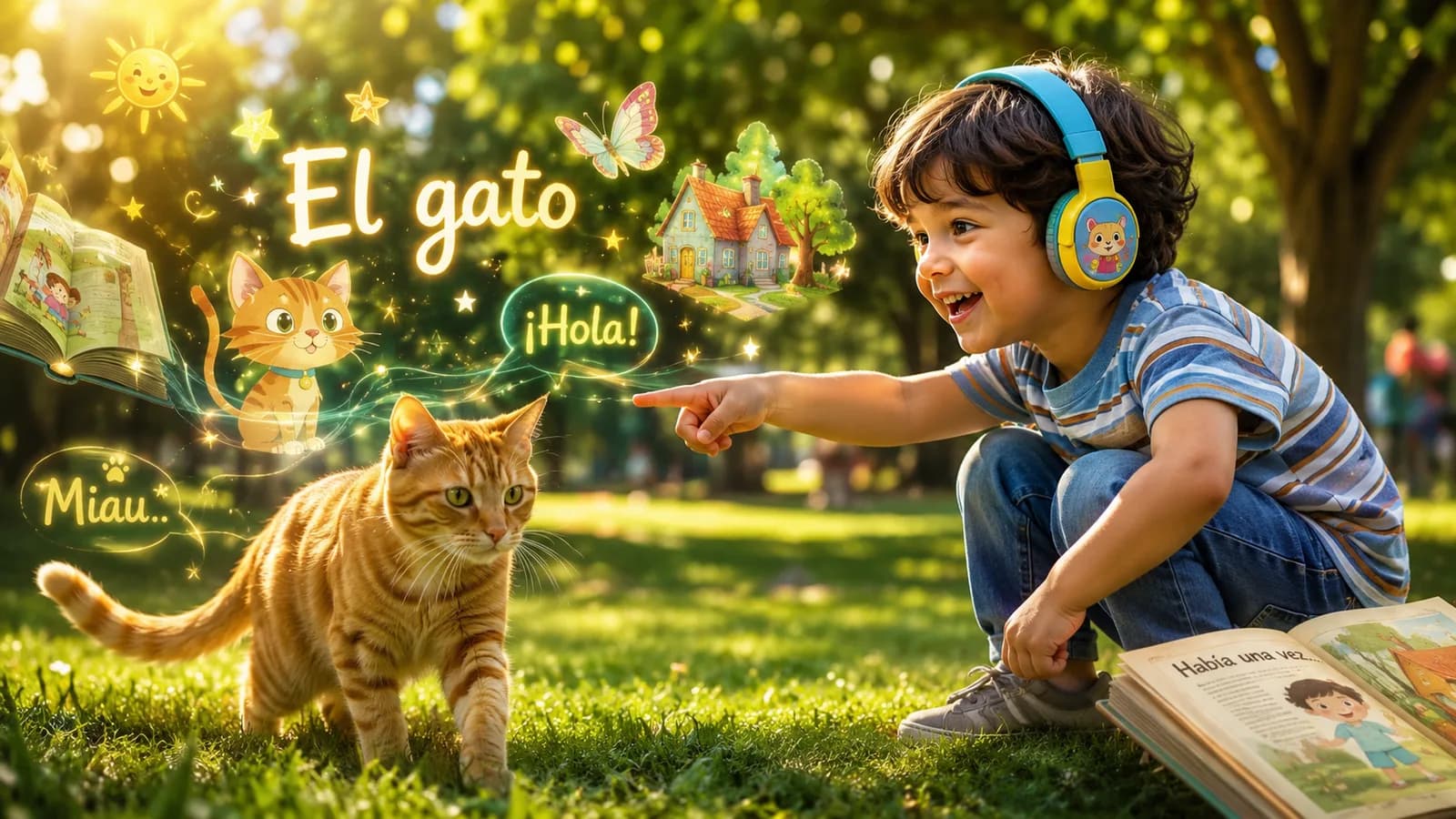
The honest answer is that you do not need to. Children acquire language through high-quality, comprehensible audio input from native speakers — not through parental instruction or grammar lessons. What your child's brain needs is consistent exposure to authentic spoken language in the right context: stories, characters, and narratives they are genuinely engaged with.
Another question most parents ask at this point is obvious: what if I don't speak the language myself? This is precisely the gap that Cocoloops was built to close. Every story on the platform is narrated by a native speaker of the target language, delivering authentic prosody, rhythm, and intonation that no app-generated voice or non-native parent can replicate. And because every story is available in multiple languages, your child builds comprehension through narrative before the language switch — using the plot they already love as the bridge into a new language.
You do not need to teach them anything. You need to press play consistently, and let a brain that evolved specifically for language acquisition do precisely what it was designed to do.
Browse the Cocoloops multilingual story library →
Frequently Asked Questions
Will introducing a second language confuse my child or delay their speech?
This concern is very common and has been thoroughly addressed by modern developmental science. The "confused bilingual" idea has been debunked across multiple research populations. Bilingual children may distribute their early vocabulary across two languages rather than concentrating it entirely in one — which can make their single-language vocabulary appear smaller — but their combined vocabulary across both languages is typically equal to or greater than that of monolingual peers. And eventually the vocabulary bank per language reaches the fluency level of any monolingual kid. There is no evidence that bilingual exposure causes clinical speech delays in typically developing children.
What is the single most important factor in raising a bilingual child successfully?
Consistency of exposure. Volume matters less than regularity. A child who hears fifteen to twenty minutes of native-speaker audio in their target language every single day will outperform a child who has intensive sessions twice a week. The brain consolidates language patterns between exposure sessions — which means daily, spaced input is neurologically more efficient than infrequent bursts, regardless of total hours. Building language into an existing daily routine, rather than treating it as a separate study activity, is the most reliable way to achieve the consistency that produces results.
What are the long-term cognitive benefits of raising a child with two languages?
The advantages that persist into adulthood are largely about mental control rather than vocabulary. Because a bilingual brain constantly manages two active language systems — selecting one while suppressing the other — it gets lifelong practice at exactly the skills executive function depends on: switching between tasks, filtering out irrelevant information, and holding competing options in mind. These carry over into domains with no linguistic content at all.
The most striking long-term finding concerns brain health decades later. Bilingual adults who develop dementia tend to show clinical symptoms around four to five years later than monolingual adults with comparable underlying pathology. The disease progresses the same way; the bilingual brain simply copes with more damage before daily function is visibly affected — an effect researchers call cognitive reserve. It is one of the few modifiable factors with an evidence base of that strength, and it originates in childhood exposure.
At what age should I start introducing a second language to my child?
The earlier, the better — but no age within the childhood window is too late to start. The brain's phonological sensitivity is highest from birth through age seven, making this the period when native-like accent acquisition happens most naturally. However, children aged eight to twelve bring strong cognitive tools to language learning that can accelerate grammatical and vocabulary acquisition. Cocoloops content is calibrated for ages three through fifteen, with stories appropriate for every developmental stage across that range.
How does listening to audiobooks compare to other methods for raising a bilingual child?
Story-based audio immersion delivers what linguists identify as comprehensible input — language heard in a context that provides enough surrounding meaning for the listener to decode unfamiliar words without translation. This is the mechanism through which children acquire their first language, and research consistently shows it is the most effective foundation for second language acquisition as well. Audiobooks narrated by native speakers additionally deliver authentic prosody — the rhythm, intonation, and emotional texture of a living language — which flashcard apps and grammar-based tools fundamentally cannot replicate. Used consistently as a daily habit, native-speaker audio stories provide the foundation on which all other language learning builds most effectively.
Cocoloops offers native-speaker multilingual audiobooks for children aged 3–15 in French, Spanish, German, Italian, and Hindi. Available globally, no app download required.
Related reading:
Tags
Related Posts
All posts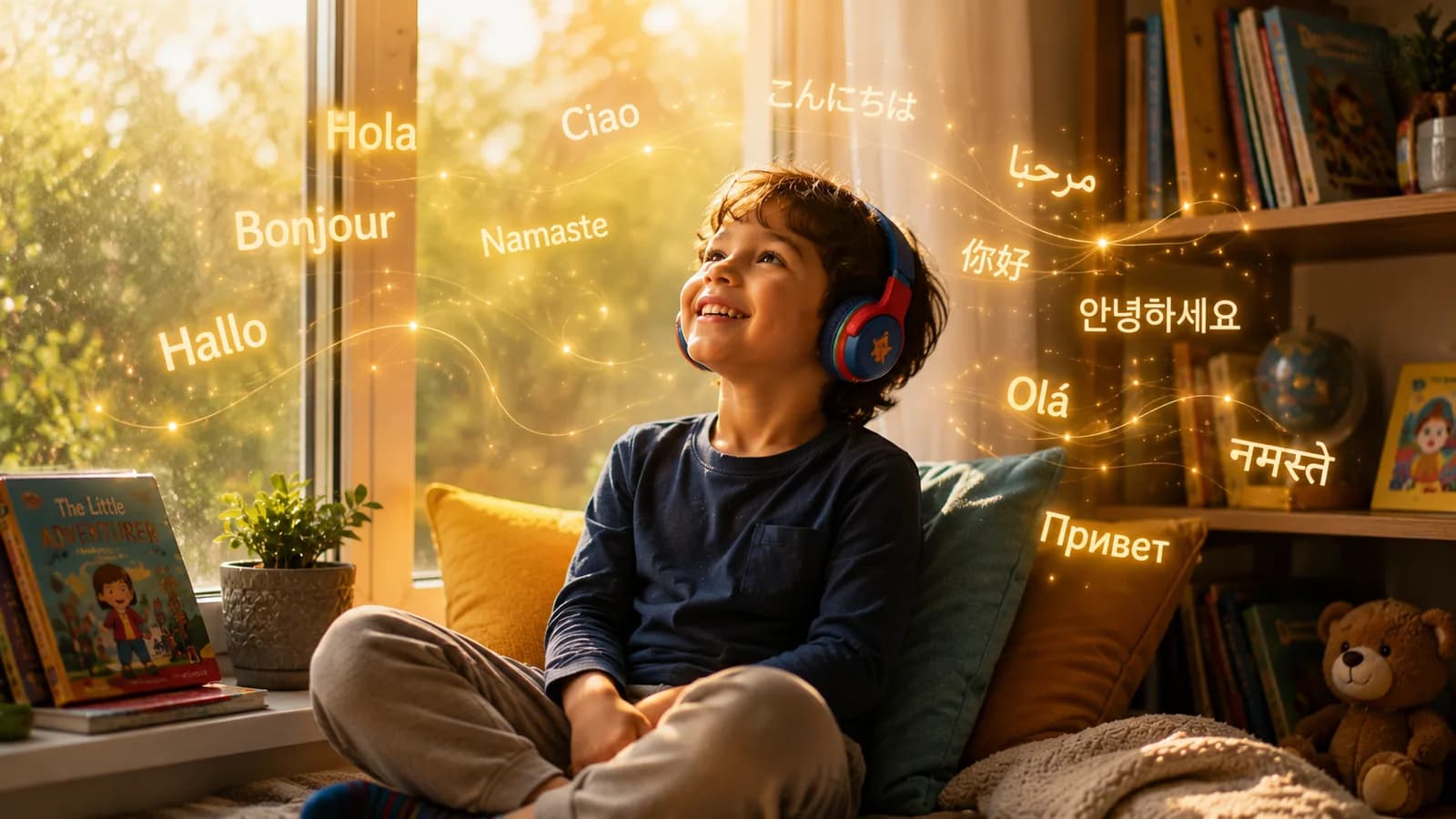

Newsletter
Get new stories & tips in your inbox
Parenting tips, audiobook picks, language learning — weekly.
