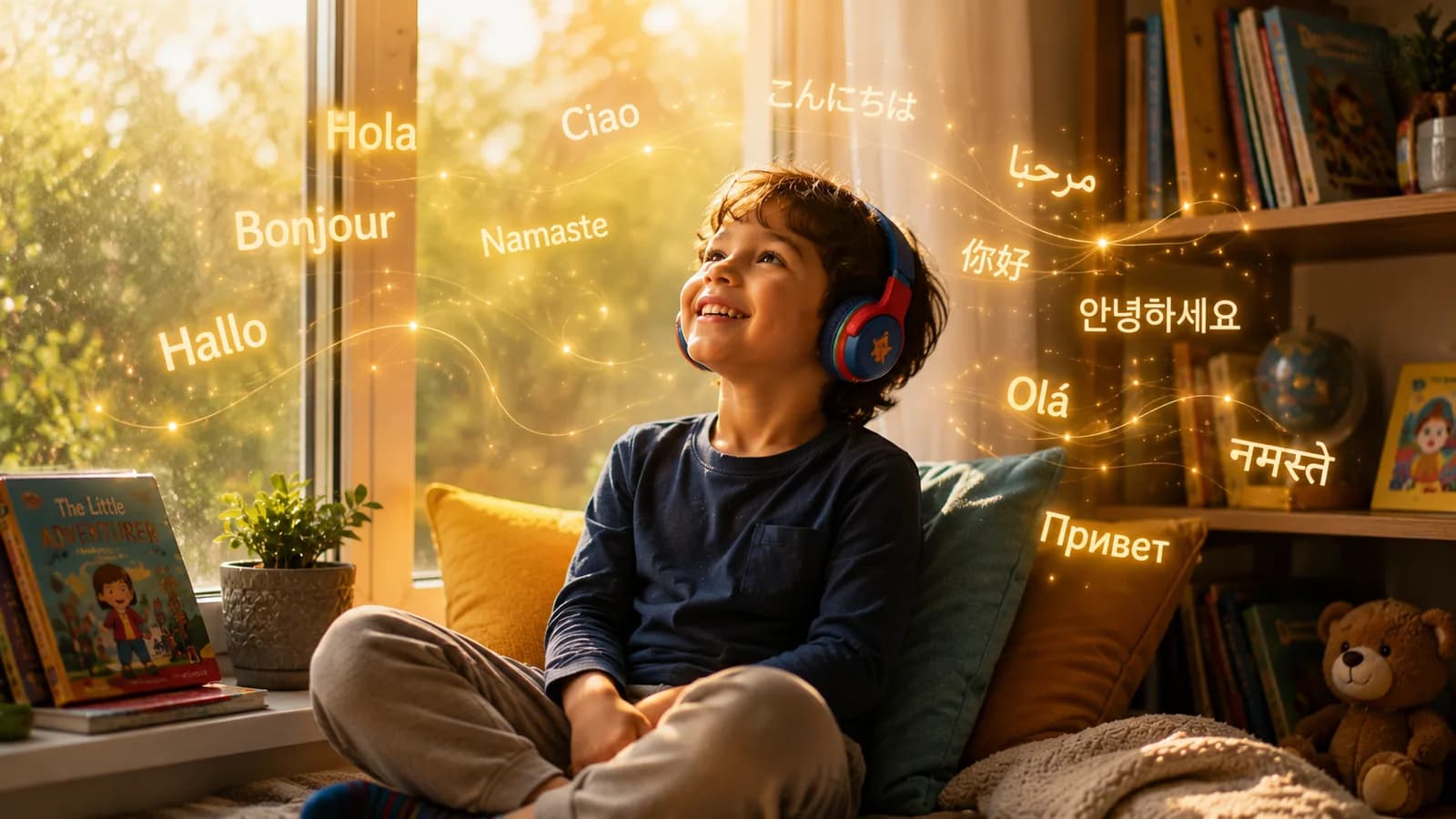
What Is the Best Age for Children to Learn a Second Language?
Whatever age your child is today, there is a sound reason to start learning a second language. The baby is building a map of the language's sounds, best switched on through stories and live interaction. The four-year-old is mid vocabulary-explosion. The six-year-old is in the accent window. The ten-year-old has analytical tools that speed up grammar. Every stage has an advantage; none is too late. So, how does it play out as a baby grows and learns?
You must have a video of your toddler speaking gibberish in the cutest possible way. Yours is doing exactly how every kid starts with a language. Before they can say a single real word of French (or any other language for that matter), toddlers will happily "speak" it anyway: a confident, melodic stream of complete gibberish, delivered with all the shrugs and the rising-and-falling lilt of someone in full Parisian flow — and not one actual word in it. It is very funny, and it is also the first clue to how this all works. Long before children collect vocabulary, they absorb the music of a language: its rhythm, its melody, its shape in the mouth.
So when should you start with a new language? The short answer: as early as possible but there is no single deadline. Early childhood offers the widest window for absorbing the sounds of a new language and picking up a native-like accent, because a young child's brain is still tuning itself to the sounds it hears most. But the window for learning a language well stays open far longer than most parents fear — children can reach real, lasting fluency starting well into the school years and beyond. Missing the earliest window is not missing the boat. It simply changes which door you walk through.
What follows is what the research actually says, stage by stage — and, more importantly, why each stage changes the way a child learns, so you can meet your child where they are.
Why Age Matters: The Science of Learning Windows
You have probably noticed that young children pick up accents and new words with an ease that feels almost unfair to adults. That is not a parental illusion — it reflects something real about how a developing brain handles language.
Researchers describe this using the idea of a critical or sensitive period: a stretch of development when the brain is especially ready to acquire a particular skill. For language, the picture is more nuanced than the popular "it's all over by seven" version — and that nuance is the whole point of this article, because different parts of a language have different windows.
For the sound system of a language — its accent, its rhythm, and the fine distinctions between speech sounds — the window is widest in the first years of life and narrows gradually through childhood. For grammar, the window is surprisingly long. One of the largest studies ever done on the question, by Joshua Hartshorne, Joshua Tenenbaum and Steven Pinker (2018), analysed an online English-grammar test taken by nearly 670,000 native and non-native English speakers. Using the sheer size of that dataset to separate age from years of experience, they estimated that the ability to learn grammar at a native-like level stays strong until around age seventeen and only then begins to decline — but that, because reaching native-like proficiency takes years of exposure, learners generally need to start by around age ten to get all the way there. As with any single finding in this field, the details get argued over — but the shape of it doesn't: start early and you're helping, start late and you're far from too late.
The engine underneath all of this is neuroplasticity: the brain's ability to reorganise itself by forming new connections. In early childhood the brain is extraordinarily plastic. It is actively building maps for the sounds it hears most, quietly setting aside sounds it rarely encounters, and reinforcing the patterns that show up most often. Picture a sound mould that hardens slowly over time. Early on it takes new impressions easily; later it is not rigid, but reshaping it takes more deliberate effort.
This is why a three-year-old who hears French daily begins to distinguish French vowel sounds that an adult English speaker cannot even perceive as different. The child's brain is still mapping. The adult's map is largely set.
None of this means older children cannot learn languages. It means they learn them differently — often with real cognitive advantages of their own. The job for parents is not to panic about a closing window, but to understand what each stage offers.
Age 0–2: Building the Sound Foundation
Long before a child produces a single recognisable word, their brain is already doing sophisticated work — listening to the acoustic world, picking out recurring patterns, and beginning to build the sound architecture of language.
By around twelve months, babies have started to specialise. They respond more strongly to the speech sounds or phonemes of the language around them and begin losing sensitivity to sounds that do not appear in it — a process the researchers Janet Werker and Richard Tees documented decades ago and called perceptual narrowing. It is why native Japanese speakers often struggle to tell the English "R" and "L" apart: those two sounds are not treated as different in Japanese, so the infant brain quietly deprioritised the distinction.
Here is the honest and important nuance for this earliest stage, and it is one a lot of language marketing skips. Patricia Kuhl's well-known experiments found that nine-month-old American infants could pick up Mandarin sound contrasts after only a few sessions with a live, in-person Mandarin speaker — but infants who received the exact same material through audio-only or video-only recordings learned nothing measurable. For babies, social interaction appears to be part of how the sound-mapping actually switches on.
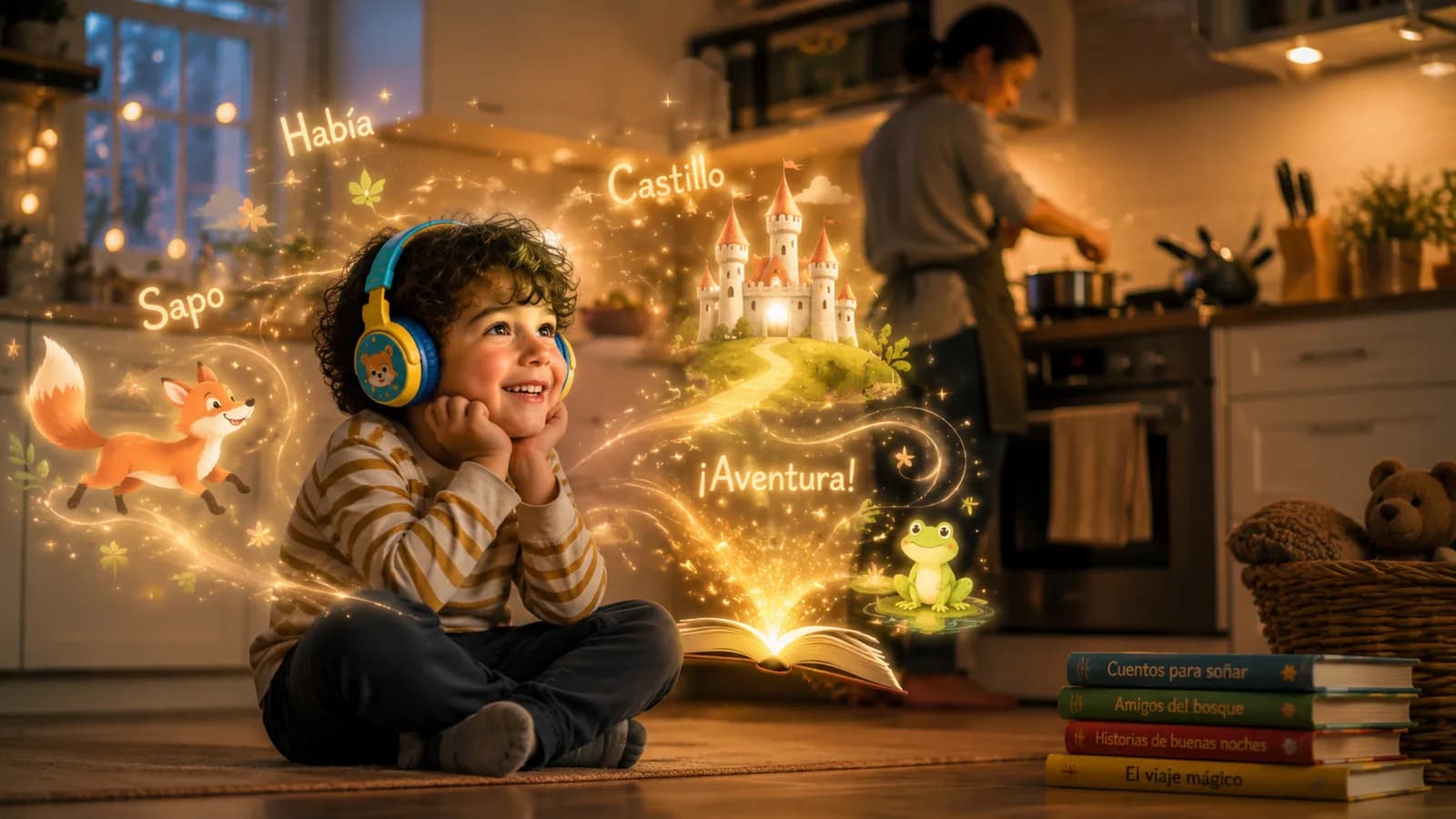
So for the under-twos, the most powerful thing you can do is talk, sing and interact in the target language if anyone in the child's world can — and treat audio as valuable supporting exposure around that, not as a substitute for it. Playing native-speaker stories during calm moments still surrounds your baby with authentic prosody — the rhythm, intonation and cadence of a living language — and helps normalise its sounds. Just don't expect a speaker in the corner of the room to do, on its own, what the research suggests interaction does. Audio's real power ramps up from age three, which is where the next stage comes in.
And if this stage feels like nothing is landing, that is completely normal — and often a little misleading. Plenty of parents play stories for weeks to what looks like total indifference: the baby crawls off, gums the speaker, and shows not a flicker of interest. Then one afternoon, out of nowhere, the same child hums the whole tune of the Spanish song from those stories, perfectly on pitch. The "nothing" was the sound of something going in.
Age 3–4: The Vocabulary Explosion
Something shifts around age three. The child who was absorbing language quietly now reaches for it — rapidly, enthusiastically, with an appetite for new words that can be startling. Questions multiply. Vocabulary that seemed dormant surfaces all at once.
You can hear the filing system at work in the mix-ups. A child who first met butterflies in a Spanish story will sometimes call every butterfly a "mariposa" — in English, to English speakers, apparently for life — and look faintly puzzled that this needs explaining. They are not translating in their head and reaching for the wrong language. They have simply filed the word straight under the thing, no English middleman required, which is exactly how first-language vocabulary gets stored in the first place.
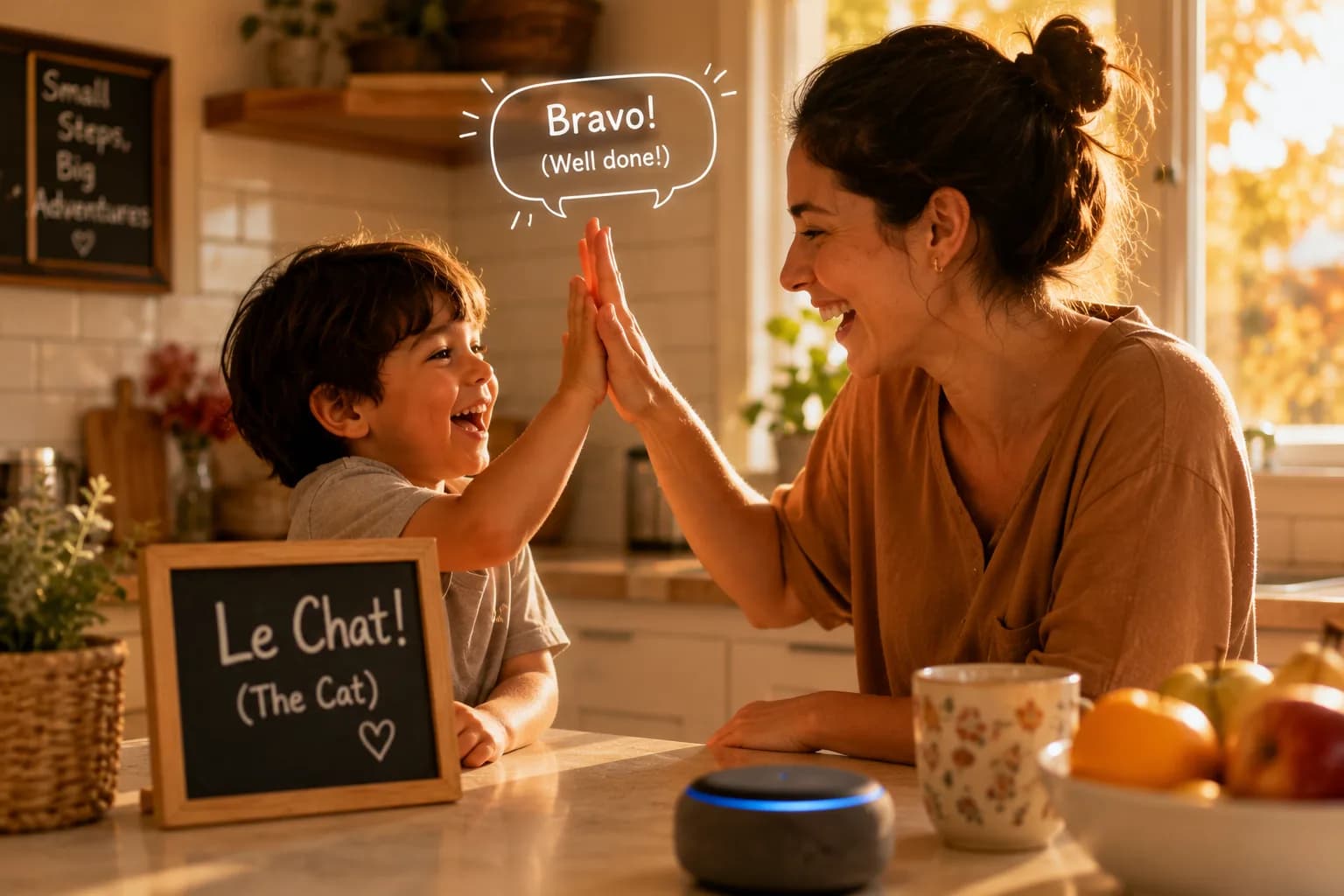
This is where audio immersion starts to pull its full weight, because two things are now true at the same time: the child's sound-mapping is still highly flexible, and they can now attach words to meaning through story. A second language delivered as narrative — characters, repeated phrases, plots a child cares about — gets absorbed the way first-language vocabulary does: not as isolated labels, but as words that belong to someone and something. And the much-maligned demand to hear the same story for the seventh night running is not a failure to move on; repetition is how a three-year-old's brain consolidates the patterns inside it.
This is the stage the same-story, two-language approach is built for — hearing a story first in a language the child already understands, then again in the target language, so the familiar plot carries them into the new sounds. The mechanics of that method, and how to fit it into a daily routine, are covered in the audiobook and habits posts linked at the end.
Age 5–7: The Golden Window for Accent
If one bracket combines a still-flexible ear with real narrative stamina, it is roughly five to seven. Children here retain much of their early phonological sensitivity — their ears can still map new sounds with a flexibility that will not last indefinitely — but they can now follow complex stories, hold characters in mind across episodes, and start noticing how a language is put together.
That combination is what makes this window special specifically for accent. This is the stage at which consistent, high-quality exposure to native-speaker sound tends to produce authentic pronunciation fairly organically, before the extra deliberate effort that accent work takes later. To be clear, this is a point about phonology — it is not what the Hartshorne grammar study measured. The accent window and the grammar window are different things, which is exactly why "the best age" has no single answer.
Any monolingual parent who has attempted the word "croissant" in front of a five-year-old knows the feeling. You give it your gamest, flattest English go; the child, without looking up from their toy, produces the real thing — nasal, effortless, faintly rolled — and carries on playing, mildly embarrassed on your behalf. That small, humbling moment is the whole mechanism in miniature: the child has modelled their pronunciation on the native audio they have been hearing, not on your brave approximation of it.
The practical implication is simple: this is not the age for grammar drills. It is the age to surround a child with language they genuinely enjoy and let the sound system take care of itself.
Age 8–12: Still Absolutely the Right Time to Start
One of the most discouraging myths in children's language learning is that missing the early window means missing the chance. It doesn't. What changes after the early years is not whether a child can learn a language — it's how they learn it best.
Eight-to-twelve-year-olds bring tools younger children simply don't have. They can notice grammatical patterns consciously. They can transfer knowledge from their first language — spotting that Spanish and English share thousands of Latin roots, or that German word order follows rules you can actually reason about. And they can handle richer, more complex stories, which means the vocabulary they meet through listening is deeper and more useful. This analytical strength is a genuine advantage, and it lines up with the Hartshorne grammar finding: the capacity to acquire grammar well is still very much intact at this age.
You can spot it in the errors, which at this age tend to be too logical rather than too random. An eight-year-old will deduce that Spanish adds a regular past-tense ending, apply the rule with complete confidence, and announce that "he goed to the tienda" — a tidy, reasoned mistake a three-year-old would never make, precisely because the three-year-old was not reasoning. The wrongness is the intelligence showing: a brain busy pulling out rules and testing them.
What this age group needs more deliberate support with is accent and pronunciation — which is precisely why authentic native-speaker audio stays valuable here, not just in the early years. Paired with the grammar they're picking up at school, immersive listening at this stage reinforces from a different direction: the classroom supplies the rules, the stories supply the ear.
The Best Age Is the One Your Child Is Now
You can start with a second language as early as possible. What matters across all age groups is the same thing: consistent, high-quality, native-speaker input, delivered through content a child actually loves. Not a streak on a vocabulary learning app or an app that translates. Not a worksheet. But a story they can't wait to hear again and again.
You will know it is working not from a test score but from a small, spontaneous moment: your child narrating their bath toys in Spanish to an audience of nobody, or counting the stairs in French without noticing they have switched, simply because that is the language they happened to learn counting in. That is the real goal — not performance, but a second language quietly folded into an ordinary childhood.
Frequently Asked Questions
Is ten years old too late to start a second language?
No — and the belief that it is may be the most discouraging myth in the field. The window for a native-like accent does narrow after the early years, but a ten-year-old's developing cognition actually speeds up other parts of language learning: they grasp grammar rules faster, transfer knowledge between languages more efficiently, and engage with richer content that carries deeper vocabulary. The route looks different from a toddler's, but genuine fluency remains very much within reach.
Which "window" is everyone talking about — is there really a deadline?
There isn't one deadline, because different parts of a language have different windows. The sound system — accent and the fine distinctions between sounds — is most flexible in the first years and narrows gradually. Grammar, by contrast, stays highly learnable much longer; the large 2018 study by Hartshorne, Tenenbaum and Pinker put the decline as late as the late teens, while noting that reaching native-like grammar favours starting by around ten. So "the best age" depends on which part of the language you're asking about — and for almost every child, the honest answer is that starting now beats waiting.
Does it matter if my child ends up with an accent?
For communication, a flawless native accent isn't the goal and shouldn't be treated as one. What helps most is that a child's ear is calibrated early to the authentic sounds of the language — which is why native-speaker narration is more useful than robotic text-to-speech or a parent approximating sounds they don't speak. Children who get consistent native-speaker exposure early tend to develop a more authentic ear and clearer pronunciation, though speaking practice, not listening alone, is what ultimately shapes how they sound.
My baby is under two — is audio actually doing anything yet?
Yes, but with a caveat worth knowing. At this age your child is absorbing the rhythm and sound patterns of whatever language fills the room, which lays useful groundwork. The caveat: research on infants suggests live, interactive exposure does far more for sound-learning than recordings do on their own. So, if anyone around your baby can talk or sing in the target language, that is the most valuable input — with audio playing a strong supporting role. From age three, audio stories move to centre-stage.
Can listening alone teach my child a second language?
Listening is the foundation — every child understands language before they produce it — and native-speaker audio delivers vocabulary, prosody and emotional context that flashcards and grammar exercises can't. But "foundation" is the operative word. For the youngest children, interaction amplifies it; for school-age children, some speaking practice and light structural work build on top of it. Rich listening is where an effective approach starts, not the whole of it.
Related reading:
Tags
Related Posts
All posts
Language Learning
Cocoloops vs Language Learning Apps: Why Stories Beat Flashcards
Language Learning
How Audiobooks Help Children Learn a Foreign Language Faster
Language Learning
How Stories from Other Cultures Make Children More Empathetic and Open-Minded
Newsletter
Get new stories & tips in your inbox
Parenting tips, audiobook picks, language learning — weekly.
