At What Age Should Children Start Listening to Audiobooks?
Quick Answer
Children can begin benefiting from audiobooks from as young as 18 months. Ages 3 to 5 is the developmental sweet spot, when attention span, working memory, and language absorption combine most powerfully for story-based learning. Children continue to gain distinct, stage-specific benefits from audiobooks through age 12 and beyond.
It's almost bedtime. You press play on a story, and within thirty seconds your toddler has wandered off to stack blocks, inspect the dog, and chase a shadow across the room.. You know the drill and now you wonder if they're too young for audiobooks—or simply not interested. The answer surprises most parents.
The instinct to wait — to hold off on audiobooks until a child seems "ready," until they can sit still and focus — is understandable. It is also, according to the developmental science, based on a significant underestimation of what young children's auditory systems are already doing.
Young children are not waiting to develop language. They are actively building it — mapping phonemes, absorbing rhythm, internalising prosody — from the earliest weeks of life. The question is not whether your child is ready to benefit from audiobooks. It is understanding what "benefit" looks like at each stage of development, and matching the format and expectation to where your child actually is.
Why Age Matters for Audiobook Readiness
Listening to an audiobook might sound simple, but your child's brain is actually coordinating several remarkable skills at once: working memory, which holds the thread of a sentence while the next one arrives; narrative comprehension, which tracks character, cause, and consequence across time; auditory attention, which sustains focus on a single sound source; and imaginative construction, which builds a mental picture from words alone.
These capacities develop at different rates and in a broadly predictable sequence. If your eighteen-month-old walks away halfway through the story, don't worry. Their brain is still listening in ways you can't yet see, but what their brains are doing with that audio is fundamentally different, and the format, length, and content of the audiobook needs to match the cognitive stage, not some idealised vision of what listening "should" look like.
Understanding these developmental milestones removes the pressure entirely. You are not trying to turn a two-year-old into a focused student. You are providing the right type of audio input for where their brain is right now — and trusting that the brain will do exactly what it evolved to do with it.
Ages 18 Months – 2 Years: The Sound Bath Stage
If you play an audiobook for a child under two and they wander around the room, stack blocks, try to touch the speaker, and appear to be paying no attention whatsoever — everything is working exactly as it should.
At this age, children are not yet able to follow narrative structure. Their working memory cannot hold a story thread across multiple sentences, and their capacity for sustained focused attention on any single stimulus is genuinely brief. None of this means audiobooks are without value at this stage. It means the value is operating at a different level than you might expect.
What infants and toddlers under two are doing with audiobook audio is phonemic mapping, basically their brain is learning the sounds and rhythm of the language. Every time a native speaker's voice fills the room, a young child's auditory cortex is registering the phonemes, rhythm patterns, intonation curves, and acoustic texture of that language. This is the same process through which they are simultaneously acquiring their first language — and it proceeds through passive exposure long before it becomes visible in speech.
For this age, choose audiobooks that are short — under five minutes is ideal — highly musical, and built on strong repetition. The melody and rhythmic structure provide a scaffold that helps very young listeners track the audio even when narrative comprehension is not yet available. Content that features recurring phrases, sound patterns, and simple vocabulary repeated across a story gives the phoneme-mapping process the clearest possible input to work with.
Playing Cocoloops stories softly during daily routines — feeding, bath time, falling asleep — is an entirely appropriate and neurologically productive use of the platform at this stage. You are not expecting comprehension. You are providing a phonemic environment.
Ages 3–5: The Sweet Spot
If there is a single age window that combines the broadest neurological opportunity with the greatest practical enthusiasm for story-based listening, it is ages three to five.
Around age three, several cognitive developments converge in a way that makes audiobook engagement genuinely transformative. Working memory expands enough to hold a simple beginning-middle-end narrative across fifteen to twenty minutes. Vocabulary is in a rapid acquisition phase — new words appear almost daily, and the appetite for language is at one of its highest points in childhood. Crucially, children this age develop a deep love for story structure and repetition that adults often mistake for boredom but is actually the primary mechanism of neurological consolidation.
A three-year-old who asks to hear the same story for the seventh consecutive evening is not failing to engage with new content. They are doing exactly what their developing brain needs: reinforcing the phonological patterns, vocabulary, and narrative structure of that story until it is encoded deeply enough to serve as a foundation for the next layer of learning.
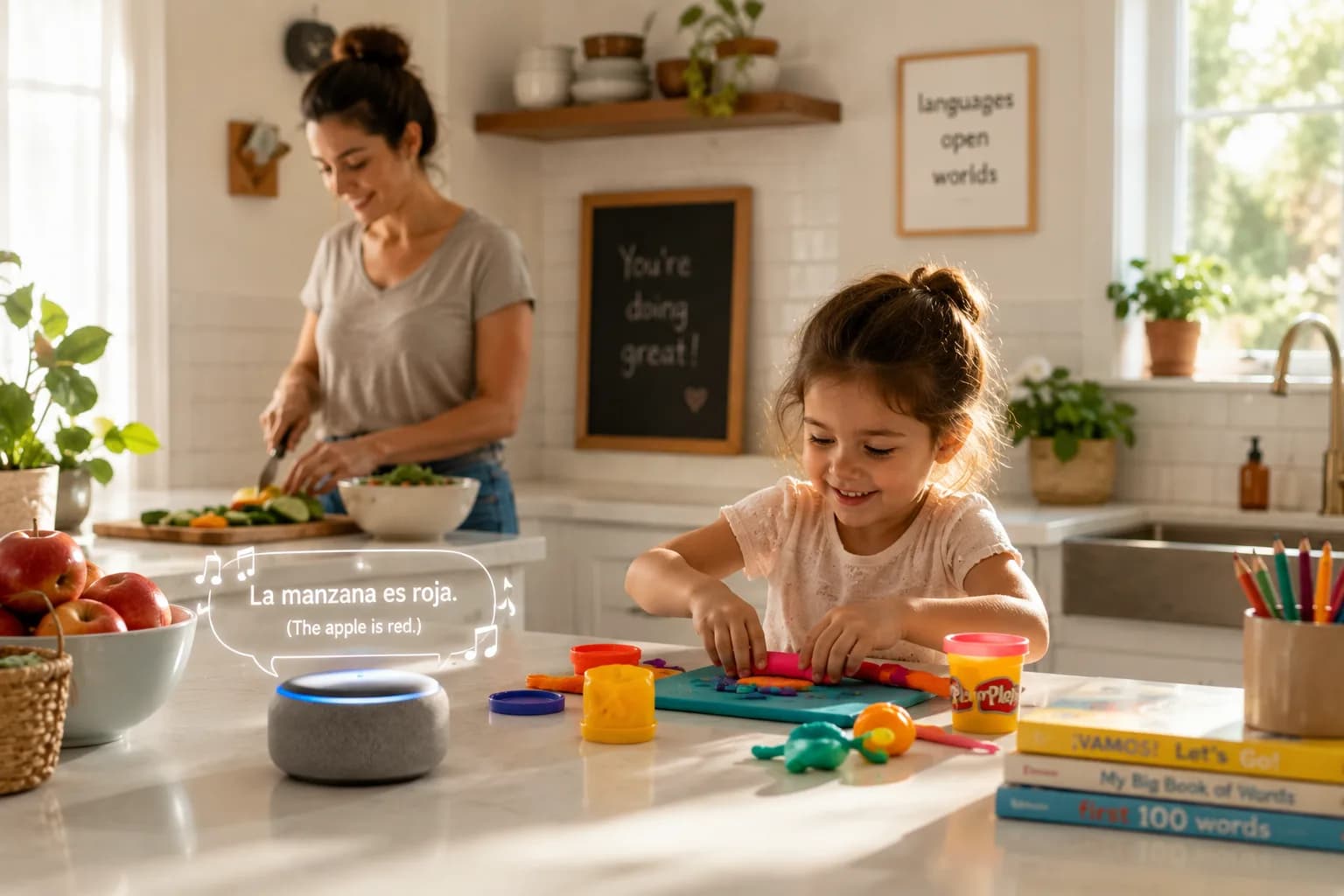
This is the age group that Cocoloops is most centrally designed for. The platform's same-story multilingual format — hearing a story in English first, then in the target language — works with particular power at this stage because the child's emotional investment in the characters and plot provides a complete comprehension scaffold for the new language. They are not studying Spanish. They are finding out whether the little dog makes it home — and the Spanish happens to be the language the story is told in this time.
Aim for fifteen to twenty minutes of daily listening at this age, anchored to an existing routine. Bedtime, the car journey, quiet time after lunch — any consistent daily slot works. The consistency matters more than the duration.
Ages 6–9: Chapter-Ready
As children enter primary school, their cognitive stamina for sustained listening increases significantly. They are transitioning from simple linear narratives to stories with multiple characters, subplot threads, and more complex emotional arcs — and their appetite for narrative complexity grows alongside their capacity to process it.
One of the most powerful and underused aspects of audiobooks at this age is the vocabulary gap, This is why many children understand stories they couldn't yet read on their own. A seven-year-old's reading level — limited by the mechanical demands of decoding written text — typically lags significantly behind their listening comprehension level. A child who can only physically read phonetic readers can follow and deeply enjoy a rich, complex audio adventure with vocabulary far above their reading grade. Audiobooks unlock a level of language exposure at this age that reading alone cannot yet provide.
For second language learning specifically, this gap is a major advantage. When a six or seven-year-old listens to a Cocoloops story in French that they already know in English, they bring a fully d comprehension of the narrative to the new language. They use the plot, the character relationships, and the emotional beats as context clues to decode unfamiliar vocabulary in real time — which is precisely the active, contextualised acquisition process that produces durable language learning rather than rote memorisation.
At this age, introduce slightly longer listening sessions — twenty to thirty minutes — and begin varying the stories rather than relying exclusively on repetition of favourites. The developing brain at this stage is ready for novelty alongside consolidation.
Ages 10–12: Independent Listeners
This is often the age when language stops being "something Mum and Dad wanted" and starts becoming something children genuinely enjoy themselves.
By the time children reach double digits, audiobook listening can transition from a family activity guided by parents to a genuinely self-directed practice. Pre-teens have the cognitive maturity to follow multi-chapter story arcs, track long-term character development across listening sessions, notice grammatical patterns in a second language, and make active comparisons between how the same story feels in different languages.
For families using Cocoloops for heritage language preservation or second language development, this is when the platform becomes something the child can meaningfully own. A ten or eleven-year-old can browse the library independently, choose stories that match their interests, select their target language, and build a personal listening habit without parental orchestration.
This self-direction is not just practically convenient — it is developmentally important. Pre-teens who experience language learning as something they choose and control, rather than something imposed on them, develop the intrinsic motivation that sustains bilingual development through adolescence and into adulthood. The goal at this stage is to provide the content and step back.
Choosing the Right Audiobook for Each Age
Selecting the wrong content — too simple, too complex, too long, too fast — is the most common reason children resist audiobooks. Here is a practical guide to matching content to developmental stage.
Length: Under five minutes for children under two. Ten to fifteen minutes for ages three to four. Fifteen to twenty-five minutes for ages five to eight. Up to forty-five minutes for ages nine to twelve. These are starting points — individual children vary considerably, and a child's engagement on a given day is always the most reliable guide.
Narrative complexity: Under-twos need musical repetition and simple recurring patterns. Three-to-five-year-olds need a clear beginning, middle, and end with a single protagonist and a straightforward goal. Six-to-nine-year-olds are ready for multiple characters, subplot threads, and mild suspense. Ten-to-twelve-year-olds can handle genuine complexity — moral ambiguity, extended character development, layered plots.
Narrator pace: A rapid, high-energy narrator voice appropriate for an older child will overstimulate a three-year-old and undermine both engagement and comprehension. For younger children especially, look for narrators with a warm, measured cadence — unhurried, expressive, and clearly articulated. Cocoloops stories are narrated with age-appropriate pacing calibrated to each developmental stage.
Subject matter: Anchor the entry point in the familiar before moving to the abstract. Animals, bedtime, family, food, and the immediate physical world are the most accessible starting themes for young children. Fantasy, science, adventure, and cultural exploration open up naturally as comprehension and attention span develop.
The Cocoloops library is organised by age bracket and developmental stage precisely to remove this guesswork from the parent's decision.
Conclusion: Start Where Your Child Is Tonight
The perfect age isn't someday. It's the age your child is today.
You do not need to wait for your child to develop a perfect attention span, an ability to sit still, or a demonstrated interest in stories before beginning. The neurological benefit of native-speaker audio exposure begins in infancy and compounds across every year of childhood that follows.
Wherever your child is right now — squirming toddler or self-directed pre-teen — there is a Cocoloops story calibrated for exactly where they are.
Explore the age-filtered Cocoloops library and start a free story today →
Frequently Asked Questions
Is eighteen months too young to start audiobooks, or should I wait until my child is older?
Eighteen months is not too young — it is a genuinely productive time to begin, provided your expectations are calibrated correctly. Children under two are not following plot or building narrative comprehension from audiobooks. They are receiving phonemic exposure — absorbing the sound patterns, rhythm, and intonation of the language being spoken. This early acoustic mapping is neurologically valuable and lays the foundation for all subsequent language development. You are not expecting your eighteen-month-old to listen attentively. You are giving their auditory cortex rich, authentic input to work with during one of the most plastic periods in their brain's development.
How long should my child listen to audiobooks each day?
Consistency matters more than duration at every age. Fifteen to twenty minutes of daily listening produces significantly stronger long-term outcomes than a ninety-minute session once a week, because language acquisition relies on spaced repetition — the brain consolidates patterns between exposures rather than during a single long one. For toddlers, even five to ten minutes of ambient audio exposure during daily routines provides meaningful phonemic input. For school-age children, fifteen to twenty-five minutes anchored to an existing habit — the school run, quiet time, bedtime — is an effective and sustainable daily target.
My child cannot sit still for audiobooks. Should I wait until they can?
Not at all. — and the expectation that listening requires stillness is itself the most common barrier parents create unnecessarily. For young children especially, physical movement during listening is entirely normal and often enhances rather than reduces engagement with the audio. A child drawing, building, or moving around the room while a story plays is still receiving the acoustic input — and the relaxed physical activity may actually support the kind of low-pressure receptive state in which language absorption is most effective. Provide something for their hands to do and let the story play.
What is the difference between what a three-year-old and a seven-year-old get from the same audiobook?
Significantly different things, which is why age-appropriate content selection matters. A three-year-old listening to a story is primarily absorbing phonemes, rhythm, vocabulary attached to narrative context, and the emotional texture of the narrator's voice. They are building the phonological and lexical foundation of the language. A seven-year-old listening to the same story brings grammatical intuition, a larger existing vocabulary, narrative comprehension skills, and the ability to make structural comparisons between languages. They are building depth and complexity on a foundation already in place. This is why Cocoloops calibrates story complexity, narrator pacing, and thematic content separately for each age bracket.
Can audiobooks replace reading for language development, or do children still need books?
Audiobooks and physical books develop overlapping but distinct skill sets, and the strongest outcomes come from both. Audiobooks develop listening comprehension, phonological sensitivity, vocabulary in context, and — critically — exposure to native-speaker prosody that reading alone cannot provide. Physical books develop print awareness, phonics, decoding skills, and the visual processing of written language. For second language development specifically, audiobooks are often more valuable than reading in the early stages because they provide the authentic spoken language input that the brain uses to map the sound system of the new language — a prerequisite for reading in that language with genuine comprehension rather than mechanical decoding.
Related reading:
Tags
Related Posts
All postsParenting Tips
Independence Day 2026: Hindi Stories, Activities & 80th Independence Day Ideas for Kids
Parenting Tips
7 Real Ways Parents Use Cocoloops to Build a Language Learning Daily Routine for Kids
Parenting Tips
Signs Your Child Has a Language Delay — And How to Support Them at Home
Newsletter
Get new stories & tips in your inbox
Parenting tips, audiobook picks, language learning — weekly.
