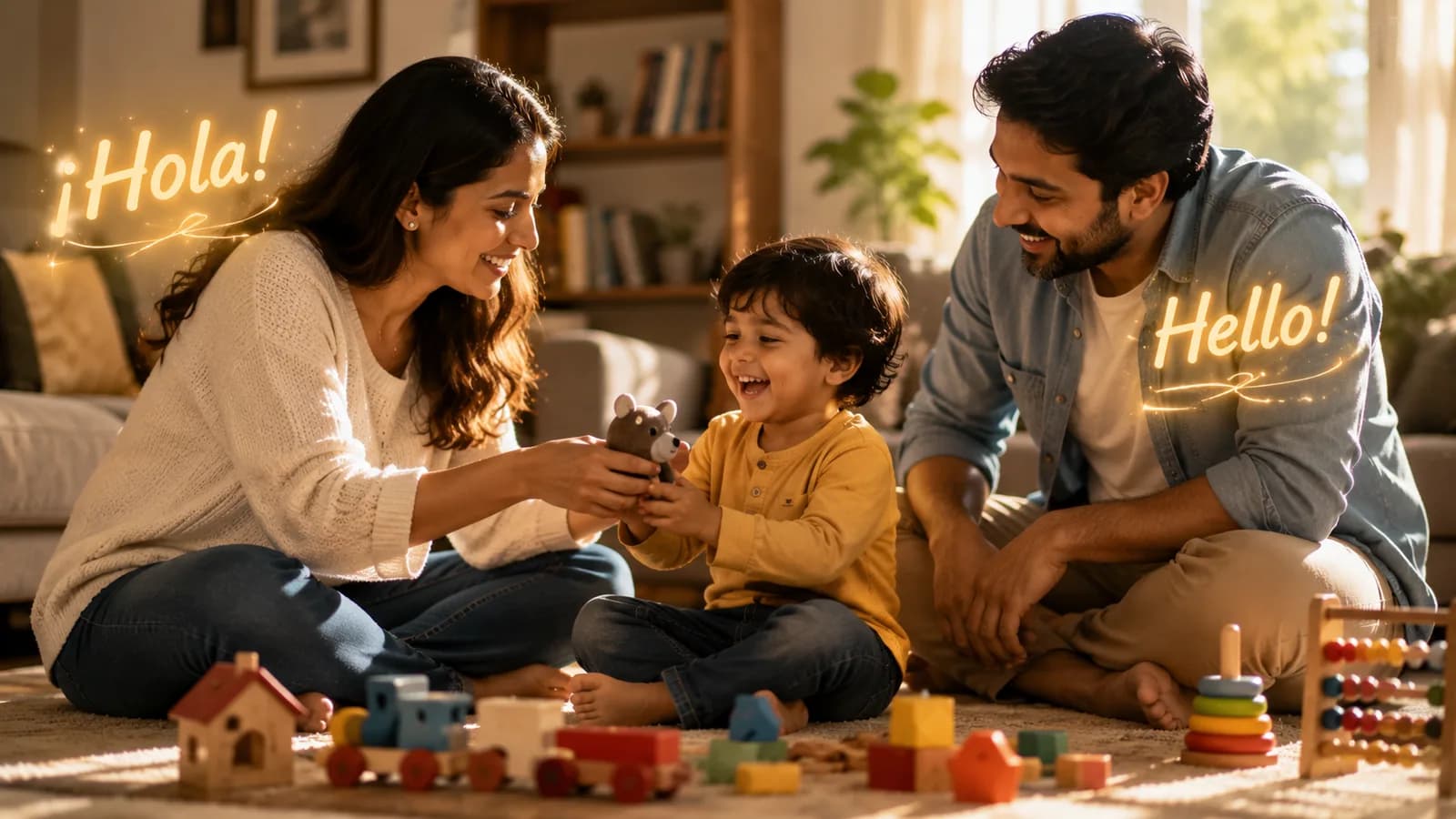
Will Bilingualism Confuse My Child? 5 Myths Busted by Science
The short answer is no. Decades of peer-reviewed research across neuroscience, linguistics, and developmental psychology have reached a consistent conclusion: a child's brain is not confused by two languages. It can provide important cognitive, linguistic, and cultural benefits.
But the fear that bilingualism will confuse your child — that it will cause speech delays, scramble their development, or put them behind their peers — is the single most common reason parents hesitate to start. It is deeply understandable, it is extremely persistent, and it is almost entirely wrong.
Here is where the myth came from, what the science actually says, and what you can watch for if you have genuine concerns about your child's language development.
Where the 'Confusion' Myth Actually Came From
To understand why this fear is so deeply embedded in parenting culture, you need to rewind about a hundred years.
In the early twentieth century, some influential early studies conducted a series of intelligence and language assessments on bilingual children and reported alarming findings: bilingual children scored lower on tests, appeared academically delayed, and seemed cognitively disadvantaged compared to their monolingual peers. These conclusions were published, circulated, and gradually hardened into received wisdom — the idea that exposing a child to two languages simultaneously was a developmental risk.
There was one major methodological limitation. The researchers were testing newly arrived immigrant children — children who were living in poverty, processing the trauma of displacement, adjusting to an entirely new cultural environment, and being assessed exclusively in English: a language they had barely begun to learn. The tests were administered in the children's weakest language, under conditions of significant stress, and the results were interpreted as evidence of bilingual confusion rather than what they actually reflected: the entirely predictable underperformance of children being tested in a language they did not yet speak.
By the time modern neuroscience comprehensively debunked these studies in the 1960s and 1970s, the "bilingual confusion" myth had already embedded itself in global parenting culture — passed from generation to generation as common sense. It persists today not because it has scientific support, but because it got a century's head start on the truth.
Here is what the evidence actually shows, myth by myth.
Myth 1: Bilingual Children Develop Speech Later
Verdict: FALSE
This is the most widespread and most damaging myth on the list. It is also among the most thoroughly disproven.
Groundbreaking research by Dr. Barbara Pearson and colleagues at the University of Miami examined vocabulary acquisition in bilingual infants and toddlers directly. Their findings were clear: while a bilingual toddler may have a slightly smaller vocabulary in each individual language compared to a monolingual peer, their total conceptual vocabulary — words and concepts across both languages combined — generally falls within expected developmental ranges.
Consider what this means practically. A child who knows twenty words in English and thirty words in Spanish has mapped fifty distinct concepts. Their brain is not behind — it is managing vocabulary across two language systems simultaneously. in the background, distributing the same cognitive load across two systems rather than one. Measuring only one language and comparing it to a monolingual child's full vocabulary is like measuring one lung's output and concluding the person has a breathing disorder.
The American Academy of Pediatrics confirms this position: bilingualism does not cause speech delays in typically developing children. If a bilingual child shows a genuine speech delay, the cause is developmental, not linguistic — and it would be present in both languages regardless of how many they are learning.

Myth 2: Code-Switching Means Your Child Is Failing
Verdict: FALSE
If your child runs up to you mid-sentence and says "I want more leche" — mixing English and Spanish in a single breath — your instinct might be to worry. It can look, from the outside, like confusion: like the two languages are tangled together rather than cleanly separated.
Linguists call this code-switching, and it is not a sign of confusion. It is a sign of sophisticated cognitive flexibility.
When a bilingual child code-switches, they are not scrambling their languages randomly. Their brain is rapidly scanning two complete linguistic databases, identifying the word that is most efficiently accessible or contextually appropriate in that moment, and inserting it seamlessly into the grammatical framework of the sentence they are constructing. It is a an efficient and natural linguistic process, a normal feature of bilingual communication.— not unlike a skilled writer reaching for the most precise word across two languages rather than settling for an adequate one in one.
Research in cognitive linguistics confirms that code-switching is a marker of bilingual competence, not bilingual failure. Children who code-switch are demonstrating that they have sufficient command of both languages to move between them fluidly. As their proficiency in each language deepens and the contexts in which each is appropriate become clearer, code-switching typically reduces naturally — without any intervention required.
Myth 3: You Need to Be Fluent to Raise a Bilingual Child
Verdict: FALSE
Many parents assume that if they cannot speak the target language fluently themselves, they will do more harm than good — that a non-native accent or imperfect grammar will confuse their child, or imprint errors that are difficult to undo.
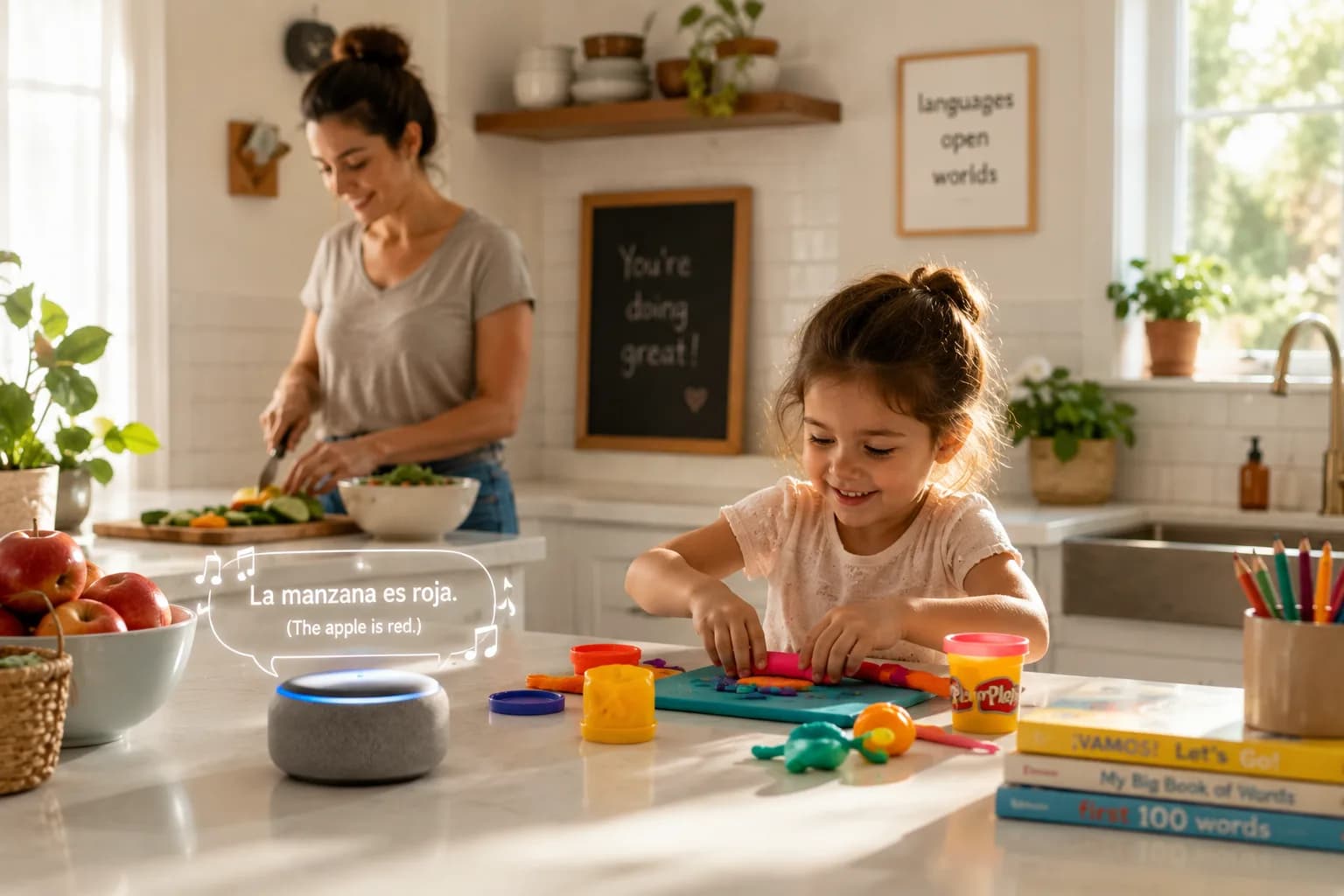
This concern, while understandable, misunderstands how children acquire language. Children do not need a parent to be their language teacher. They need consistent, comprehensible exposure to the target language in a context that makes sense. The source of that exposure does not have to be a parent. It can be a grandparent, a community, a school — or high-quality native-speaker audio content.
Research on language acquisition consistently shows that children are highly responsive to consistent, high-quality language input from proficient speakers. If a child regularly hears French narrated by a native French speaker — even if their parent's French is limited — they will model their accent and prosody on the native speaker, not on the parent's approximation. The parent's role is not to teach the language. It is to curate the environment in which the language is heard.
This is the principle that makes audio immersion platforms effective for non-native parents. Consistent native-speaker audio, delivered through stories the child genuinely engages with, provides the phonological model and comprehensible input that drives acquisition — with no fluency required from the parent at all.
Myth 4: Bilingualism Causes Language Disorders
Verdict: FALSE
This is the highest-stakes myth on the list, and it causes enormous anxiety — particularly for parents of children who are neurodivergent or who have been flagged for speech and language assessment.
The American Speech-Language-Hearing Association (ASHA) is unambiguous on this point: bilingualism does not cause, trigger, or worsen autism spectrum disorder, dyslexia, speech-language disorders, or any other developmental condition. This position is shared by the UK's National Health Service (NHS) and by the broad international consensus in paediatric speech pathology.
If a child has a genuine underlying language disorder, that disorder is neurological in origin. It will manifest across both languages — not because of the bilingual exposure, but because the underlying condition affects language processing regardless of how many languages are being learned. Removing the second language does not treat the disorder. It only removes a source of cultural connection, cognitive enrichment, and family belonging without addressing the root cause.
ASHA's clinical guidance explicitly advises against recommending that families drop a heritage or home language in response to a child's speech delay. Early intervention, conducted with a qualified paediatric speech-language pathologist, is recommended — and that intervention should proceed alongside, not instead of, continued bilingual exposure.
Myth 5: Older Children Will Be Permanently Behind
Verdict: FALSE
The idea that a child who has not started a second language by age five or six has already missed their chance is both inaccurate and unnecessarily discouraging. What changes after the early childhood phonological window is not the ability to learn a language — it is the primary mechanism through which certain aspects of it are most easily acquired.
Children aged eight and above bring a significant cognitive advantage to language learning that toddlers do not have: they already understand how language works. They grasp tense, sentence structure, and grammatical abstraction in their native language, and they can apply that existing blueprint to accelerate the structural acquisition of a second one. Older children often reach conversational fluency and grammatical competence faster than younger children precisely because their analytical capacity is more developed. Older children often benefit from stronger analytical and literacy skills, which can support certain aspects of language learning.
What older children benefit from most is structured, high-quality audio input that delivers both comprehensible narrative content and authentic native-speaker prosody — providing the immersive exposure that their more analytical learning style can then actively process and consolidate.
What the Science Actually Says: Quick Reference Table
| Myth | Verdict | Source |
|---|---|---|
| Bilingual children develop speech later | FALSE — combined vocabulary meets developmental norms | Dr. Barbara Pearson, University of Miami |
| Code-switching means confusion | FALSE — it is a marker of cognitive flexibility | Cognitive linguistics research |
| You need fluency to raise a bilingual child | FALSE — consistent native audio input is sufficient | Language acquisition research |
| Bilingualism causes language disorders | FALSE — no causal link established | ASHA / NHS clinical guidance |
| Older children are permanently behind | FALSE — older learners have distinct cognitive advantages | Developmental linguistics research |
How to Know If Your Child Actually Needs Support
Because normal bilingual development includes a "silent period" of active listening before speaking, occasional code-switching, and vocabulary that may appear smaller in one language when measured in isolation, it can be genuinely difficult for parents to distinguish typical bilingual development from a genuine language concern.
The developmental milestones to watch are these: by twelve months, your child should be babbling and responding to their name consistently. By sixteen months, they should be using at least a few words — in either language, not necessarily both. By age two, they should be combining at least two words into simple phrases. By age three, speech should be intelligible to familiar adults most of the time, and sentences should be forming across daily communication.
If your child is not meeting these milestones — or if they appear to be losing language skills they previously had, which is known as regression — do not attribute it to the bilingual exposure and do not drop the second language as a first response. Contact a paediatric speech-language pathologist. A qualified therapist will assess both languages separately, distinguish between typical bilingual patterns and genuine delays, and — in line with ASHA guidance — will almost certainly encourage you to maintain the bilingual environment throughout any intervention.
Early support, when it is needed, works best alongside bilingualism rather than instead of it.
Conclusion: Your Child's Brain Was Built for This
The science is clear, consistent, and has been for decades. A large body of research now supports the conclusion that bilingualism does not confuse children rather It challenges them in the most productive way a developing brain can be challenged — supporting flexible thinking, communication skills, and cultural connection.
Your child's brain is not going to short-circuit because you pressed play on a French story. It is going to do exactly what it was designed to do: listen, map, absorb, and grow.
Explore the Cocoloops library and start your child's first story tonight →
Frequently Asked Questions
Is it normal for a bilingual child to mix languages in the same sentence?
Yes — completely normal, and actually a positive sign. Code-switching, the practice of moving between two languages within a single conversation or sentence, is well-documented in bilingual children and adults. It reflects cognitive flexibility and active command of both language systems, not confusion or failure. Children typically code-switch less as their proficiency in each language deepens and the social contexts for each become clearer. No intervention is needed; the pattern resolves naturally with continued exposure.
My child had a speech delay — should I stop the second language?
No. The American Speech-Language-Hearing Association explicitly advises against dropping a second language in response to a speech delay. If a child has an underlying language disorder, it is neurological in origin and affects both languages — removing one language does not treat the disorder and removes genuine developmental and cultural benefits without any compensating gain. Work with a qualified paediatric speech-language pathologist, who will assess both languages separately and support bilingual development as part of any intervention plan.
How long does the silent period last in bilingual children?
The silent period — the phase in which a child actively absorbs a second language without yet producing it — is entirely normal and can last anywhere from a few weeks to several months (although the duration varies considerably), depending on the age of the child, the frequency of exposure, and the individual child's temperament. During this period, comprehension is developing even when speaking is not. Parents sometimes interpret silence as evidence that the language is not landing, when in fact the opposite is true. Consistent daily exposure during this period is especially important, because it is when the phonological and vocabulary foundations are being quietly laid.
Can a child learn a language purely through audio stories, without any speaking practice?
Listening is the foundation of all language acquisition — every child learns to understand language before they learn to produce it, and production develops as a natural consequence of sufficient comprehensible input. Audio stories deliver the vocabulary, prosody, and contextualised language that build this foundation. Speaking practice, conversation, and formal instruction are valuable additions as a child's listening competence develops — but they build on the audio foundation rather than replacing it. For young children especially, rich listening input is the most developmentally appropriate starting point.
What should I do if family members criticise my decision to raise a bilingual child?
This is more common than many parents expect, and the criticism typically reflects the persistence of the myths addressed in this article rather than any genuine scientific concern. The most effective response is simply the evidence: multiple decades of peer-reviewed research across neuroscience, developmental psychology, and clinical linguistics which strongly supports bilingual child-rearing in typical developmental contexts. If the concern is specifically about speech delays or confusion, the position statements of ASHA and the NHS are publicly available and clearly worded. You are not taking a risk with your child's development. You are giving them one of the most well-evidenced cognitive and cultural advantages available in early childhood.
This article is intended for general informational purposes and does not substitute for professional medical or speech-language pathology advice. If you have concerns about your child's development, please consult a qualified healthcare provider.
Related reading:
Tags
Related Posts
All posts

Newsletter
Get new stories & tips in your inbox
Parenting tips, audiobook picks, language learning — weekly.
