
Signs Your Child Has a Language Delay — And How to Support Them at Home
If you stand in a valley and watch a gentle river flow over solid rock, it does not look like much is happening. The rock seems unchanged. But underneath the surface, at a microscopic level, that steady water is actively carving an entire canyon. The progress is enormous. It is just temporarily invisible to the naked eye.
Language development in early childhood works exactly like this.
As a parent, you pour words, stories, lullabies, and conversations into your child every single day. And when months pass and your toddler is still not speaking as much as the children at the playground, a very specific, heavy anxiety sets in. You look at the surface and think: it is not working. Is my child falling behind? Do they have a language delay?
Before you go further — take a breath. The range of what is normal in early childhood language development is far wider than most parenting content acknowledges, and a large proportion of children who worry their parents in the toddler years go on to develop rich, full language without any intervention at all. This article will help you understand the clinical milestones, recognise the specific signs that genuinely warrant a professional conversation, and — most importantly — understand what you can do at home to support your child's language growth right now, regardless of where they are on the developmental spectrum.
A Note Before We Start: Normal Variation Is Wide
The first and most important thing to understand about child language development is how extraordinarily varied the normal range is.
Some children speak in full, structurally complex sentences before their second birthday. Others are quiet, observant children who absorb enormous amounts of language in apparent silence and then begin speaking in complete sentences seemingly overnight at age three. Both of these children are within the normal range. In other words, children do not all follow the same timeline—and that's often completely normal.
If you are raising a bilingual child, the picture looks even more complex — and this complexity is frequently and unnecessarily misread as a warning sign. A bilingual child's language is distributed across two developing systems rather than one. Their individual-language vocabulary at any given age may appear smaller than a monolingual peer's, while their combined conceptual vocabulary is perfectly on track. The bilingual silent period — a phase in which a child who has been exposed to a new language temporarily reduces their speaking output while their brain focuses entirely on auditory processing and decoding — is a normal and productive developmental phase, not a sign of delay.
Knowing the clinical milestones does not mean measuring your child against them with anxiety. It means having the information to distinguish between the wide variation of typical development and the specific patterns that genuinely benefit from professional attention.
Age-by-Age Language Milestones: Birth to Age 5
Milestones are helpful guideposts—but they don't tell the whole story.
The following milestones are used by speech-language pathologists as general developmental markers. They are not strict deadlines, and individual children vary considerably within the normal range. For bilingual children, assess combined vocabulary across both languages rather than either language in isolation.
| Age | What Typical Development Looks Like | What You Might Notice at Home |
|---|---|---|
| 12 months | Babbling with varied inflection that sounds like speech. Turning consistently to their name. Using 1–3 recognisable words such as "mama," "dada," or "no." | They seem to hold conversations in babble, with real rise and fall in their voice. They look up when you call them across the room. |
| 18 months | Using 10–20 recognisable words. Pointing to objects and pictures they want. Following simple one-step instructions ("Get your shoes"). | They point at things constantly — to request, to share, to draw your attention. Their word list is growing noticeably week by week. |
| 24 months | Using 50 or more words. Beginning to combine two words ("More milk," "Big dog," "Daddy go"). Pointing to body parts when named. | Speech is imperfect but purposeful. They are communicating wants and observations with increasing clarity. |
| 36 months | Using three-word sentences regularly. Vocabulary of 200 or more words. Strangers can understand their speech approximately 75% of the time. | They narrate what they are doing during play. They ask "why" questions. They refer to things that are not immediately present. |
| 4–5 years | Telling short stories with a recognisable beginning, middle, and end. Using adult-like grammatical structures. Strangers can understand them nearly 100% of the time. | They can describe a past event in sequence. They engage in genuinely back-and-forth conversation. They correct their own speech errors spontaneously. |
Bilingual Children and Language Milestones: What Is Different
If your child is developing language in two languages simultaneously, the milestone framework above applies — but the way you apply it matters enormously.
The most important adjustment is to assess vocabulary across both languages combined, not within each language separately. A child who knows twelve words in English and fifteen words in Spanish at eighteen months has a combined vocabulary of twenty-seven words — well within the typical range for that milestone. Measuring only their English vocabulary and comparing it to a monolingual English-speaking peer's full vocabulary will produce a false picture of delay where none exists.
Several other patterns are common in bilingual language development and are frequently — and unnecessarily — mistaken for warning signs.
The silent period is a normal phase that many children go through when significantly increasing their exposure to a second language. They may temporarily reduce their speaking output, sometimes dramatically, while their brain redirects cognitive resources toward auditory processing and decoding of the new language. This phase typically lasts weeks to a few months and resolves naturally. It is the water carving the canyon — invisible on the surface, productive underneath.

Code-switching — mixing languages within a single sentence or conversation — is not confusion or failure. It is a marker of bilingual competence and cognitive flexibility. Children code-switch deliberately, selecting the most accessible or contextually appropriate word across their two languages. It reduces naturally as proficiency deepens in both languages.
Uneven language development across the two languages is entirely normal and reflects the difference in exposure and opportunity to use each language. The language your child hears and uses most will typically develop faster. This is not a problem to fix — it is a natural consequence of living in a particular linguistic environment, and it adjusts as exposure adjusts.
Signs That May Warrant a Professional Conversation
While the range of normal variation is wide, there are specific patterns that developmental science and clinical guidance identify as genuinely worth discussing with a professional. The following markers, drawn from guidance published by the American Speech-Language-Hearing Association (ASHA) and the UK's National Health Service (NHS), indicate that a speech-language assessment would be valuable.
- By 12 months: No babbling with varied inflection. Not turning consistently to their name when called. No pointing or gesturing to communicate needs or share attention with you.
- By 16 months: No recognisable single words in either language (for bilingual children).
- By 24 months: No spontaneous two-word combinations in either language. Note: only repeating words or phrases they have heard (echolalia) without using language spontaneously to communicate does not count as meeting this milestone.
- By 36 months: Speech that familiar adults cannot understand more than half the time. Very limited vocabulary. No two-word combinations.
- At any age: A regression — a child losing language skills or social engagement they previously demonstrated. This is the most significant pattern on this list and warrants prompt professional attention regardless of the child's age.
If your child reaches any of these markers, the appropriate response is not alarm. It is action. An assessment is simply a baseline — a professional look at where your child is and what tools would help them most. The earlier that assessment happens, the more effectively any support can be targeted.
What You Can Do at Home to Support Language Development
Whether your child has received a formal diagnosis, is showing some signs worth monitoring, or simply needs encouragement, the home environment is the most powerful language support tool available. These strategies are evidence-based, practical, and require no specialist training to implement.
Children learn words best when they are attached to real life and not isolated lessons. Provide a running commentary of what you and your child are doing as you move through the day. "I am getting the blue bowl. Now I am pouring the cold milk in. Can you see the milk?" This floods the child's environment with contextual vocabulary — words attached to real objects, real actions, and real situations — which is the type of language input that produces the most durable acquisition.
Minimise competing background noise during interaction. Young brains, and particularly children with language processing difficulties, struggle to filter speech from background noise. When you are playing with your child or trying to communicate with them, turn off the television, radio, or adult podcasts. Clear auditory conditions allow them to hear the distinct sounds of speech without the cognitive cost of filtering out competing input.
Use the wait-and-respond strategy. When you ask your child a question or invite a response, count silently to five before filling the silence yourself. Children with language delays or simply slower processing speeds often need significantly more time than adults expect to formulate a response. The instinct to fill silence quickly — to rephrase, prompt again, or answer for them — inadvertently removes the processing time they need. Wait. The response often comes.
Prioritise shared listening and reading. Read physical books together daily, pointing at pictures and naming what you see. On days when you are tired or time is short, high-quality native-speaker audio stories keep language input flowing without requiring active parental participation. The key is ensuring that your child's auditory environment is consistently rich in authentic, contextualised spoken language.
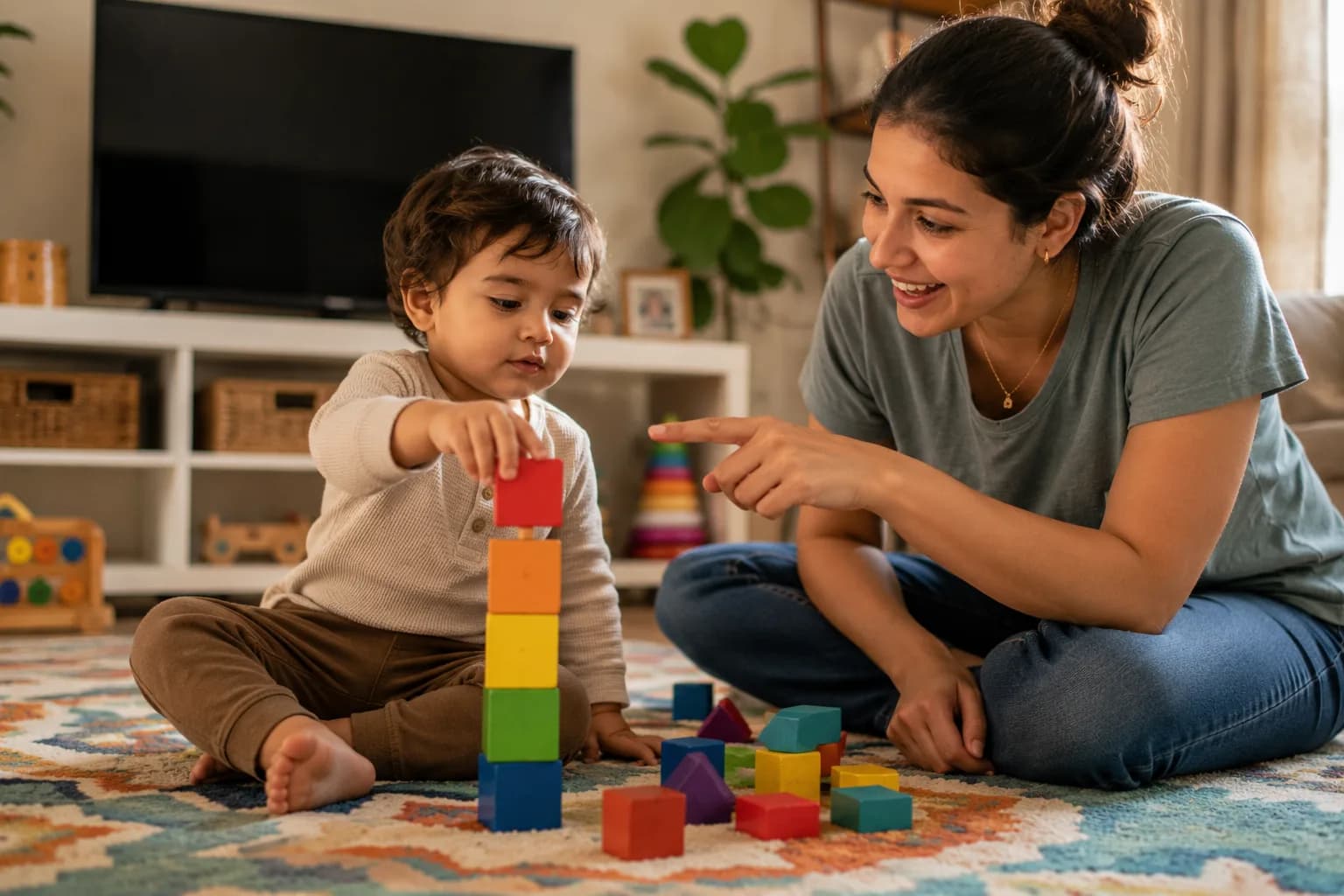
Follow their lead in play. Comment on what your child is doing rather than directing what they should do. "You put the red block on top. Now it is a tall tower." Following the child's attention and narrating their experience — rather than structuring the interaction around your agenda — produces the most language-rich interaction for children at all developmental stages.
When to Seek Help — And How
If your instinct tells you something is worth exploring, trust it. You know your child better than anyone else and the instinct to act on a concern is almost always better followed than suppressed.
In the United Kingdom, speak to your health visitor or GP about a referral to a speech and language therapist. NHS early intervention services are available and free. In the United States, children under three are entitled to a free early intervention assessment through their state's early intervention programme regardless of family income. Children aged three and over can be assessed through the local school district's special education system, also at no cost. Private speech-language pathology assessment is available in most regions for families who prefer it or need faster access.
A speech-language assessment is not a formal or frightening process. For young children, it is typically conducted through play — the therapist observes and interacts with your child in a structured but relaxed setting and builds a profile of their current language functioning across multiple domains. The assessment gives you information. It is a tool for understanding, not a verdict.
If therapy is recommended, the evidence for early intervention outcomes in language development is genuinely strong. Children who receive targeted speech-language support in the early years show significantly better long-term language outcomes than those for whom support is delayed. You are not failing your child by seeking help. You are giving them the most effective support available at the most effective time.
Listening-Rich Environments and Language Growth
The foundation of all spoken language is listening. Before a child can produce a word, they must absorb it hundreds of times over — in varied contexts, attached to meaning, delivered by voices they can hear clearly and process without effort.
Creating a listening-rich home environment is one of the most effective things parents can do for children at all points on the language development spectrum — including children who are showing signs of delay or who have received a formal diagnosis.
For children who feel frustrated or self-conscious about speaking, audio-only storytelling removes the performance pressure entirely. There is nothing to produce, nothing to get right, no adult watching expectantly for a verbal response. The child simply listens — relaxed, pressure-free — while rich, native-speaker vocabulary and narrative structure quietly build the auditory foundations of language in the background.

Cocoloops stories are designed with this in mind. The screen-free audio format, native-speaker narration, age-calibrated vocabulary, and structured narrative arcs make them a genuinely supportive tool for children who need a listening-rich environment without additional cognitive or social demand. Parents of children receiving speech-language therapy should share any audio tools they are using with their therapist, who can advise on how they complement the specific goals of their child's therapy programme.
Conclusion: The Words Will Come
Every child's linguistic canyon is carved at a different pace. Some are carved by rushing rivers. Some by slow, steady, quiet streams. Both produce canyons. Both reach the same destination.
If your child needs more time, more support, or a different set of tools than you expected — that is not a reflection of anything you did wrong. It is simply information about what your child needs next.
Every conversation, every lullaby, and every story is another drop of water shaping your child's canyon. Keep singing. Keep surrounding them with beautiful language. Keep creating the listening-rich environment that gives their developing brain the best possible material to work with. And if your instinct says it is time to ask for professional support — follow it without hesitation. Early action is always the kindest action.
Explore Cocoloops stories as part of a listening-rich home environment →
Frequently Asked Questions
Could introducing a second language be causing my child's language delay?
No — and this is one of the most important myths to address clearly. Bilingualism does not cause language delays or disorders. If a child has a true language delay, it is neurological in origin and will be present across both languages, not caused by exposure to two languages simultaneously. The American Speech-Language-Hearing Association is unambiguous on this point: bilingual exposure does not cause, trigger, or worsen language disorders. If your child is showing signs of delay, the cause should be investigated by a qualified speech-language pathologist — and the second language should not be removed as a first-response intervention, because it will not address the underlying cause and removes meaningful developmental and cultural benefits in the process.
My child has been diagnosed with a language delay. Should we stop speaking our home language and use only English?
Speech-language pathologists strongly advise against this, and the clinical guidance from ASHA is clear: families should not be advised to drop their home or heritage language in response to a child's language delay. The home language is the language of family intimacy, cultural connection, and the richest natural conversation available to the child within their family. Removing it does not treat the underlying delay — it only impoverishes the child's linguistic environment and severs a cultural connection that cannot easily be rebuilt. Bilingual therapy, conducted by an SLP with bilingual competence, is the appropriate approach for children with language delays in multilingual households.
Can a child with a language delay receive speech therapy in two languages?
Yes — and for children in bilingual households, this is the recommended approach. Many speech-language pathologists are bilingual and incorporate both the home language and the community language into their therapy sessions, supporting the child's whole linguistic profile rather than only the majority language. If your current therapist works only in one language, ask for a referral to a bilingual SLP or a therapist with experience supporting bilingual children. In the United States, you have the right to request services that reflect your child's full linguistic background under IDEA (Individuals with Disabilities Education Act).
What is the difference between a speech delay and a language delay, and does it matter?
Yes, it matters clinically. A speech delay refers specifically to difficulty producing the sounds of speech clearly — articulation, pronunciation, and intelligibility. A language delay refers to difficulty with the underlying system of language itself — vocabulary, grammar, comprehension, and the ability to use language to communicate meaning. Some children have only one of these difficulties; some have both. The distinction matters because the interventions are different. A speech-language assessment will identify which area or areas need support and tailor the therapy approach accordingly. Both are highly responsive to early intervention.
My child seemed to be developing language normally and then suddenly stopped speaking as much. Should I be worried?
A regression in language — a child losing skills they previously demonstrated, particularly if accompanied by any reduction in social engagement or responsiveness — is the one pattern that warrants prompt professional attention regardless of the child's age or history. It is listed as a red flag by both ASHA and the NHS at any developmental stage. In some cases, language regression follows a period of illness or significant change and resolves naturally. In others, it can be an early indicator of conditions that benefit significantly from early assessment and support. Do not wait and see with regression. Contact your GP, health visitor, or paediatrician promptly and request a referral.
This article is intended for general informational purposes and does not substitute for professional medical or speech-language pathology advice. If you have concerns about your child's development, please consult a qualified healthcare provider.
Related reading:
Tags
Related Posts
All postsParenting Tips
Independence Day 2026: Hindi Stories, Activities & 80th Independence Day Ideas for Kids
Parenting Tips
7 Real Ways Parents Use Cocoloops to Build a Language Learning Daily Routine for Kids
Parenting Tips
At What Age Should Children Start Listening to Audiobooks?
Newsletter
Get new stories & tips in your inbox
Parenting tips, audiobook picks, language learning — weekly.
