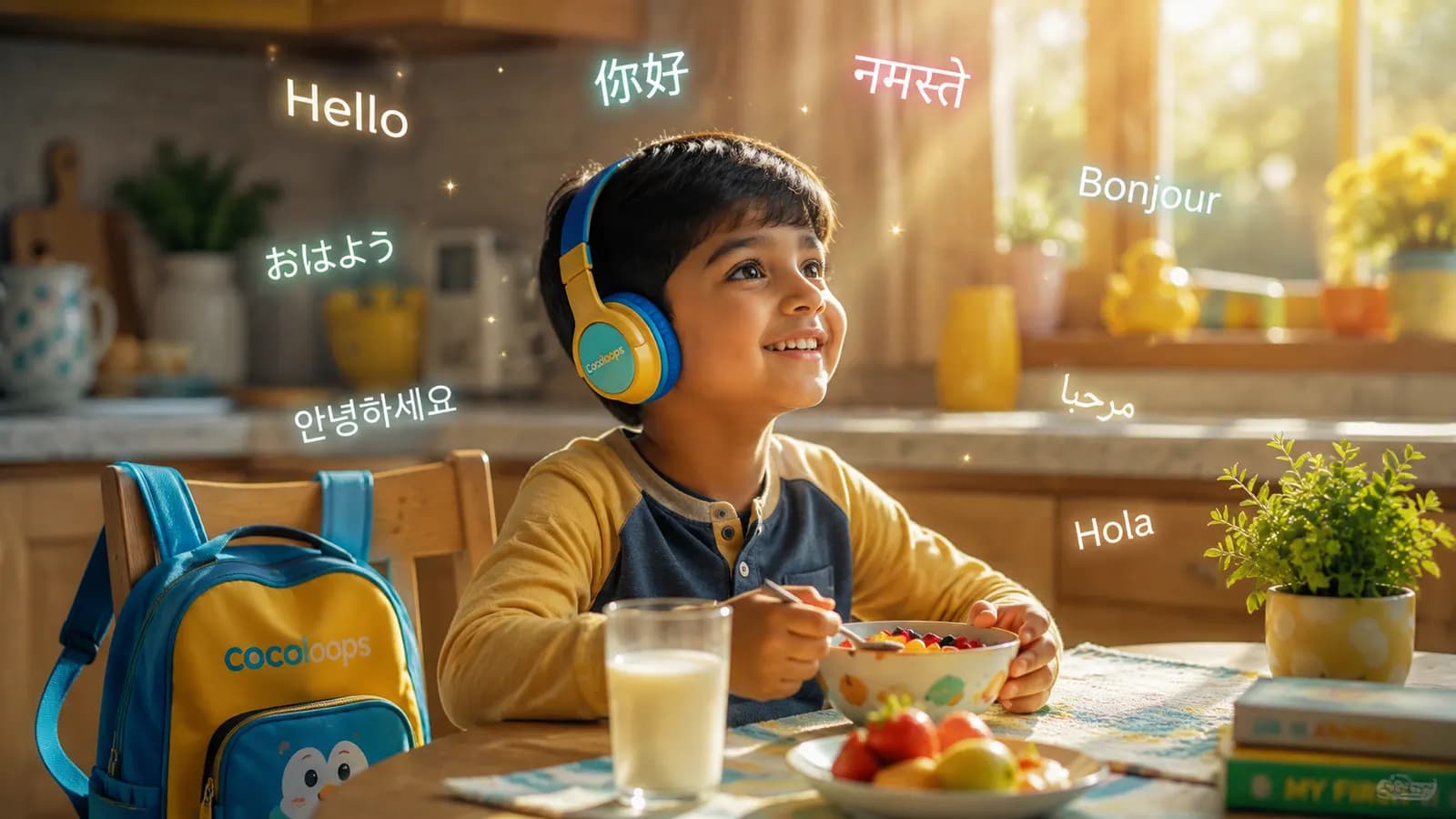
7 Real Ways Parents Use Cocoloops to Build a Language Learning Daily Routine for Kids
Every evening, thousands of parents make the same promise to themselves: "Tomorrow we'll spend more time with French." Tomorrow comes, homework happens, dinner runs late, bedtime arrives, and the language quietly disappears from the day again.
What nobody tells you is how brutally difficult it is to actually maintain that daily exposure without it turning into a battle of wills, another screen to manage, or yet another item on an already impossible to-do list.
The greatest challenge in children's language learning is not vocabulary or grammar. It is consistency. Language is entirely dependent on its environment. A child who hears French only during a fifteen-minute app session, sitting alone in a bedroom, learns to associate French with isolation and obligation. When they meet a real French speaker in the real world, they freeze — because the real world does not offer multiple choice buttons.
What works is different. What works is weaving the language into routines that already exist — into the car ride that happens anyway, the bedtime that happens anyway, the Saturday breakfast that happens anyway. When language becomes part of the rhythm of a family's day, it stops feeling like a chore and starts feeling like just how your family does things.
Here are seven practical, real-world ways families are using Cocoloops audiobooks to build a language learning daily routine that actually sticks — without adding a single extra obligation to their week.
Way 1: The Bilingual Bedtime Story
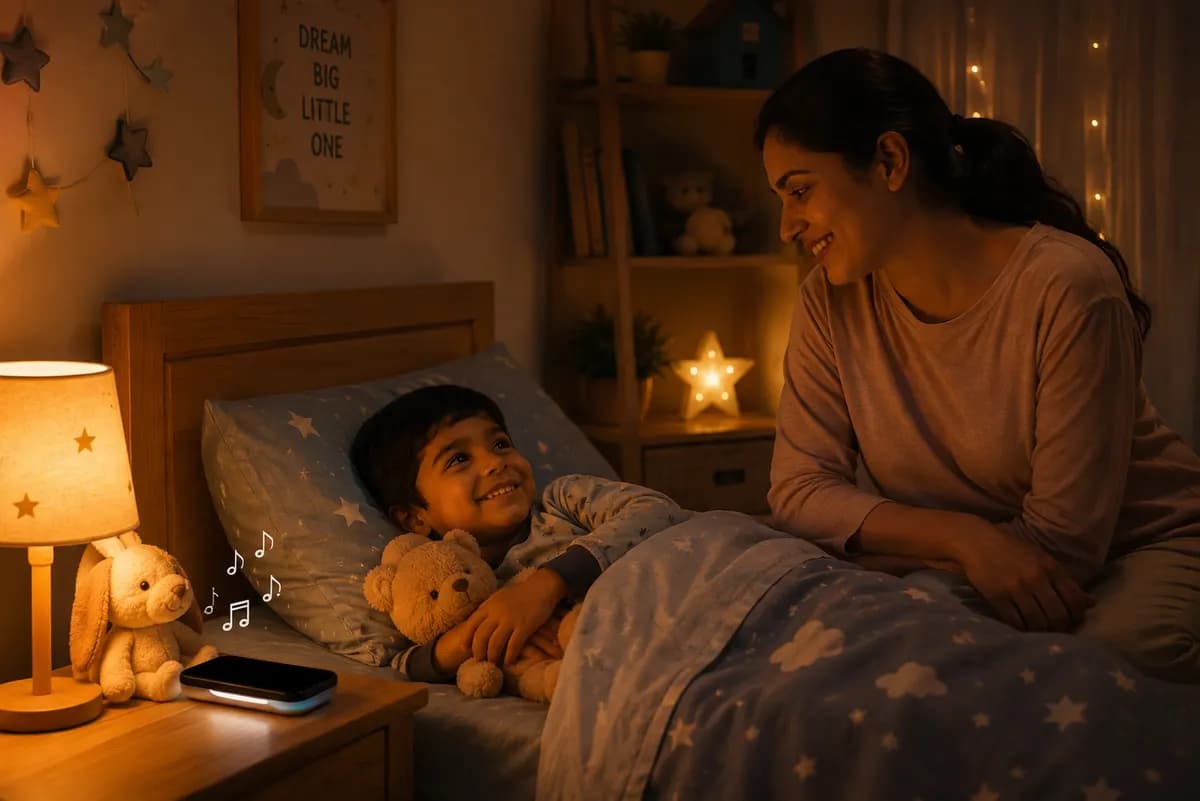
Of all the moments in a child's day, bedtime is the most psychologically open. The lights are low. There is no pressure to perform. The anxiety that blocks language acquisition — what linguists call the "affective filter" — drops almost completely. The brain shifts into a receptive, absorptive state that is genuinely ideal for language input.
Families who build audio into bedtime have discovered that replacing one English bedtime story per week with the same story in a target language is one of the highest-impact, lowest-effort habits available.
The approach is simple. Earlier in the week — say, Tuesday — the family listens to a Cocoloops story in English. The child learns the characters, follows the plot, and emotionally invests in what happens. Then on Thursday evening, the same story plays again at bedtime — this time in Spanish, or French, or Hindi. Because the child already knows what happens, they do not feel lost or anxious at the unfamiliar sounds. They relax into it. The known story provides the bridge.
One parent described it this way: "We play the same Cocoloops story twice a week. They listen to it in English so they understand the plot, and then in Spanish as they fall asleep. Within three weeks, our daughter was humming the theme in Spanish without realising she was doing it."
The real-world result is a child who wakes up associating a second language not with school pressure or digital rewards, but with warmth, imagination, and safety. That emotional association is one of the most powerful predictors of long-term language motivation a parent can build.
Practical tip: Download the story in advance for offline listening so no buffering interrupts the wind-down atmosphere.
Way 2: The School Run Listen
Most parents spend the school run thinking about traffic, lunches, or the workday ahead. Few realize they're sitting on one of the easiest language-learning opportunities of the week. Every weekday morning, the school run happens whether you're ready or not. Most families spend it in silence, with the radio on, or listening to the same playlist.
The key is that it requires no extra willpower. The car journey is happening regardless. The audio is the only addition. And because it happens at the same time, in the same place, every single school day, the habit anchors itself within weeks rather than months.
By week three, parents consistently report the same thing: their children start mimicking the character voices. They drop a foreign word into conversation as they unbuckle their seatbelts. They ask which language they are listening to today. The language stops living inside a tablet and starts becoming part of the texture of their actual day — which is precisely what produces real-world fluency rather than app-based performance.
Practical tip: Let the child choose the language for the week. Ownership of the choice increases engagement significantly.
Way 3: Quiet Time Replacement
For children between five and nine who have outgrown afternoon naps but still desperately need a sensory wind-down, "quiet time" almost always defaults to a screen. A tablet. A fast-paced cartoon. Something that gives the parent twenty minutes of peace but leaves the child more wired than before.
Cocoloops offers a genuinely better alternative — for the child's attention span and for their language development simultaneously.
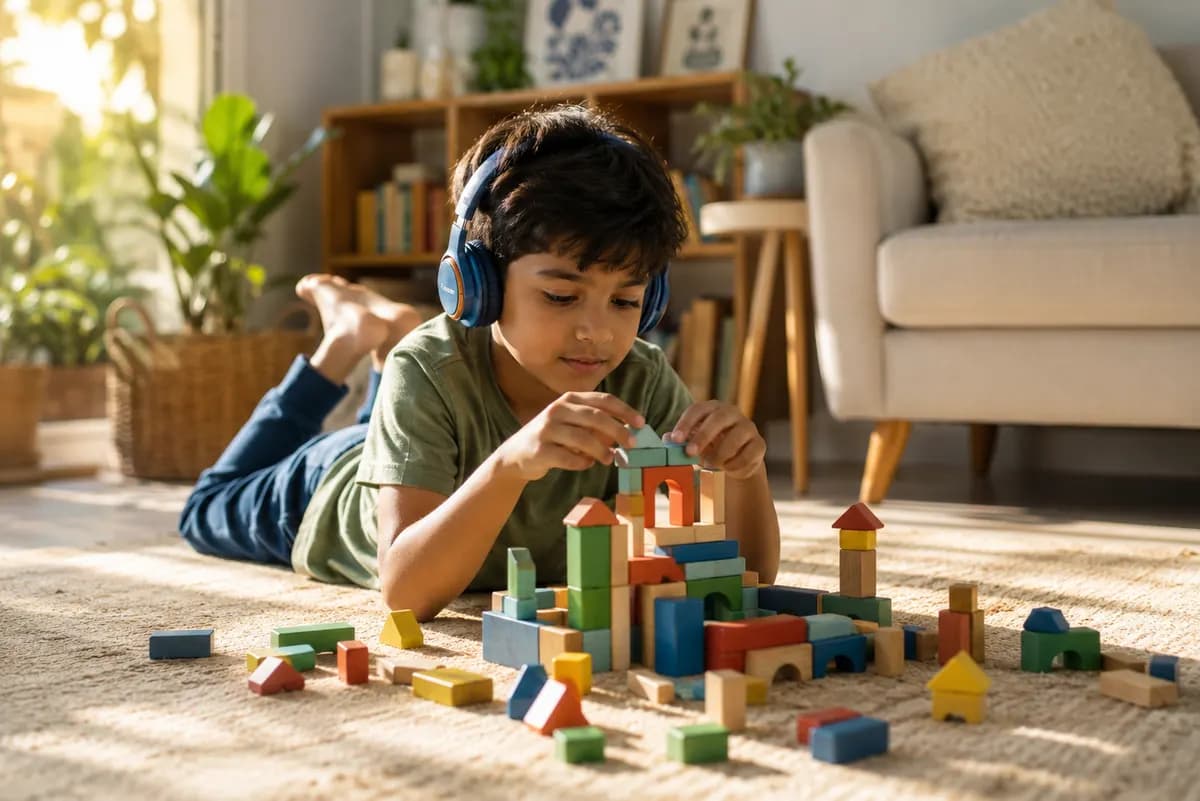
Parents are replacing screen-based quiet time with Cocoloops listening sessions. The child is free to draw, build, do a puzzle, or simply lie on the floor — and a beautifully sound-designed story plays in the background. No screen required. No visual stimulation competing for their attention.
Without the visual crutch, the child's brain is gently recruited into active listening. It has to build the picture of the narrative internally — tracking characters, imagining scenes, following cause and effect. Developmental psychologists call this "auditory stamina"—the ability to stay focused on spoken language for longer periods. That same skill supports classroom listening and later reading comprehension.
As a language learning tool, quiet time Cocoloops sessions are particularly effective because the relaxed physical state mirrors the bedtime receptivity described above. Ambient language exposure during low-pressure activity is one of the conditions most consistently associated with natural language absorption.
Way 4: The Weekend Language Breakfast
Language learning in most households is a solitary activity. A child sits alone with headphones and an app in the corner. They interact with a screen. The language never enters shared family space.
This matters more than it might seem. When a child experiences a language only in isolation, their brain files it as a private, individual pursuit. When they experience it as something the whole family engages with — something discussed over food, something that prompts laughter and questions — their brain marks it as socially valuable. And social value is one of the most powerful drivers of language motivation.
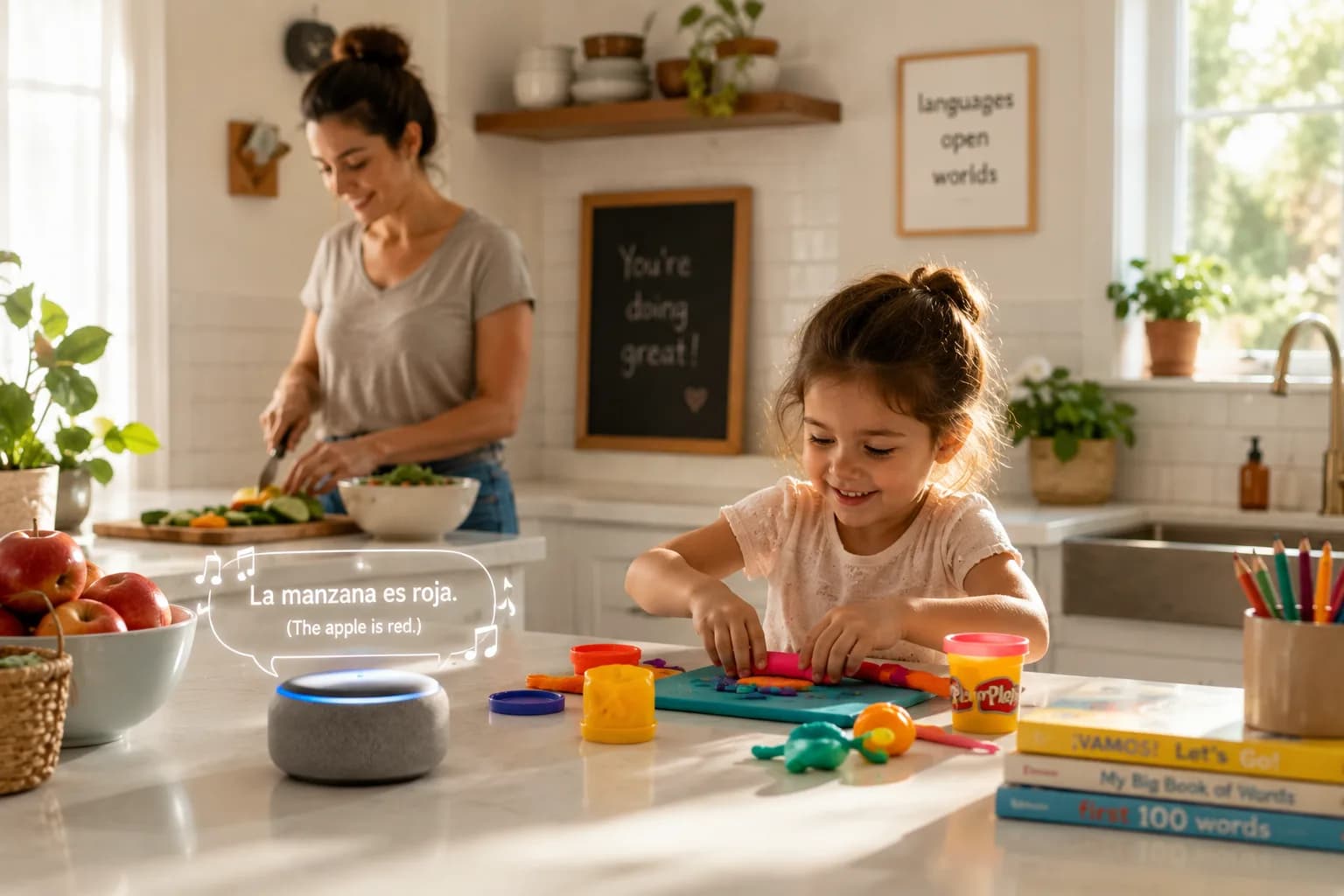
On Saturday mornings, while families eat breakfast, a Cocoloops story plays on the kitchen smart speaker. Parents do not need to speak the language. They just listen alongside their children. Afterward, someone asks casually — never as a test, always as curiosity — "Did anyone catch the French word for bread?" Or: "The German character sounded different in that scene — did you notice?"
The conversation that follows is not a language lesson. It is a family sharing something interesting. But from a language acquisition perspective, it is exactly the kind of contextualised, emotionally positive exposure that research shows produces lasting vocabulary retention.
Practical tip: Rotate the language each weekend so children gradually build familiarity across multiple languages without pressure to master any one immediately.
Way 5: Grandparent Language Time
For heritage language families — households where a grandparent, parent, or extended family member speaks a language that is not the dominant language of the country — the pressure to pass that language to the next generation is real and urgent. Heritage language loss typically happens within a single generation. Once it is gone, it is very difficult to recover.
The challenge is that grandparents who speak the language fluently often do not know how to teach it to a young child. They are not language teachers. Structured lessons feel unnatural and quickly lose a toddler's attention.
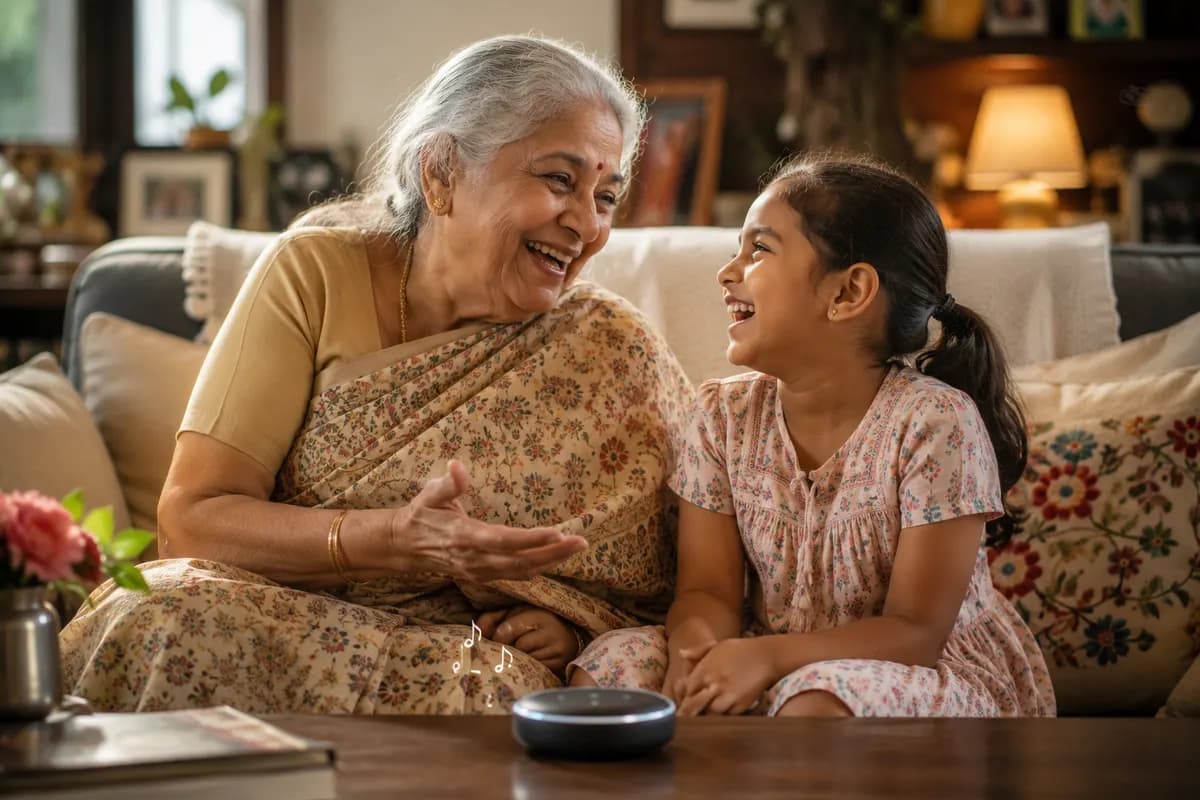
Cocoloops provides a different model entirely. A grandmother who speaks Hindi does not need to become a tutor. She simply sits with her grandchild and they listen to a Hindi Cocoloops story together. She can pause the audio to explain a cultural reference, laugh at something that lands differently in Hindi than it would in English, or share a memory that the story triggers. The interaction is natural. The connection is genuine.
The result is a child who associates their heritage language not with academic obligation but with the presence of someone they love. That emotional anchoring is exactly what keeps a heritage language alive across generations — and no app or tutor can replicate it.
Way 6: Multilingual Road Trips
Somewhere around hour three of every family road trip, parents face the same decision: another movie, or another argument.
Families using Cocoloops on road trips have discovered something unexpectedly engaging: playing the same story in different languages, chapter by chapter, turns a long journey into an active intellectual game.
Play the opening of a story in English. Then switch to Spanish for the next section. Then French. Ask the children what they notice: does the Spanish narrator sound more expressive? Does the German version feel more precise? What words sounded almost the same across both languages?
This kind of active comparison builds what linguists call metalinguistic awareness — the ability to think about language as a system rather than just use it. Children who develop metalinguistic awareness early learn subsequent languages significantly faster, because they already understand intuitively that languages have structure, patterns, and personality.
As a bonus: the children are quiet, engaged, and not watching a screen. The journey becomes part of the memory.
Way 7: The Language Warm-Up Before School Classes
For older children who are studying a second language at school, one of the most common problems is cognitive switching. They spend the morning in English maths and English science, and then the bell rings for French and their brain has to shift registers entirely — cold, unprepared, and slightly anxious.
A ten-minute Cocoloops listen on the walk or drive to school changes this completely. Playing a short story in the target language before school primes the auditory cortex. Vocabulary already known from previous Cocoloops sessions surfaces to the front of working memory. The child arrives at their French classroom with the language already active — not having to dig for it, but ready to use it.
Parents who have introduced this habit consistently report the same outcome: their child participates more in class, feels less anxious about speaking aloud, and picks up new classroom vocabulary faster because it lands on already-activated neural pathways.
Start Your Own Cocoloops Routine
Before you decide which of these scenarios to try first, take sixty seconds to think about your family's actual daily rhythm — not the ideal version, the real one.
When does your child have their ears available, even when their hands are busy? Building with blocks on the living room floor. Eating breakfast. Sitting in the back seat on the way to school. Lying in bed waiting to fall asleep.
What routine already exists in your week that could carry an audio story? The bath. The commute. The weekend meal. The afternoon wind-down.
You do not need to create a new study hour. You need to find a slot that already exists — ideally one that happens at the same time each day — and attach a high-quality Cocoloops story to it. Within three to four weeks, the habit will anchor itself. The language will stop being something you have to remember to do and start being something your child asks for.
That is the shift that produces real bilingual results. Not a better app. A better routine.
Conclusion: Pick One Scenario and Start Tonight
You do not need to implement all seven of these at once. Choose the scenario that fits most naturally into your family's existing rhythm — the bedtime slot that is already there, the car journey that already happens — and start there.
Every minute of consistent, native-speaker audio exposure your child receives is a deposit into a cognitive account that compounds over time. The interest is fluency, cultural confidence, and a relationship with language that will serve them for the rest of their lives.
One story every night becomes hundreds of stories over the years. That's how bilingual families are built—not all at once, but one routine at a time.
Start tonight with a free Cocoloops story →
Frequently Asked Questions
How much time per day does my child need to listen to Cocoloops to see language results?
Surprisingly, your child doesn't need an hour a day. Research consistently shows that regular exposure matters much more than long sessions. Even fifteen minutes of daily native-speaker audio exposure — across car rides, mealtimes, or bedtime — produces measurable phonetic familiarity within four to six weeks. The routines in this article are designed specifically to fit within existing daily time slots rather than requiring additional dedicated study time.
Do I need to listen with my child for the Cocoloops routine to work, or can they listen independently?
Both approaches work, and each has different benefits. Independent listening — during quiet time or at bedtime — allows children to absorb language in a low-pressure, relaxed state that is ideal for passive acquisition. Listening together, as in the Weekend Language Breakfast or Grandparent Language Time scenarios, adds social value and family connection that research shows significantly boosts long-term motivation.
At what age should I start incorporating Cocoloops into our daily routine?
Cocoloops is designed for children aged 3 to 15, and the earlier you start, the greater the neurological benefit. Children under eight are in the critical period for native-like phonetic acquisition, meaning their brains map new sounds far more efficiently than they will in adolescence. However, starting at any age within the 3–15 range produces meaningful results — the routines simply adapt to the child's developmental stage and attention span.
What if my child resists switching from English to the foreign language version of a story?
This is very common, especially in the first two to four weeks. The most effective approach is the two-listen method: let your child hear the story in English first until they genuinely enjoy it, then introduce the foreign language version as a follow-up. Because they already know the plot, the unfamiliar language feels less threatening. If resistance persists, try ambient listening — playing the foreign language version in the background during an activity they enjoy, without drawing attention to the language switch at all.
Can Cocoloops routines work alongside formal school language classes?
Yes — and the combination is particularly effective. Cocoloops provides the daily audio immersion and native prosody modelling that classroom instruction rarely has time to deliver. School classes then provide the grammatical framework and speaking practice that consolidates what the child has absorbed through listening. The Language Warm-Up Before School scenario described in this article is specifically designed to bridge these two contexts, priming the child's auditory cortex before they enter the classroom.
Related reading:
Tags
Related Posts
All postsParenting Tips
Independence Day 2026: Hindi Stories, Activities & 80th Independence Day Ideas for Kids
Parenting Tips
At What Age Should Children Start Listening to Audiobooks?
Parenting Tips
Signs Your Child Has a Language Delay — And How to Support Them at Home
Newsletter
Get new stories & tips in your inbox
Parenting tips, audiobook picks, language learning — weekly.
