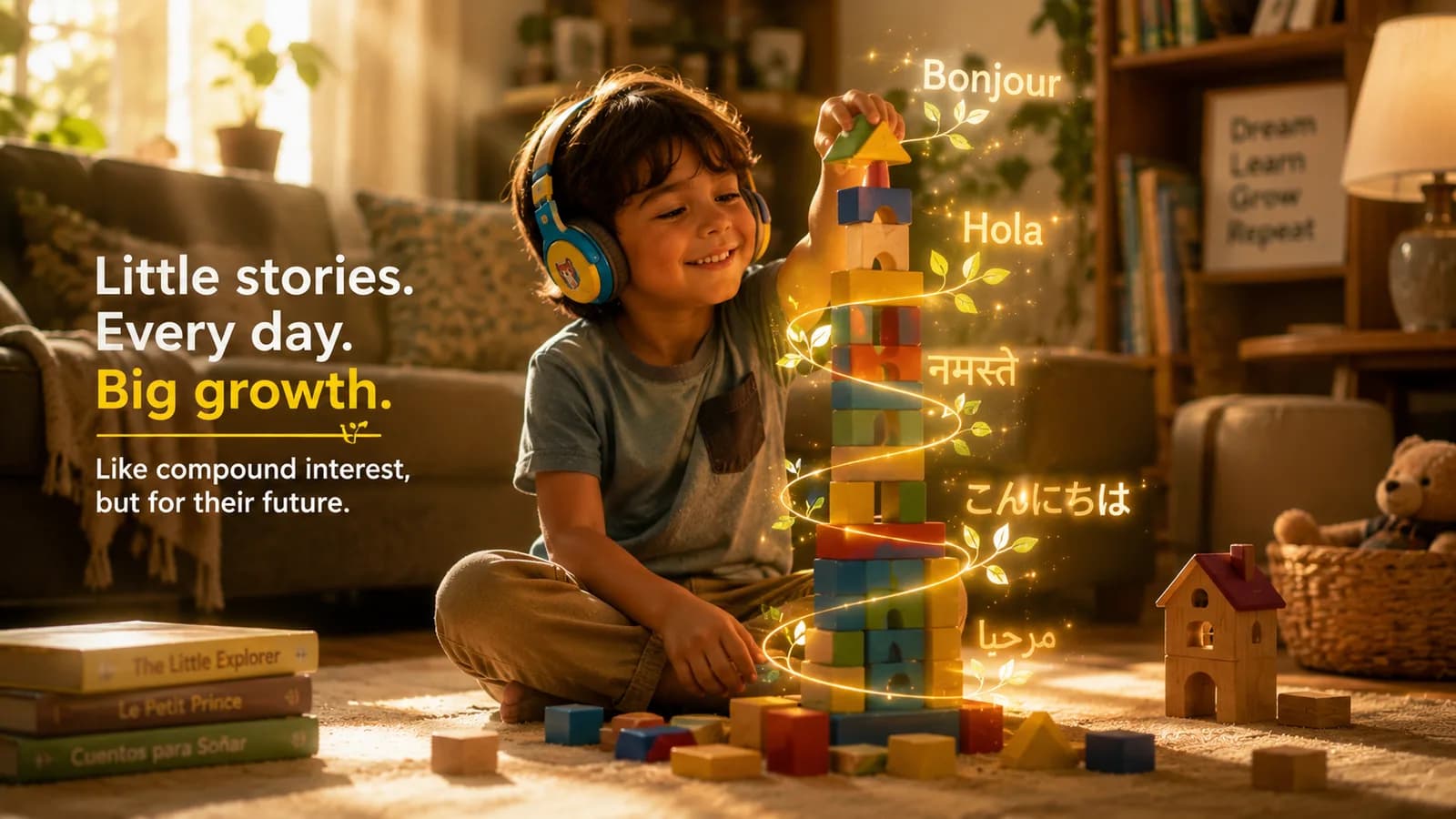
Screen-Free Ways to Expose Your Child to a Second Language Every Day
You want your child to learn a second language. You also want to reduce their screen time. In 2025, these two goals feel almost impossible to pursue simultaneously — because many of today's popular language-learning tools marketed at families requires a screen to function.
Duolingo needs a tablet. Lingokids needs a tablet. Spanish YouTube cartoons need a tablet. The entire children's language ed-tech industry is built on visual gamification, which means parents who are genuinely trying to manage their child's daily screen exposure face an uncomfortable choice: accept more screen time in the name of language learning, or abandon the language goal entirely.
This article is about a third option — one that the research increasingly supports and that no major language platform has built a clear content claim around. Screen-free language learning for kids is not only possible. In several respects, it is more effective than screen-based alternatives, for reasons rooted in how young children's auditory systems develop and how language is most naturally acquired.
Why Screen-Free Learning Is Having a Moment
For most of the past decade, the parenting conversation around children and screens was framed almost entirely around time limits. How many minutes per day? What age to introduce them? How to enforce the boundary without triggering a meltdown?
That framing has shifted. The American Academy of Pediatrics updated its guidance to move away from rigid time-limit rules toward a more nuanced framework centred on content quality, context, and the nature of the interaction. High-quality content experienced alongside a parent or caregiver is treated differently from passive solo screen consumption. The question is no longer simply "how long?" but "what, with whom, and in what context?"
Alongside this, a significant and growing movement of parents — particularly those with children under six — is actively pushing back toward sensory-rich, device-free activities. The concern driving this is not primarily about screen time duration. It is about what screens displace: physical exploration, imaginative play, sustained listening, face-to-face interaction, and the kind of boredom that produces creativity. Young children often benefit from learning experiences that combine movement, interaction, imagination, and conversation. None of these conditions are easily met on a glowing rectangle.
For language learning specifically, the screen-free approach has a distinct neurological advantage: when visual stimulation is removed, the removing visual distractions may help some children dedication more attention to spoken language.. Children listen more deeply, process spoken language more carefully, and build phonological maps with greater clarity — which is precisely the foundation that produces genuine language acquisition rather than app-based performance.
The Challenge: Most Language Tools Require Screens
Here is the frustrating irony. If you search "how to teach my child a second language," approximately most of the solutions you find require a device with a screen. Tap the flashcard. Pop the balloon. Watch the cartoon. Match the image to the word.
This is not a design accident. The children's language ed-tech industry is built on visual gamification because engagement metrics — daily active users, session lengths, streak completions — are easiest to drive through visual reward loops. These mechanics work reasonably well for adult learners and older children. For children under seven, they carry a meaningful cost: the screen itself becomes the dominant sensory input, and the language can sometimes become secondary to the visual interaction..
The methods below require no screen at all — and several of them outperform screen-based alternatives in the research on early childhood language acquisition.
Method 1: Language Audiobooks — The Screen-Free Immersion Tool
When the screen is removed, something important happens to a young child's listening. Without visual animation competing for attention, children often focus more closely on spoken language. Children attend more closely to the rise and fall of a narrator's voice, absorb the natural rhythm and intonation of the language, and use their imagination to construct the world of the story rather than having it delivered passively on a screen. This active auditory engagement is closer to the conditions under which children acquire their first language — immersed in meaningful spoken language, building comprehension through context — than anything a visual app can replicate.
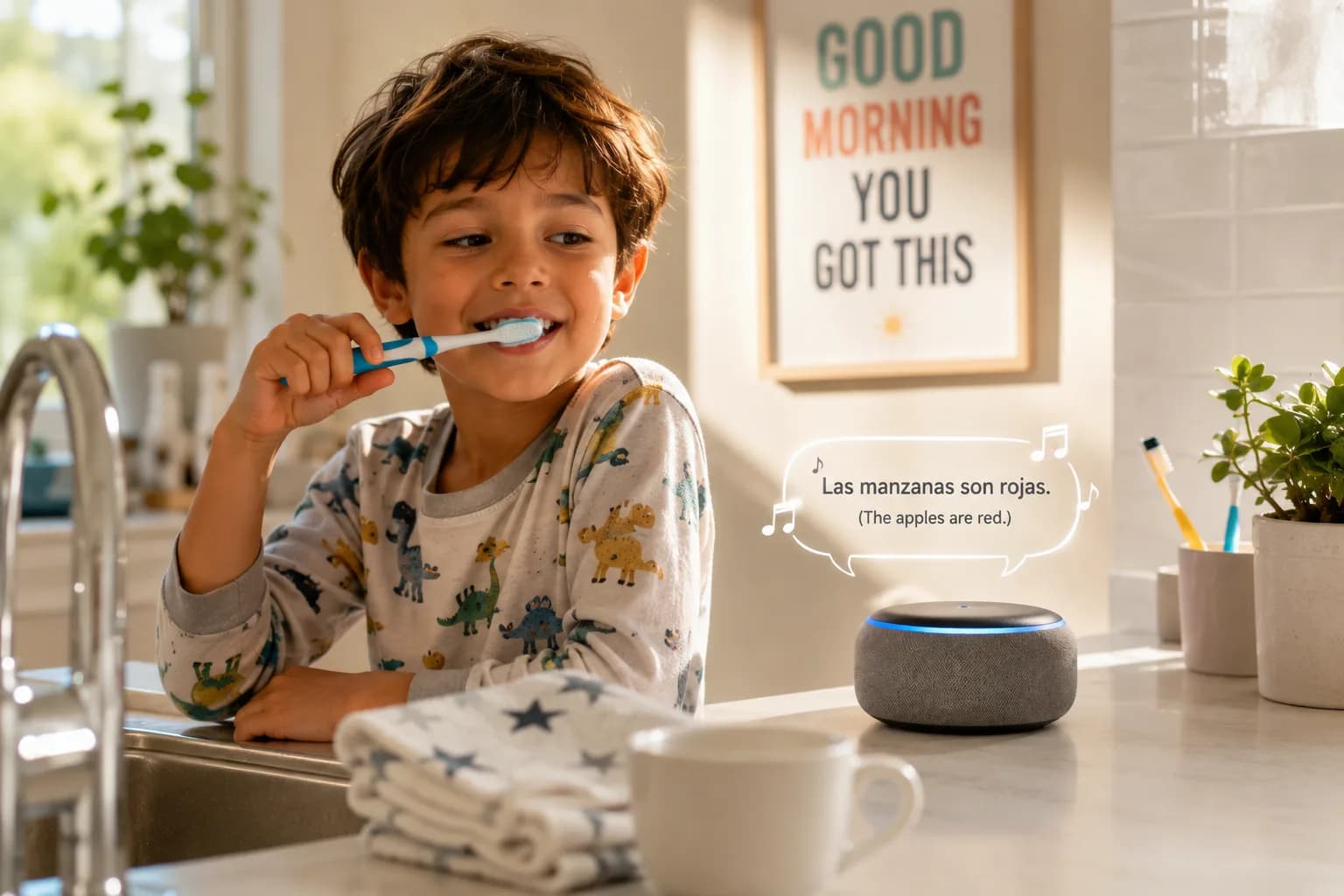
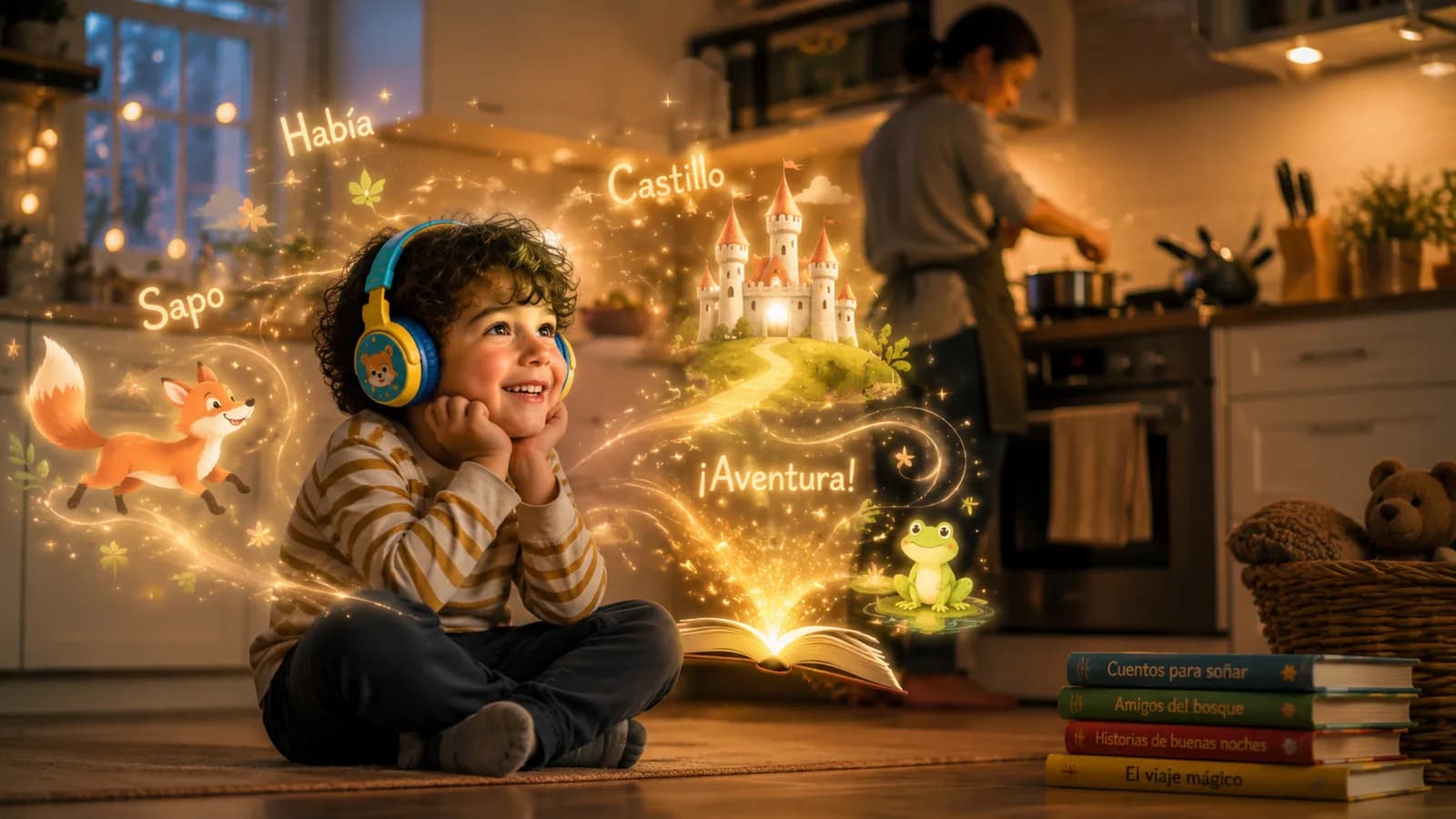
Native-speaker audiobooks in the target language, played through a smart speaker, car stereo, or basic bluetooth speaker, provide immersive comprehensible input with zero screen involvement. The child can be doing anything — building, drawing, eating, lying in bed — while the language fills the room. The physical activity does not reduce the linguistic input; it often enhances retention, According to Stephen Krashen's Input Hypothesis, relaxed learning environments may reduce emotional barriers that interfere with language acquisition.
Cocoloops is designed specifically for this use case. Every story on the platform is narrated by a native speaker of the target language and is available in multiple languages — meaning the same story your child already knows and loves in English can be played in French, Spanish, German, Italian, or Hindi through any speaker in your home, with no screen required at any point in the experience.
Method 2: Bilingual Songs and Music
Music is one of the oldest and most effective mnemonic devices available to parents — and it requires nothing but a speaker and a playlist.
The melody of a song can make vocabulary easier to remember by pairing words with rhythm and repetition, encoattaching foreign words to a rhythmic and emotional structure that the brain finds intrinsically memorable. A toddler who cannot yet hold a conversation in Spanish will nonetheless memorise the vocabulary of a Spanish counting song within a handful of listens, because the melody provides a retrieval scaffold that pure spoken language does not.
Build a target-language playlist for your household and rotate it during low-pressure moments: breakfast, bath time, tidying up, car journeys. Here are starting points by language:
- French: Frère Jacques, Promenons-nous dans les bois, Une souris verte — classic French children's folk songs with simple, repetitive vocabulary that preschoolers absorb quickly.
- Spanish: Traditional counting songs like Cinco lobitos and Los pollitos dicen introduce number vocabulary and animal names through immediately memorable melody.
- German: Backe backe Kuchen, Alle meine Entchen, and Der Kuckuck und der Esel are German nursery staples with strong rhythmic structures suited to young learners.
- Italian: Nella vecchia fattoria (the Italian Old MacDonald) and Giro giro tondo offer simple, physically playful vocabulary anchored to familiar melodies.
- Hindi: Lakdi ki kathi, Machli jal ki rani hai, and Chanda mama door ke are classic Hindi children's songs that heritage language families will often recognise from their own childhoods and can share directly with their children.
Method 3: Language Labelling and Environmental Print
This is a zero-cost, five-minute setup that works continuously in the background of your household without any parental effort after the initial installation.
Take a pad of sticky notes and walk through your home, labelling common objects in the target language: la puerta (door), la ventana (window), el frigorífico (fridge) in Spanish; die Tür, das Fenster, der Kühlschrank in German. Place the labels at your child's eye level — on the objects they touch and interact with throughout their day.
Research on environmental print and vocabulary acquisition consistently shows that words encountered repeatedly in their physical context — attached to the actual objects they name rather than to pictures of those objects on a screen — are often remembered more easily because they are repeatedly encountered in meaningful contexts. Every time your child reaches for the door handle and sees the word, the association is reinforced without any deliberate teaching. The language becomes part of the texture of the home rather than a lesson that happens at a specific time.
Refresh the labels weekly, focusing on one room or one theme at a time to prevent habituation. Turn the refresh into a low-key game: which words does your child remember from last week before you replace the labels?
Method 4: Bilingual Play and Storytelling
Children learn fastest when they are physically engaged, laughing, and in control of what is happening. Taking language off a screen and putting it into their hands — literally — changes the entire dynamic.
Puppet shows: Give one puppet a personality that only speaks the target language. Children accept this premise immediately and, over time, begin responding to the puppet in the target language without any instruction to do so. The fiction of the puppet removes the self-consciousness that often inhibits language production.
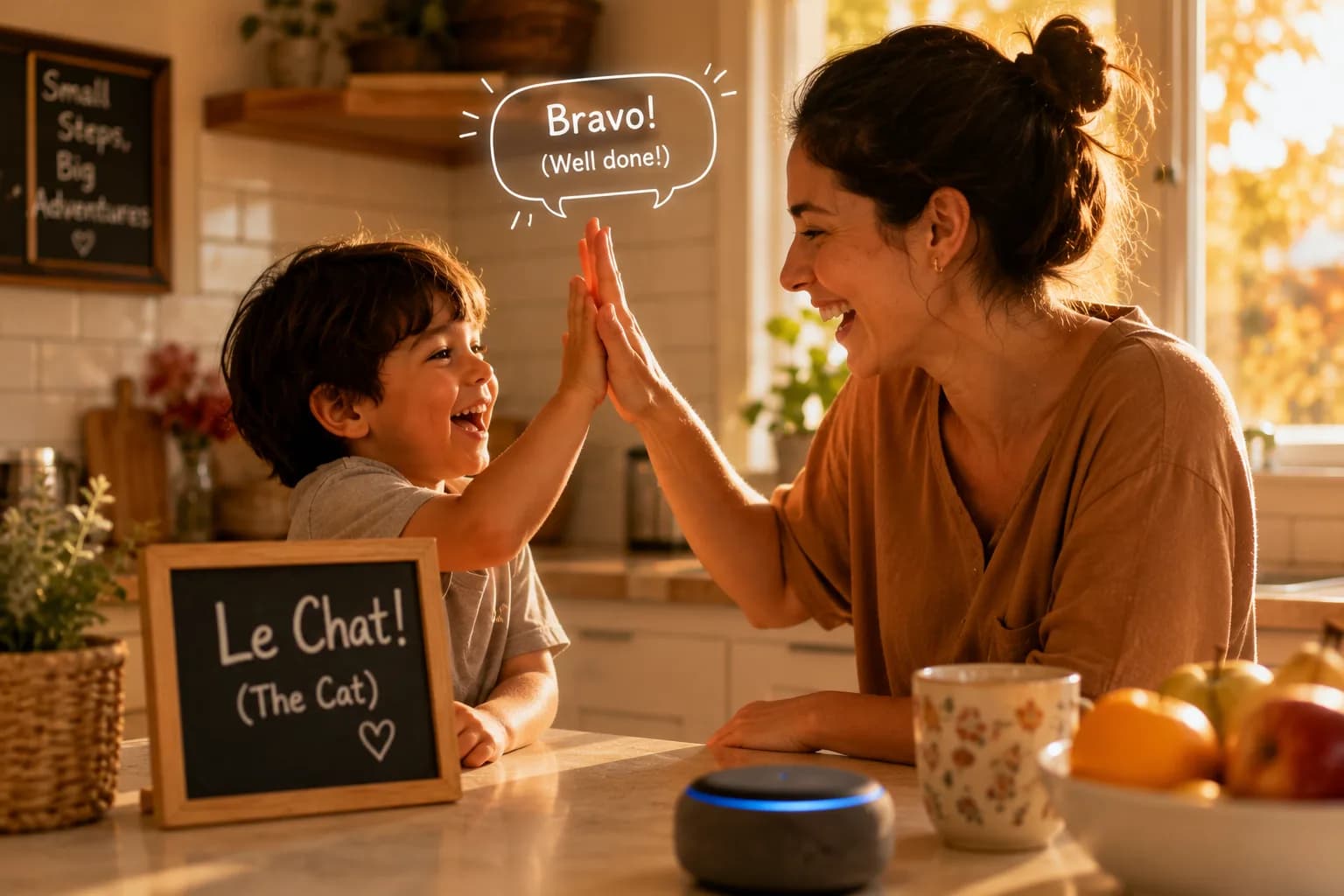
Physical games: Simon Says — Jacques a dit in French, Simón dice in Spanish, Simon sagt in German — is one of the most effective vocabulary-building games available to parents of young children. It requires no materials, no preparation, and no screen. Body movements anchor vocabulary to meaningful movement and repeated association., creating a retrieval pathway that purely auditory or visual learning does not provide.
Storytelling with objects: Gather a handful of small toys or household objects and take turns building a story in English — then challenge your child to retell one sentence from the story using a word in the target language. Keep it playful, low-stakes, and genuinely collaborative. The goal is not correctness; it is engagement with the sounds and words of the language in a context your child controls.
Method 5: Community and Cultural Immersion
Language is ultimately a social tool, and children who experience it only through devices — however high-quality — are missing the most powerful motivator available: seeing real people use the language to connect with each other.
Look for local language playgroups run by parent communities, libraries, or cultural centres in your area. Many cities with significant diaspora populations run informal weekend gatherings where children can hear the target language spoken naturally in a social setting. Cultural food festivals, music events, and community celebrations offer exposure that no app can replicate — the child sees and hears that the language belongs to real people, real food, real laughter, and real life.
For families without easy access to in-person community events, video calls with grandparents or extended family who speak the heritage language provide the same essential signal: this language is how people who love me communicate. That emotional anchoring is one of the most durable motivators in heritage language preservation.
Building a Screen-Free Language Routine: A Weekly Template
The goal is not to do everything every day. It is to ensure that language exposure happens consistently across the week, attached to routines that already exist, without adding meaningful effort to an already full schedule.
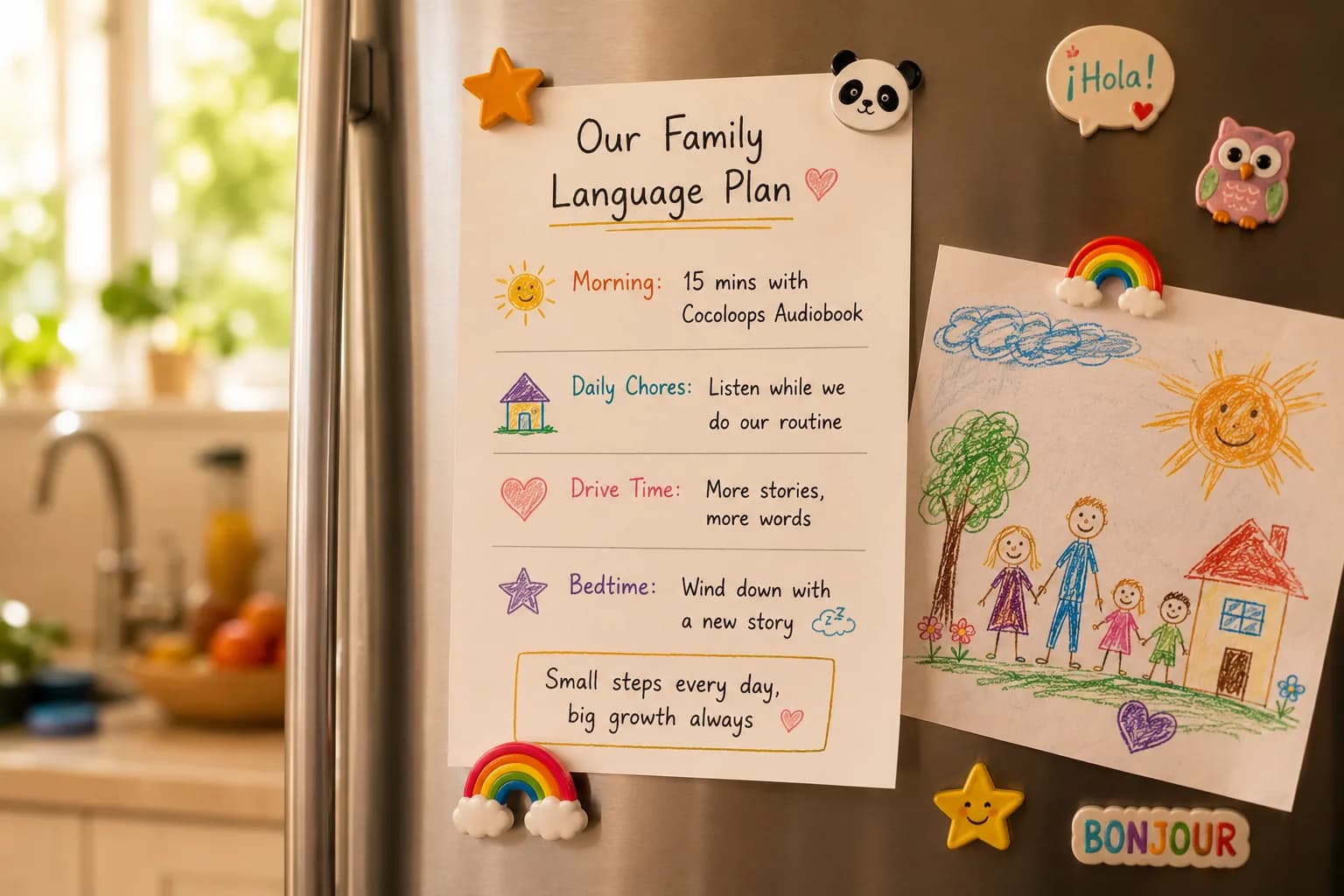
- Monday — The Audio Morning: Play a Cocoloops story in the target language through the kitchen speaker during breakfast. No expectation of attention or comprehension — ambient native-speaker input while the morning routine unfolds.
- Tuesday — The Musical Bath: Swap your usual bath-time playlist for your target-language music playlist. Cinco lobitos in Spanish or Alle meine Entchen in German while they splash. No instruction needed.
- Wednesday — The Car Immersion: School run or errands with a Cocoloops story playing through the car stereo. Fifteen minutes of native-speaker audio in a contained, low-distraction environment.
- Thursday — The Physical Game: A five-minute round of Simon Says in the target language before dinner or after school. Three to five vocabulary words, physical movement, and genuine laughter. No preparation required.
- Friday — The Label Walk: Walk through the house together and read the sticky note labels aloud in the target language. How many does your child remember? Replace any they have clearly absorbed with new words from a different room or category.
- Saturday — The Cultural Connection: Cook a simple dish associated with the target language culture, play target-language music in the background, and if possible, make a video call to a family member who speaks the language. Make it social and sensory rather than instructional.
- Sunday — Rest and Replay: A Cocoloops bedtime story in the target language, low volume, lights dimmed. No expectation. Just the language, the dark, and the sleeping brain doing its consolidation work.
Conclusion: Language Without the Screen Battle
You do not have to choose between raising a bilingual child and managing your child's screen exposure. One of the most effective ways to support early language learning th — sustained, contextualised, native-speaker audio delivered through narrative — requires no screen at all.
A smart speaker in the kitchen. A car stereo on the school run. A bedside speaker at bedtime. These are simple tools that can help families create consistent bilingual routines in 2025 — not tablets, not gamified apps, not digital flashcard streaks.
Explore the Cocoloops library and start your screen-free language routine tonight →
Frequently Asked Questions
Is screen-free language learning actually as effective as app-based learning for children?
For children under seven, the evidence consistently favours audio-based immersion over screen-based gamification for genuine language acquisition. The core reason is neurological: when visual stimulation is removed, screen-free listening encourages children to pay closer attention to speech sounds and rhythm, both of which are important foundations for language learning.. Apps optimised for engagement metrics — streaks, badges, visual rewards — are effective at keeping children interacting with the device, but the Transfer Problem (the gap between in-app performance and real-world language use) is well-documented. Native-speaker audio delivered through narrative provides comprehensible input in its most natural form, which research consistently associates with durable acquisition rather than game-state performance.
How much screen-free language exposure does my child need each day?
Consistency matters significantly more than duration. Research on language acquisition supports the principle that fifteen to twenty minutes of daily native-speaker audio exposure produces meaningfully better long-term outcomes than infrequent longer sessions. The weekly template in this article is designed around this principle — short, consistent exposures anchored to existing daily routines rather than a dedicated study hour that adds friction to an already full schedule. Even ten minutes of ambient audio during breakfast or a car journey counts as meaningful comprehensible input.
My child is used to screens for entertainment. How do I transition them to audio-only content without resistance?
The transition is easier than most parents expect, because the resistance to audio-only content is usually lower than the resistance to ending screen time. Children do not typically protest a story playing through a speaker the way they protest having a tablet taken away — there is nothing to switch off in the same emotionally charged way. Start with audio content during activities your child already enjoys — breakfast, drawing, building — so the listening is additive rather than replacing something they value. Choose narratives with strong characters and genuine story momentum so the content earns attention on its own terms.
Can I use screen-free methods as the only approach, or do I need to supplement with screens eventually?
For children under seven, screen-free methods — native-speaker audiobooks, music, environmental labelling, physical games, and community exposure — provide a genuinely complete foundation for language acquisition. As children grow older and begin formal language study at school, some screen-based tools become useful supplements for vocabulary reinforcement and grammar exposure. The audio foundation built through screen-free immersion in the early years makes all subsequent learning, screen-based or otherwise, more efficient — because the phonological map, prosody, and vocabulary base are already in place.
Does environmental labelling (sticky notes) actually work, or is it just busywork?
Environmental print research consistently shows that words encountered repeatedly in their physical context — attached to the actual objects they name, in the environments where children live and move — are encoded more durably than words encountered on screens or in flashcard formats. The critical variable is repetition in context: a child who sees la puerta every time they reach for the door handle encounters that word dozens of times daily in a physically grounded, meaningful context. This is a fundamentally different type of exposure from seeing the same word on a rotating flashcard screen, and the research on contextual vocabulary acquisition consistently favours the physical, environmental approach for young children.
Related reading:
Tags
Related Posts
All posts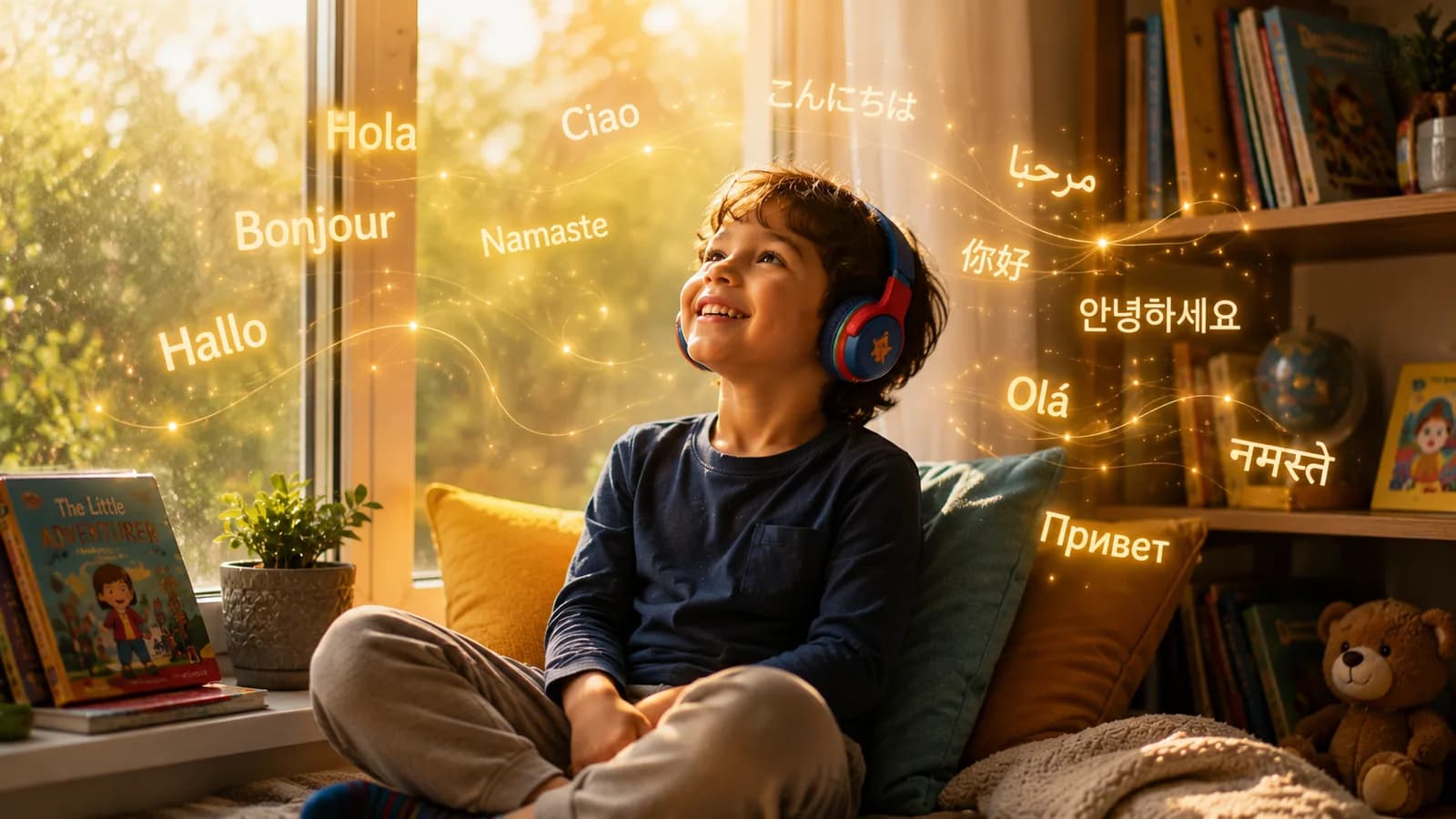
Newsletter
Get new stories & tips in your inbox
Parenting tips, audiobook picks, language learning — weekly.
