
Chinese New Year 2027 for Kids: Year of the Goat Explained
Chinese New Year is one of the biggest celebrations in the world, and it's a joyful one to share with young children. There are animals, lanterns, red envelopes, dumplings and dancing dragons, and a lovely old story about a race between twelve animals. This guide explains the festival in a way you can pass straight on to a child aged about 3 to 8, with dates, simple facts, the Great Race story told for bedtime and a few easy ways to celebrate at home.
When Is Chinese New Year 2027?
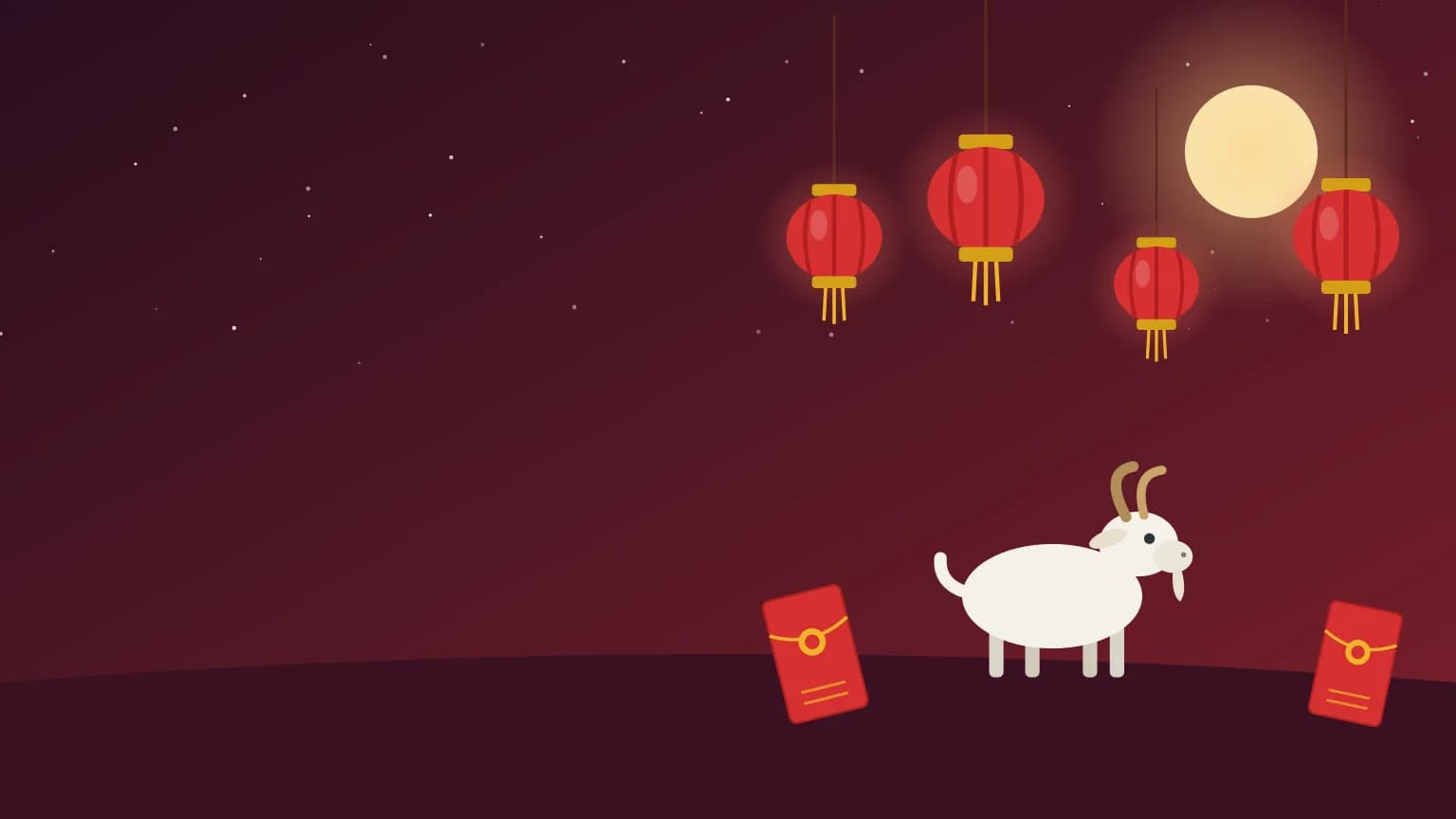
Chinese New Year 2027 falls on Saturday 6 February 2027. It begins the Year of the Goat. The animal is also translated as the Sheep or the Ram, so you may see all three names.
The date moves every year because it follows the lunar calendar, which is based on the moon. New Year begins with a new moon, somewhere between late January and mid-February. Celebrations traditionally last 15 days and end with the Lantern Festival under the first full moon of the year.
What Is Chinese New Year? (A Simple Explanation for Kids)
Here's a way to explain it to a young child:
"In China and in many other places, people celebrate a new year at the end of winter, when spring is on its way. Families clean their homes, eat a big dinner together, give each other red envelopes and wish everyone good luck for the year ahead. Each year is named after an animal, and this year is the goat."
It's also called Lunar New Year or the Spring Festival. It isn't only celebrated in China. Families in Vietnam call it Tết, families in Korea call it Seollal, and Chinese communities around the world, from London and Manchester to San Francisco, New York and Sydney, celebrate with parades and festivals.
The Great Race: Why Each Year Has an Animal
There are twelve animals in the Chinese zodiac, and each year takes its turn: Rat, Ox, Tiger, Rabbit, Dragon, Snake, Horse, Goat, Monkey, Rooster, Dog and Pig. A traditional story explains the order. It's told in many versions; here's a short one for bedtime.
The Great Race (a short retelling)
Long ago, the Jade Emperor wanted a way to measure time. "I will hold a great race across the river," he said. "The first twelve animals to reach the other side will each have a year named after them."
All the animals lined up on the riverbank. The Rat was small and could not swim far, so he asked the strong Ox for a ride. "Of course," said kind Ox, and off they went. Just before the shore, Rat jumped off Ox's head and landed first. Rat became the first animal, and Ox came second.
The powerful Tiger fought the current and came third. The Rabbit hopped across on stepping stones and a floating log, and came fourth. The Dragon could have flown across first, but stopped to make rain for thirsty villages, and came fifth.
Next came the Horse, galloping out of the water, but the Snake had hidden around Horse's hoof and slid out in front to take sixth place. Horse came seventh.
Then a little raft drifted in. On it were the Goat, the Monkey and the Rooster, who had worked together. Rooster found the raft, Monkey and Goat cleared the weeds, and they paddled across side by side. Goat came eighth, Monkey ninth and Rooster tenth.
The Dog loved the water so much that he stopped to splash and play, so he came eleventh. And last of all came the Pig, who had stopped for a snack and a nap. "Twelfth is still a very good place," said the Emperor kindly.
Talk about it: Which animal was kindest? (Many children pick the Dragon or the Ox.) Which animals worked as a team? That's the Goat, Monkey and Rooster, which makes 2027 a good year to talk about helping each other.
The Year of the Goat
In Chinese tradition, each animal is said to share some qualities with the people born in its year. These are traditions and fun, not science, but children love finding their own animal. The Goat is usually described as gentle, calm, kind and creative.
Children born between 6 February 2027 and the next Chinese New Year in early 2028 will be born in the Year of the Goat. To find your child's animal, look up the year they were born. Remember that a child born in January or early February may belong to the previous year's animal.
How Families Celebrate Chinese New Year
Cleaning the house
Before New Year, families give their homes a big clean to sweep away the old year and make room for good luck. Many don't sweep on New Year's Day itself, so they don't sweep the new luck away. Little ones can help with a "lucky sweep" before the day.
Red decorations
Red is the colour of luck and happiness, so homes are decorated with red paper lanterns, paper cuttings and couplets (pairs of lucky sayings) beside the door. Some families hang the character 福 (fú), meaning good fortune, upside down. The word for "upside down" sounds like the word for "arrived", so it means "good fortune has arrived".
The reunion dinner
On New Year's Eve, families gather for a big dinner. Dishes often have lucky meanings. Dumplings are shaped like old money purses for wealth, fish stands for plenty, because the word for fish sounds like the word for "surplus", and long noodles are for a long life. Making dumplings together is one of the best New Year activities for kids.
Red envelopes
Grown-ups give children red envelopes (hóngbāo in Mandarin, lai see in Cantonese) with a little money inside, for good luck. Children say a New Year greeting in return. At home, a red envelope with a sticker, a drawing or a note inside works just as well.
Dragon and lion dances
Parades often have lion dances, with two dancers inside one lion costume, and long dragon dances carried by many people on poles, with drums, cymbals and sometimes firecrackers. The noise and colour are said to scare away bad luck. Many cities hold a public parade, often on the weekend nearest New Year.
The Lantern Festival
On the 15th day, under the full moon, the celebrations end with the Lantern Festival. Families light lanterns, solve riddles written on them and eat sweet rice balls called tangyuan.
How to Say Happy New Year
Teach your child one greeting to use on the day:
| Language | Greeting | Say it like |
|---|---|---|
| Mandarin | 新年快乐 Xīnnián kuàilè | "shin-nyen kwai-luh" |
| Mandarin | 恭喜发财 Gōngxǐ fācái | "gong-shee fah-tsai" |
| Cantonese | 恭喜發財 Kung hei fat choi | "gong hay fat choy" |
| Vietnamese | Chúc mừng năm mới | "chook mung nam moy" |
| Korean | 새해 복 많이 받으세요 Saehae bok mani badeuseyo | "seh-heh bok mah-nee bah-deu-seh-yo" |
Xīnnián kuàilè means "Happy New Year". Gōngxǐ fācái and Kung hei fat choi mean "wishing you happiness and prosperity". Children use them when they receive a red envelope.
If your family is raising a bilingual child, festivals like this are a natural way to meet new words. Our guide to how stories from other cultures make children more empathetic explains why.
Easy Chinese New Year Crafts and Activities for Kids
- Paper lanterns: fold a sheet of red paper in half lengthways, cut slits from the fold to about 2 cm from the edge, open it, roll it into a tube, glue the ends and add a paper handle. Use child-safe scissors and an adult for younger children.
- Red envelope art: decorate red envelopes with gold pens and fill them with a drawing for each family member.
- Zodiac animal masks: draw a goat mask on a paper plate, or let each child make their own birth-year animal.
- Dumpling making: shop-bought wrappers and a simple filling make this an easy family project. Little hands can do the folding while a grown-up handles the cooking.
- Act out the Great Race: give each person an animal and race across a "river" of cushions. Remember the teamwork raft!
- Lantern riddles: write easy riddles on paper lanterns for the Lantern Festival.
- A calm story at bedtime: after a busy festival day, wind down with a gentle story. See our screen-free ways to fill the day for more quiet ideas.
Frequently Asked Questions
When is Chinese New Year 2027?
Chinese New Year 2027 is on Saturday 6 February 2027. Celebrations traditionally continue for 15 days and end with the Lantern Festival.
What animal is 2027 in the Chinese zodiac?
2027 is the Year of the Goat, also called the Year of the Sheep or Ram. It follows the Year of the Horse (2026) and comes before the Year of the Monkey (2028).
How do you explain Chinese New Year to a child?
Keep it simple: it's a spring new year celebrated by families in China and around the world, with cleaning, a big family dinner, red envelopes for good luck and dragon dances. Each year has an animal, and the Great Race story explains why.
Why is red important at Chinese New Year?
Red stands for luck and happiness. Traditionally it was also said to scare away Nian, a monster from an old story who was afraid of loud noises and the colour red.
Is Chinese New Year the same as Lunar New Year?
Mostly, yes. Chinese New Year is the Chinese celebration of the Lunar New Year. Other countries celebrate the same new moon in their own ways, like Tết in Vietnam and Seollal in Korea, so many people say "Lunar New Year" to include everyone.
What are good Chinese New Year activities for preschoolers?
Paper lanterns, decorating red envelopes, goat masks, acting out the Great Race and helping to fold dumplings all work well for ages 3 to 5. Keep each activity short and hands-on.
Listen Together on Cocoloops
Festivals are a wonderful way to show children that the world is full of languages and stories. Cocoloops has narrated, ad-free audio stories for ages 2–12 in English, Hindi, Spanish, French, German and Italian, and the same story can be heard in more than one language. To see why that helps, read about the same story in six languages.
Tags
Related Posts
All posts

Newsletter
Get new stories & tips in your inbox
Parenting tips, audiobook picks, language learning — weekly.
