The Thirsty Crow Story for Kids (With Moral and Questions)
- Ages 3–7
- 3 min read
- Aesop's Fables (The Crow and the Pitcher)
The Thirsty Crow Story
It was the hottest day of the whole summer. The sun blazed in the sky, the grass had turned yellow and even the birds had stopped singing.
A crow flew high above the fields, searching for a drink. He flew over the river, but the river had dried into cracked mud. He flew over the pond, but the pond was gone. "Caw," he croaked softly. "I am so very thirsty."
His wings grew tired. Just when he thought he could not fly any farther, he spotted something below him in a quiet garden: a tall clay pot, sitting in the shade of a mango tree.
The crow landed on the rim of the pot and peered inside. There was water! But there was only a little, right down at the very bottom.
He stretched his neck. He pushed his beak down as far as it would go. He leaned so far that he nearly toppled in. But his beak could not reach the water.
"I could try to tip the pot over," thought the crow. He pushed with all his strength, but the pot was far too heavy. And if it fell, the water would spill into the dry earth and be lost.
The crow did not fly away. He did not give up. Instead, he sat very still and thought.
He looked around the garden. Beside the gate lay a little pile of smooth, round pebbles.
An idea sparkled in his mind.
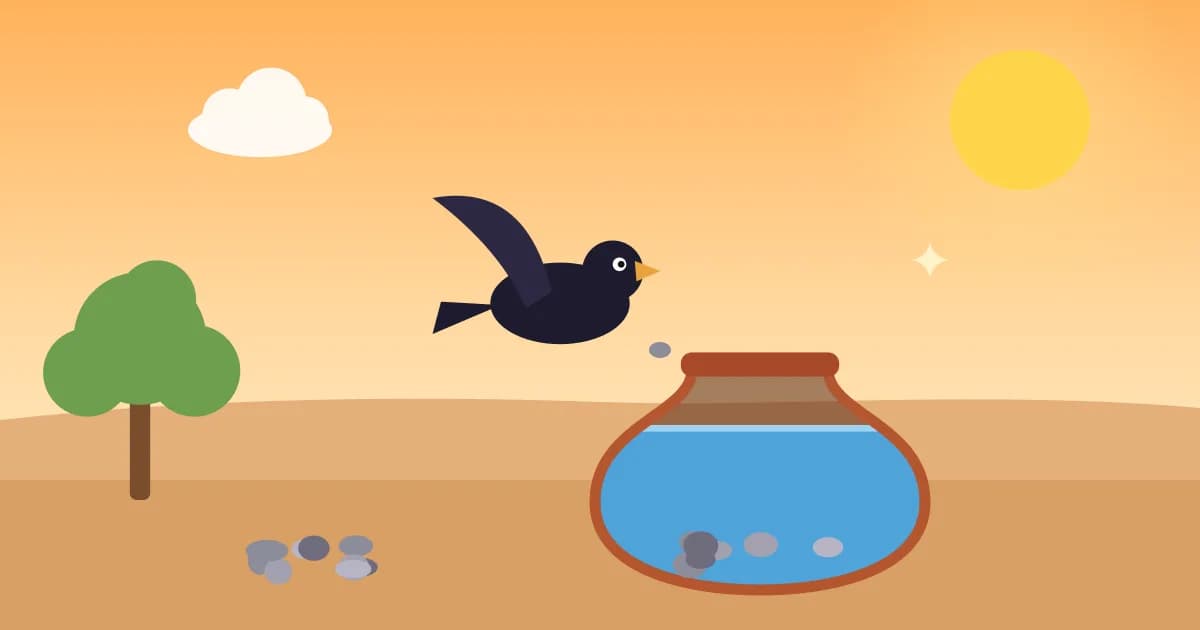
The crow picked up one pebble in his beak, flew back to the pot and dropped it in. Plop. The water rose, just a tiny bit.
He fetched another pebble. Plop. And another. Plop. And another. Plop, plop, plop.
It was slow, hard work, and the sun was hot on his feathers. But with every pebble, the water crept a little higher up the side of the pot.
At last, after many trips to the gate, the cool water was sparkling right near the top.
The crow dipped his beak and drank, and drank, and drank, until he was not thirsty at all.
Then he fluffed his feathers, gave a happy "Caw!" and flew home to his nest, where he slept in the shade until the evening breeze came.
The Moral of the Thirsty Crow Story
Where there's a will, there's a way. The crow could have given up when his beak didn't reach, or when the pot was too heavy to tip. Instead, he stopped, looked around and used what he had. The story teaches children three things at once:
- Keep trying. The answer took many trips, not one.
- Think before you act. Tipping the pot would have spilled the water. Thinking found a better plan.
- Small steps add up. One pebble did almost nothing. Many pebbles solved the problem.
The Moral in 6 Languages
Cocoloops tells stories in six languages. Here is the same moral the way children hear it around the world:
| Language | The moral |
|---|---|
| English | Where there's a will, there's a way. |
| Spanish | Querer es poder. |
| French | Quand on veut, on peut. |
| German | Wo ein Wille ist, ist auch ein Weg. |
| Italian | Volere è potere. |
| Hindi | जहाँ चाह, वहाँ राह। |
Key Words From the Story
| English | Spanish | French | German | Italian | Hindi |
|---|---|---|---|---|---|
| crow | cuervo | corbeau | Krähe | corvo | कौआ (kauaa) |
| water | agua | eau | Wasser | acqua | पानी (paani) |
| pot | jarra | cruche | Krug | brocca | घड़ा (ghada) |
| pebble | piedrita | caillou | Kieselstein | sassolino | कंकड़ (kankad) |
| thirsty | sediento | assoiffé | durstig | assetato | प्यासा (pyaasa) |
Questions to Ask Your Child
- Why couldn't the crow drink the water at first?
- Why didn't the crow just tip the pot over?
- What made the water go up?
- What would you have used instead of pebbles?
- Can you think of a time you kept trying until something worked?
Try It: The Thirsty Crow Experiment
You can test the crow's idea in two minutes. Pour a little water into a tall glass and mark the level with a sticker or a pen. Let your child drop in pebbles, marbles or coins one at a time. Watch the water rise with each one.
Then ask: "Where did the extra water come from?" (It didn't come from anywhere. The pebbles take up space and push the water up.) It's a simple first science lesson, and the story makes it stick.
Frequently Asked Questions
What is the moral of the Thirsty Crow story?
The moral is "where there's a will, there's a way." The crow keeps trying and thinks of a clever plan instead of giving up, which shows children that patience and clear thinking can solve a hard problem.
Who wrote the Thirsty Crow story?
It comes from Aesop's Fables, a collection of short stories from ancient Greece, where it is called "The Crow and the Pitcher." It is also one of the best-known moral stories in India, where children often learn it in school.
What age is the Thirsty Crow story for?
It works best for children aged 3 to 7. The plot is simple enough for toddlers, and older children enjoy the science behind why the water rises.
Is the Thirsty Crow story true?
It's a fable, but the idea is real. Scientists have tested crows and rooks with water tubes and floating treats, and the birds dropped stones in to raise the water, just like in the story.